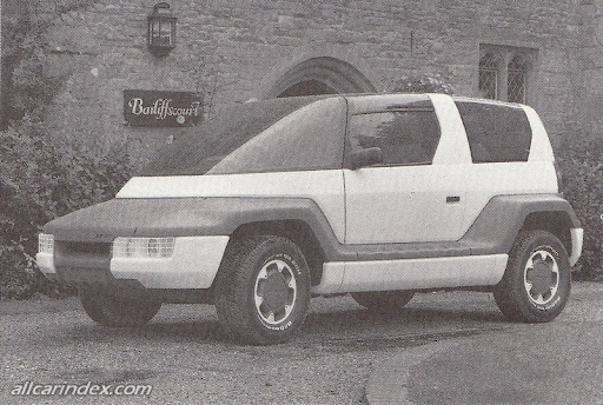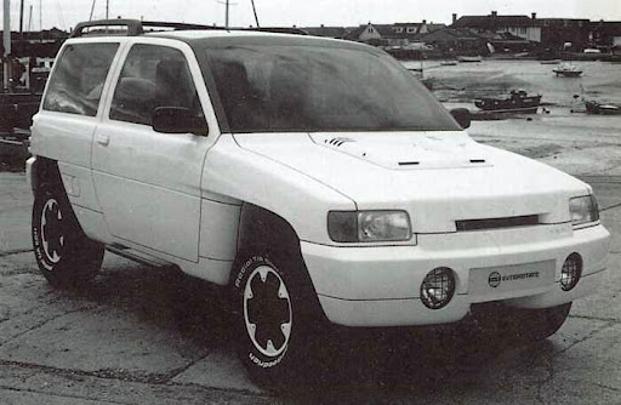

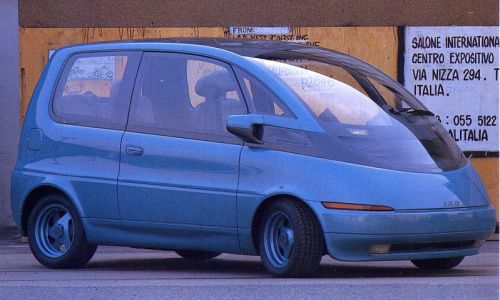
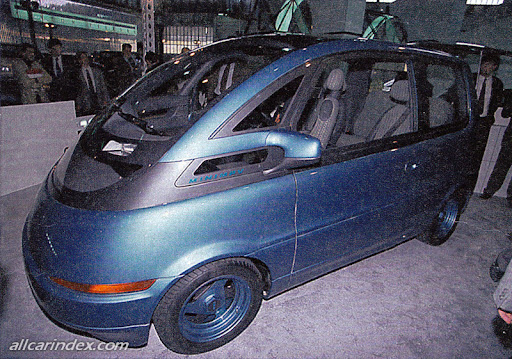
The Mini MPV was a concept car developed by the British design and engineering firm IAD, created in collaboration between its English headquarters and its California studio, IAD West Coast Inc. It was presented at the 1990 Turin Motor Show alongside a separate design study, the Villedeuxmille by Michelotti. The Mini MPV was a compact one-box multi-purpose vehicle with three doors and seating for six occupants, measuring just 430 cm in length. It was conceived as a fully drivable second car intended to meet varied family needs.
Technically, the Mini MPV was based on the American Ford Escort, with a shortened wheelbase of 239 cm and a significantly widened track of 154 cm at the front and 157 cm at the rear. It used a 1859 cc four-cylinder engine producing 89 PS (88 hp) at 4400 rpm and 146 Nm of torque at 3800 rpm, paired with a three-speed automatic transmission. The car measured 430 cm long, 170 cm wide and 190 cm tall, and weighed 1275 kg. It rode on special alloy wheels fitted with BF Goodrich tyres sized 225/50 VR 15. Viewed from the front at an angle, the body had an egg-like shape, while the rear ended in an almost vertical line.
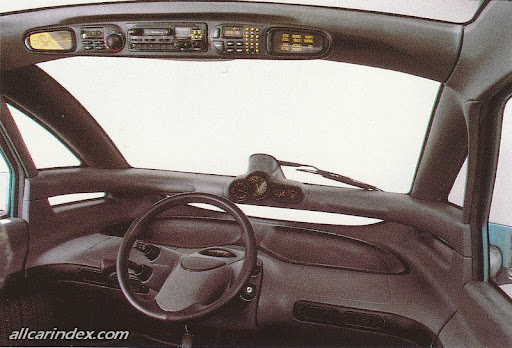
The defining feature of the design was its central driving position, a layout last notably used by Pininfarina in the 1960s. The driver's seat was set further forward than the passenger seats, improving sideways visibility. IAD argued that central steering simplified production, since separate left- and right-hand-drive versions were unnecessary, and that it would let drivers feel equally at home in countries with either traffic convention. The car also featured single-arm, fully rotating wipers for both the front and rear screens, a mechanism that doubled as a means of keeping clean the headlights mounted high in a crossbar behind the windscreen.
The deep windscreen and additional side windows ahead of the doors gave occupants a wide field of view. The doors provided access to the front and rear seats and revealed underfloor storage for the spare wheel and tools. Both front seats could rotate 180 degrees and fold down into picnic tables, while the rear seats were foldable and removable. The lower section of the tailgate was glazed, and a glass roof was also planned. A console above the windscreen housed controls for an audio system, and the design carried through to a single-spoke steering wheel and instruments partly integrated into the crossbar.