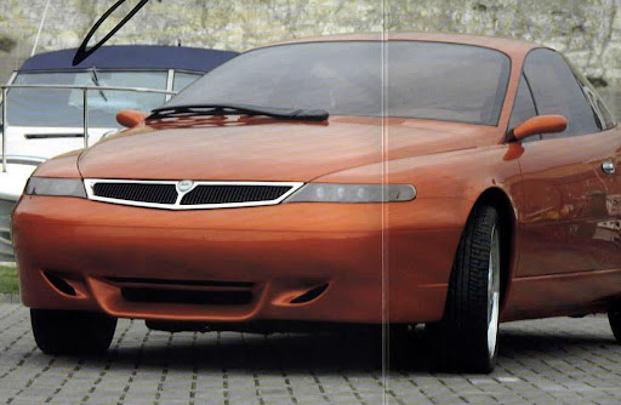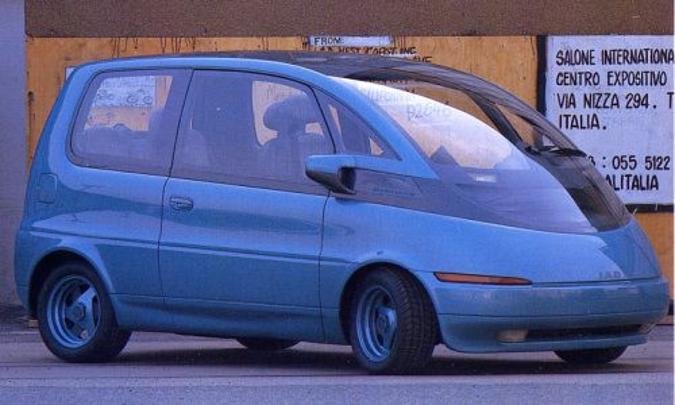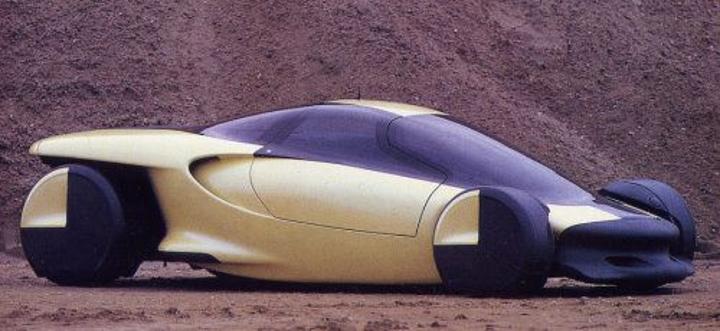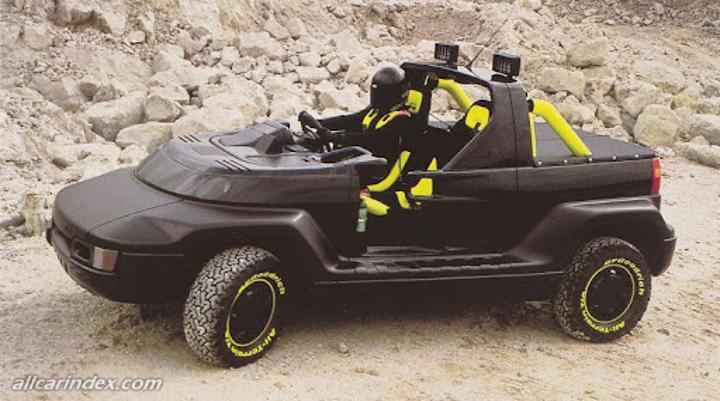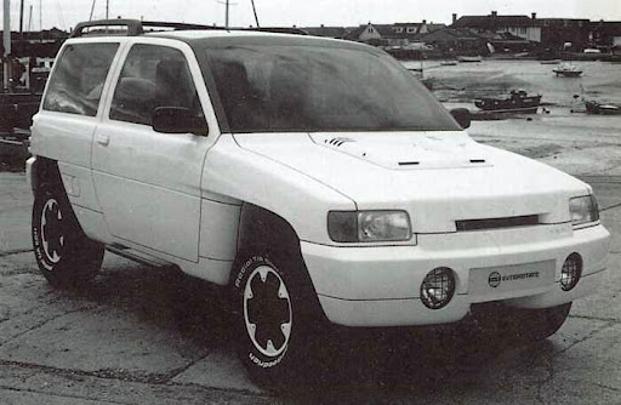

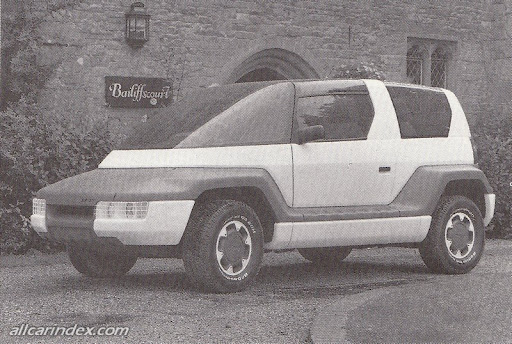
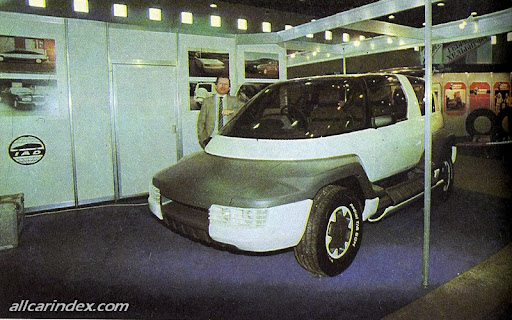
The Impact was a concept vehicle developed by International Automotive Design, shown at the 1987 Frankfurt IAA alongside a second, related concept study. Both cars adopted a roughly compact sports-estate form with a notably tall silhouette, reflecting their intended role as sport and leisure vehicles envisioned for a future era. The Impact itself was built as a fully drivable prototype, with a design that recalled the Ital-Design Capsula of 1982, sharing its emphasis on functionality over pure styling. Its overhanging lower body and raised passenger cell drew some criticism for their appearance.
Earlier project sketches for the Impact had proposed more adventurous lines than the finished prototype, including a flat front leading into a steeply raked, dome-shaped windscreen, with side windows merging visually with glazed roof inserts. Flared wheel arches incorporated a running-board-style door sill between them and covered wide 275/60 HR 15 tyres from BF Goodrich's Euro Radial T/A range. IAD described the car as a passenger vehicle intended for both city use and off-road travel, emphasizing extensive functionality and advanced electronics.
Practicality was paired with a upscale interior and a high level of comfort. Standing 173 cm tall, in the manner of a large estate, the Impact offered 765 litres of boot space, with a further 142 litres of underfloor storage; removing the rear seats freed up an additional 340 litres. The underfloor compartment, accessed through electrically operated side flaps, was designed to carry items such as skis or surfboards. A glass sunroof, also electrically operated, could be fully removed to create a targa-style opening. The tailgate extended down to the loading floor, below which a section of the bumper folded down to form entry and exit steps.
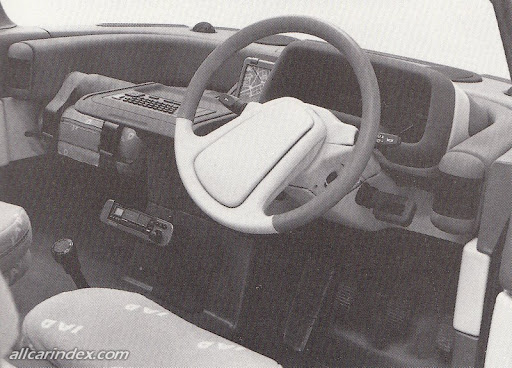
Inside, the Impact had four individually shaped seats with horizontally divided cushions, with the front seats able to swivel outward to ease entry. A center console housed a Philips Carin navigation system, along with a Philips car phone and a CD 10 stereo system. The two-tone front end integrated polyellipsoid headlamps for improved road illumination and lateral spread of light.
Permanent four-wheel drive was provided by a Ford 2.8-litre V6 engine producing 150 PS (148 hp) at 5800 rpm and 218 Nm of torque at 3000 rpm, paired with a five-speed gearbox. All four wheels used independent suspension, with trailing arms at the rear, along with coil springs and disc brakes; the spare wheel was mounted on a sliding carrier within the underfloor storage. Overall proportions were compared to the Range Rover, though the Impact had notably short overhangs of 89.5 cm and 64.5 cm, and a minimum ground clearance of 27 cm versus the Range Rover's 19 cm. The car measured 414 cm long, 191 cm wide and 173 cm tall, with a 261 cm wheelbase, track widths of 152.5/159 cm, and a weight of 1455 kg. It was built as a three-door high-roof estate with four seats.