
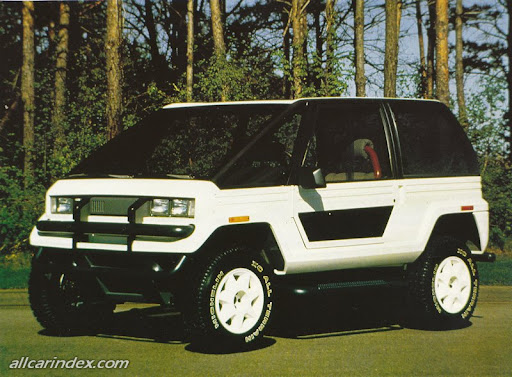
The LSV was a concept vehicle developed jointly by the Asha Corporation of Santa Barbara, California, and C&C (Cars and Concepts) of Brighton, Michigan. Its name stood for Lifestyle Vehicle, reflecting the intention of its creators to appeal to new patterns of living, and it was also described as a "seven-day Sport Utility Vehicle." The design originated with Swiss designer Mark Stehrenberger, who worked in Santa Barbara, and the vehicle was first shown to the public in early January 1990 at the North American International Auto Show in Detroit. It was conceived as a one-off concept, with its creators hoping a manufacturer would take up production.
The LSV was built as a plastic-bodied, half-forward-control off-road estate with three doors and seating for five. Its very short front and rear overhangs gave it an overall length of only 356 cm despite a wheelbase of 231 cm, while a width of 185 cm and height of 174 cm provided generous interior space and strong maneuverability. Cargo capacity ranged from a modest 96 dm³ with the rear seats up to 1020 dm³ with them folded down.
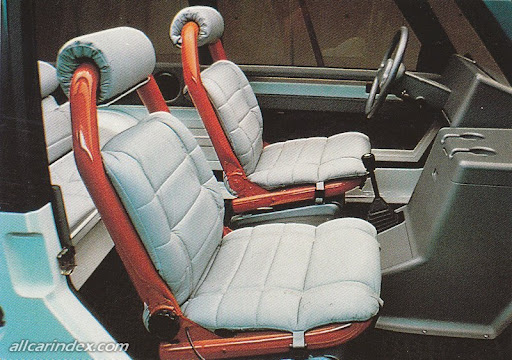
A key feature was its modular construction, which allowed the lightweight roof panel and side window glass to be removed entirely, turning the vehicle into a roadster retaining only its roll-over structure. The solid plastic roof could be swapped for a fabric top, and plastic panels could replace the side and rear windows; the lower door sections incorporated see-through panels intended to assist off-road driving. A two-piece roof arrangement, with a front section sliding back over the rear, was also considered. The interior used tubular seat frames with removable cushions, allowing the cabin to be hosed out, and the instrument panel and radio were protected by a fold-down glare shield before such cleaning.
Power came from a 2-liter engine paired with a five-speed manual or four-speed automatic transmission, driving all four wheels through a system C&C had patented specifically for this vehicle. The layout used a longitudinally mounted engine with front-wheel drive and a transaxle, sending power to separate differentials at the front and rear axles without a transfer case, reducing friction losses, weight, fuel consumption, and manufacturing cost. Suspension consisted of MacPherson struts at all four corners, with disc brakes front and rear. Unladen weight was given as 1100 kg (also cited as 1110 kg), and the design was noted as suitable for small-scale production.