

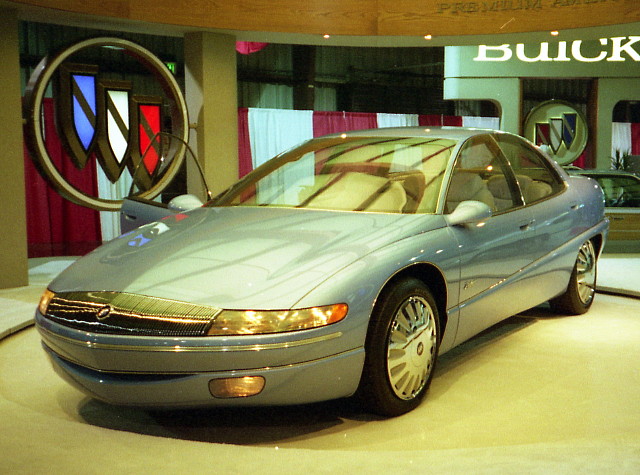
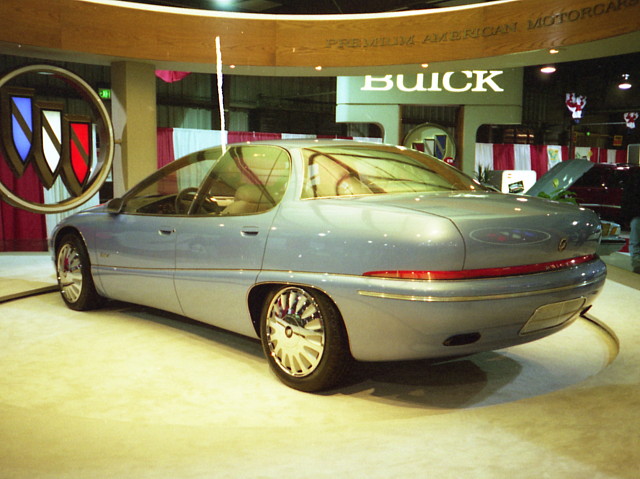
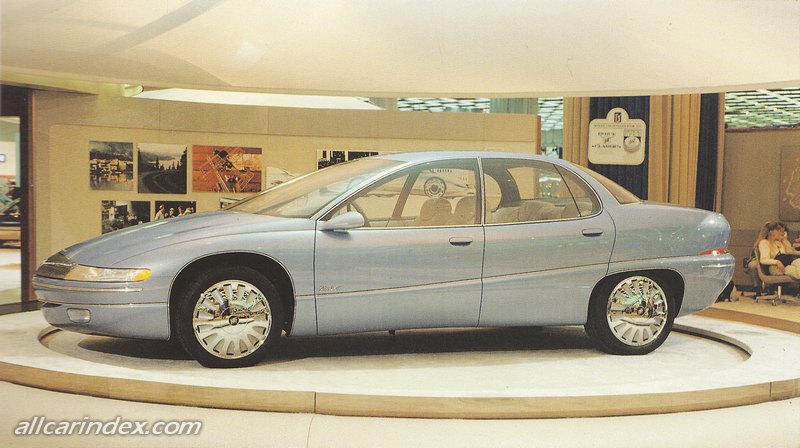
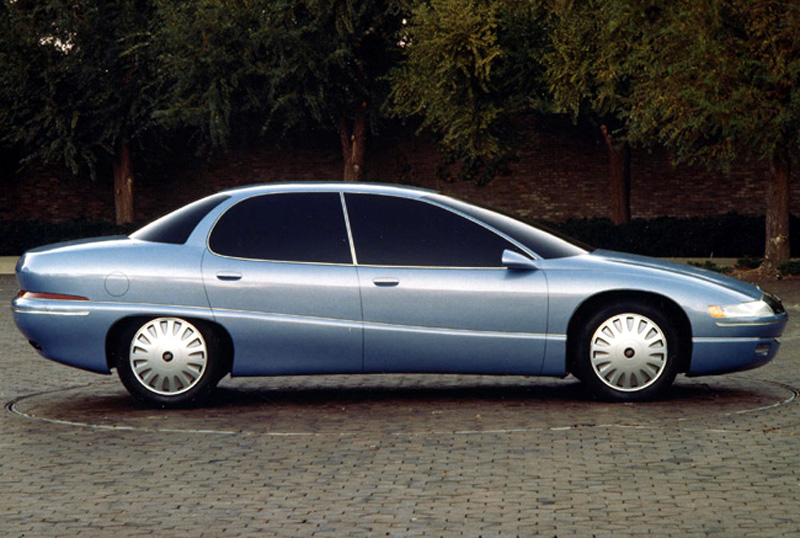
The Buick Bolero was a show car unveiled by Buick at the North American International Auto Show in early 1990, presented alongside the production Buick Regal Gran Sport Sedan at the same event. Buick managers described it as reflecting what market research indicated buyers wanted, aiming it at young families seeking an expressive yet practical car. It took the form of a conventional three-box sedan with relatively restrained dimensions. GM design chief Charles M. Jordan said the concept combined brand-typical styling with an appealing character inside and out.
Styling details included a more rounded nose than the Regal Sedan, headlamp covers with vertical bars bent into the front fenders flanking a low cooling inlet, four large side windows instead of six, and a panoramic rear window. A fine crease ran from the front wheel arch back into a fiber-optic taillamp band spanning the full width of the car. Fiber optics also lit the analog gauges, switches, and door lights. The interior, trimmed in leather under development leader Phil Garcia of GM Design Staff's Advanced Studio No. 1, included a cooling compartment in the parcel shelf, front and rear cup holders, rear headphone jacks, and removable radios built into the front seatbacks.
The Bolero used a transversely mounted, front-drive 3340 cc supercharged V6 producing 210 hp at 5200 rpm and 350 Nm at 2000 rpm, paired with an electronically controlled four-speed automatic transmission with overdrive. It had ABS brakes and 225/55x16 tires. It measured 4830 mm long, 1790 mm wide, and 1350 mm high, with a 2715 mm wheelbase and track widths of 1500/1520 mm, seating four or five in a four-door sedan body.