
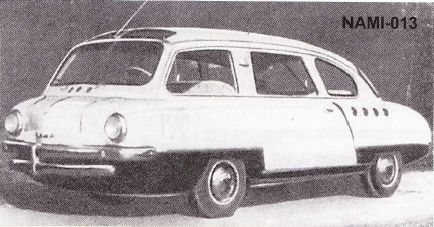
NAMI-013 was an experimental automobile developed in the Soviet Union between 1950 and 1953, one of the first original postwar designs from NAMI and avant-garde for its time in both engineering and styling. Designer V.I. Aryamov led the project together with Yu.A. Dolmatovsky and K.V. Zeyvang, with several differing full-size mockups built by Aryamov, Dolmatovsky and Shishkin. Only one running example was completed. Its one-box wagon-type layout would today be classified as a minivan, making it one of the earliest examples of the type worldwide.
The first test drive took place on 4 December 1950, with the car still carrying a temporary body that amounted to little more than a bare frame. It was reworked repeatedly afterward, including changes to its bodywork. In its 1952 form the car had a rear-mounted engine with the radiator at the front, an automatic transmission, and so-called discless wheels bolted directly to the brake drums. A dedicated boxer engine was developed for the project, but the prototype itself ran a modernized GAZ-M20 engine. Experience gained through the NAMI-013 program was later applied in part to the design of the experimental Belka.