
Walk through any major airport parking lot, look down from a high-rise over a crowded city street, or scroll through the inventory of a multi-brand dealership group. What do you see? A vast, undulating sea of high-riding, anonymous sheet metal. If you stripped the corporate badges off ninety percent of the crossovers and SUVs on sale today, you’d be left with an unidentifiable, amorphous blob of homogenized product.
Modern car design hasn't just stalled; it has suffered a catastrophic structural collapse. We are living in an era where cars are no longer sculpted by passion, romance, or the pursuit of mechanical beauty. Instead, they are stretched, bloated, and homogenized by aerodynamic regulations, cost-cutting platform sharing, and a corporate obsession with tech-industry aesthetics.
The question for automotive enthusiasts isn't just "Why did cars get so ugly?" It’s far more pressing: Is there a way back?
The Monoblob and the "Apple Mouse"Infestation
The primary symptom of this design sickness is the total erasure of visual identity. Every crossover looks exactly like its competitor because they are all trying to solve the exact same mathematical equation: how to move a heavy battery or an upright family cabin through the air with a drag coefficient low enough to appease environmental regulators. The result is the Monoblob.
When the rules dictate the shape, the human designer is relegated to merely detailing the surface. And how are they detailing it? Look no further than the collective internet meltdown over the newly unveiled Ferrari Luce.
The Luce—Ferrari’s first-ever fully electric production car—was not styled by the internal artisans at Maranello who gave us the breathtaking curves of the 250 GTO or the sharp, purposeful anger of the F40. It was handed over to LoveFrom, the creative collective led by former Apple design chief Sir Jony Ive and Marc Newson.
The result? An incredibly precise, clinically resolved, five-meter-long luxury capsule that the internet immediately and accurately dubbed the "Apple Mouse on 24s." By shedding the hyper-aggressive, driver-centric proportions of legacy combustion Ferraris, it embraces a frictionless, teardrop aesthetic. It is a stunning piece of industrial design if you are judging a premium smartphone or a high-end desktop peripheral. But as a Ferrari? It’s a terrifying signpost. When the world’s most emotional car brand trades its mechanical soul for the smooth, sanitized grammar of consumer electronics, the art of automotive sculpture is officially on life support.
From Sculptural Mastery to the Coffin on Wheels
On the absolute opposite end of the spectrum lies the other great modern design disease: the lazy, low-poly shock tactic.
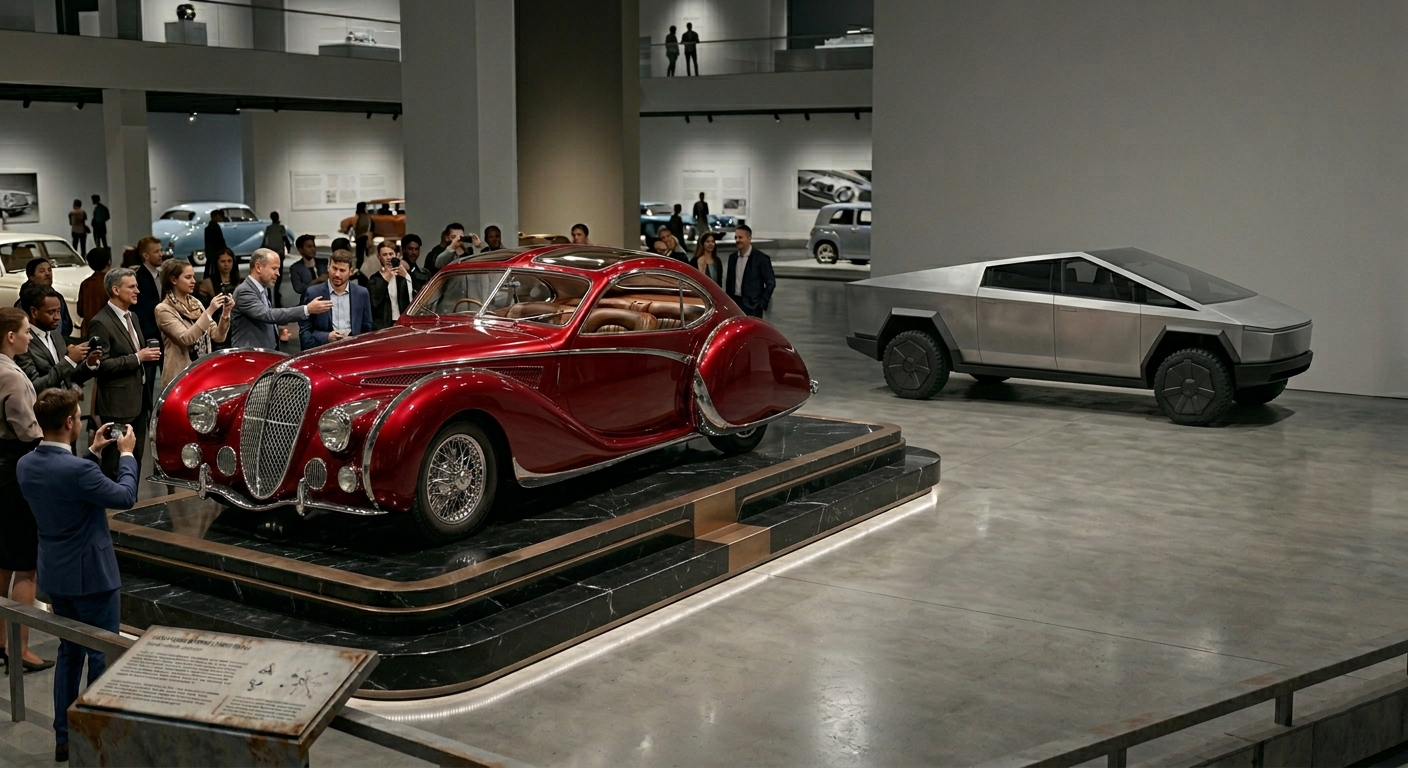
When Tesla rolled out the Cybertruck, it was treated as a revolutionary break from convention. In reality, it was the ultimate example of lazy, anti-automotive design. It looks less like a vehicle and more like a rolling coffin or a low-resolution video game asset that failed to render properly. It completely lacks nuance, curvature, or an understanding of how light plays across a complex metal surface.
Worse still is the cultural fallout. Because the Cybertruck generated billions in free PR through sheer, unadulterated shock value, other mainstream manufacturers are trying to copy its homework. We are suddenly seeing production cars and concepts abandoning the hard-earned mastery of stamping complex, emotional lines in favor of flat panels, harsh angles, and brutalist nonsense. It’s design by meat-cleaver, championed by executives who value viral social media metrics over timeless proportions.
The Death of Design Language and the Rise of "Promo Speak"
Automotive design used to speak the language of engineering and artistry. A line existed to accentuate a muscle, to cool a brake rotor, or to plant the rear axle at 150 mph. Today, design speaks the language of marketing departments and corporate PR presentations.
Take a look at the latest crop of Mercedes-Benz vehicles. Rather than relying on the dignified, majestic proportions that defined the brand for a century, Stuttgart’s designers have resorted to a desperate, insecure cry for attention: embedding the three-pointed star logo into every conceivable corner. It’s integrated into the faux grille mesh. It’s stamped into the taillight graphics. It’s projected onto the ground from the mirrors. It’s patterned across the lower bumper intakes.
This isn’t design; it’s luxury-goods branding exercise. It is the automotive equivalent of a cheap designer T-shirt covered in giant, repeating corporate monograms. When a manufacturer has to plaster its logo fifty times across a vehicle's exterior just to remind you who built it, it means the car's actual silhouette has failed to communicate its identity.
The Interior Wasteland: Glass, Pixels, and Passenger TV Screens
If you think the exteriors are bleak, open the door. The modern car interior has been completely hollowed out, replaced by a cold, uninviting digital wasteland.
The historical joy of an enthusiast cabin lay in the tactile engagement: the weighted click of a physical toggle switch, the knurled aluminum of a climate control dial, the deep, mechanical sweep of an analog tachometer needle. Now, we are forced to stare at an uninspired, generic pane of black glass glued to the dashboard.
The Great Touchscreen Lie
Carmakers told us that removing buttons was about "minimalism" and "clean aesthetics." That is marketing garbage. The reality is that a massive, centralized touchscreen is infinitely cheaper to source and program than a complex network of physical switches, wiring harnesses, and precision-machined dials.
The absolute zenith of this interior nonsense is the industry's sudden obsession with putting a dedicated "TV screen" on the passenger side of the dashboard. Why? What problem does this solve? It is a monument to cognitive overload. A car interior should be a focused, cohesive space centered around the act of driving and traveling together. Instead, the passenger is given a private glass portal to stream video or scroll menus, completely isolating them from the drive itself and creating an annoying, glowing ambient distraction in the driver's peripheral vision at night.
When you strip away physical buttons, you strip away human muscle memory. Adjusting your fan speed shouldn't require navigating three layers of a digital menu while doing 70 mph on a rainy highway. It is a massive step backward for ergonomics, ergonomics that were perfected back in the 1990s and are now sacrificed on the altar of tech-spec sheet superiority.
The Roadmap Back to Sanity
Can the automotive industry pull itself out of this tailspin? Yes, but it requires a fundamental paradigm shift away from the "car as a rolling smartphone" mentality. The road back to design sanity relies on three non-negotiable principles:
1. Proportions Over Gadgetry
A great car design must look incredible when the vehicle is entirely switched off. Designers need to stop relying on animated LED light bars, illuminated grilles, and digital graphics to give a car "character." True automotive beauty is found in the hard stuff: the dash-to-axle ratio, the muscle over the rear arches, the stance of the wheels, and the way the beltline catches the sun.
2. Tactile Rebellions
We are seeing the very first whispers of a counter-revolution here. Even on the controversial Ferrari Luce, the designers realized that a pure touchscreen interior is an ergonomic failure; they integrated a self-contained driver binnacle with physical, multi-layered instruments and mechanical toggles designed to click "like a rifle bolt." Mazda, Porsche, and a handful of others are keeping the physical button alive. True luxury and true performance in the future will not be measured by screen real estate; it will be measured by the exquisite engineering of physical touchpoints.
3. Rejecting the Monoculture
Manufacturers must stop chasing the same bland, aerodynamic cross-section for every vehicle in their lineup. There is a market for cars that take a slight aerodynamic penalty in exchange for jaw-dropping, emotional, unmistakable presence.
If car design is to survive the 2020s with its dignity intact, car executives need to take the keys back from the consumer-electronics consultants and the marketing focus groups. It’s time to hand the pens back to the people who actually love cars.