


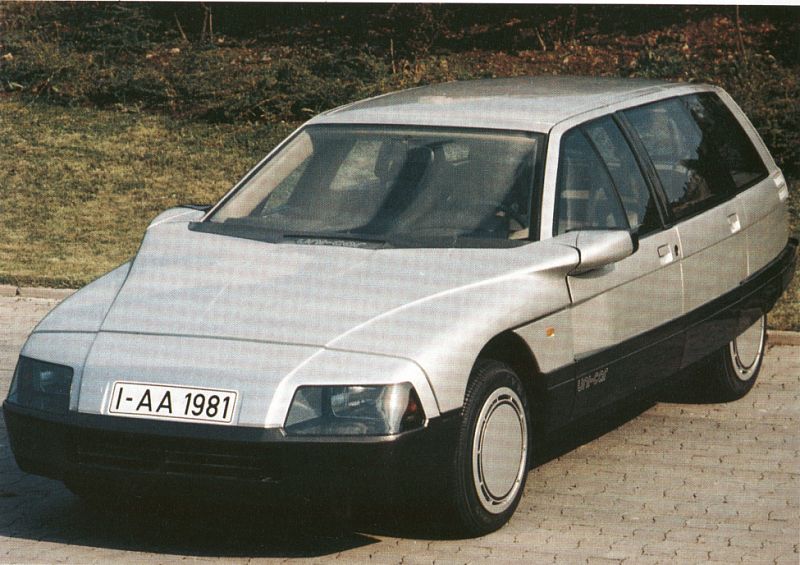
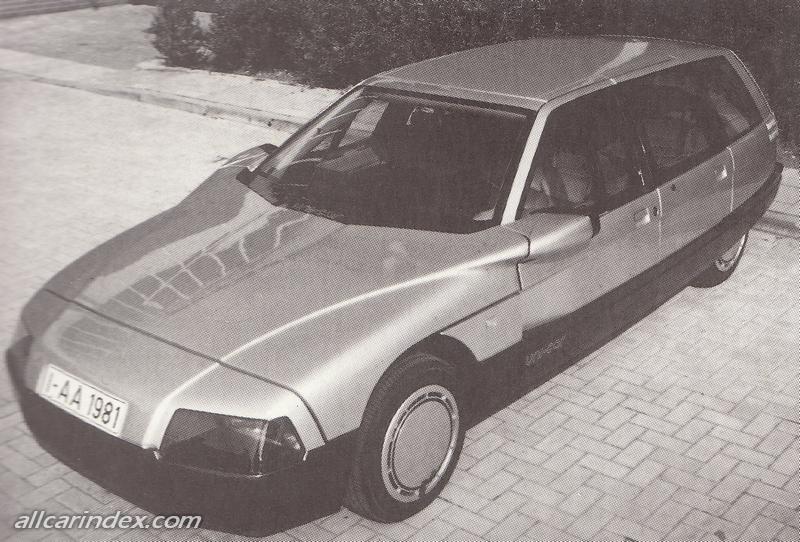
The Uni-Car was a research prototype developed jointly by four German technical universities as part of the "Auto 2000" research project, alongside separate prototypes built by Audi, Mercedes-Benz and Volkswagen. The project had been commissioned in early 1978 by the German Ministry for Research and Technology (BMFT), which drew up guidelines and requirement catalogues covering safety, fuel consumption and environmental protection. A total of 110 million Deutschmarks was allocated to the overall Auto 2000 programme, with 33.5 million going to the university consortium behind the Uni-Car. The Uni-Car took the form of a five-door station wagon and was completed as a prototype shown just before the opening of the 49th Frankfurt motor show.
Work was divided among the Kraftfahrtechnische Institute of four institutions: the Technische Hochschule Darmstadt (project leadership, body construction, prototype assembly, electrical systems, driver information system, fuel tank), the Technische Universität Berlin (body structure, pedestrian and occupant protection, ergonomics, pedals, steering column, seats), the Forschungsinstitut für Kraftfahrwesen und Fahrzeugmotoren Stuttgart (diesel engine, noise reduction, climate control, suspension and ride-height control, brakes, aerodynamics and design), and the Technische Hochschule Aachen (transmission and control, suspension, wheels and tyres, steering, chassis tuning, utility testing). The Uni-Car fell into the medium of three weight classes defined by the project guidelines, which capped unladen weight at 1250 kg and average fuel consumption at 9.5 l/100 km.
Body design and construction proved the most expensive part of the project, costing around 12.5 million Deutschmarks, with Wilhelm Karmann GmbH and Ital-Design assisting in manufacture while the FKFS handled design and pre-development, drawing on aerodynamic research including the K-form work of institute founder Wunibald Kamm. After wind-tunnel testing of various fastback, notchback, estate and K-tail shapes using clay models, a moderated K-tail form was chosen, balancing aerodynamics against pedestrian protection requirements. The finished prototype achieved a drag coefficient of 0.24, with a tapering roofline, flush-fitted glazing, enclosed rear wheels, recessed wipers, streamlined mirror housings and a smoothed underbody.
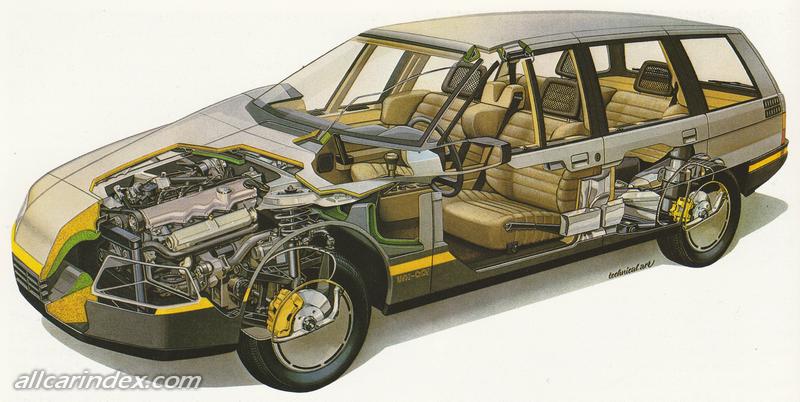
Power came from a 2500 cc four-cylinder direct-injection diesel engine derived from the Citroën CX unit, extensively reworked by MAN with a new light-alloy cylinder head, overhead camshaft and MAN-CDI injection, plus a Garrett turbocharger, producing 98 hp at 4300 rpm and 185 Nm at 2800 rpm. It drove the front wheels through a Van Doorne Transmatic continuously variable transmission with a push-belt and a Borg-Warner hydropneumatic clutch, coordinated by central electronics. Fuel consumption figures included 7.8 l/100 km in the city cycle, 4.6 l/100 km at a constant 90 km/h and 6.0 l/100 km at 120 km/h, for an average of 6.55 l/100 km. The car weighed 1375 kg, reached 100 km/h in 13 seconds and had a top speed of around 190 km/h. It measured 4650 mm long and 1340 mm high, with a wheelbase of 2750 mm and a width of 1980 mm including mirrors. Equipment included speed-sensitive power steering, rear ride-height control, ventilated front disc brakes with ABS, and BBS alloy wheels with Goodyear 195/65 HR 15 tyres with tyre-pressure monitoring. Seven examples of the experimental engine were built for the programme by the time of its Frankfurt debut.


