
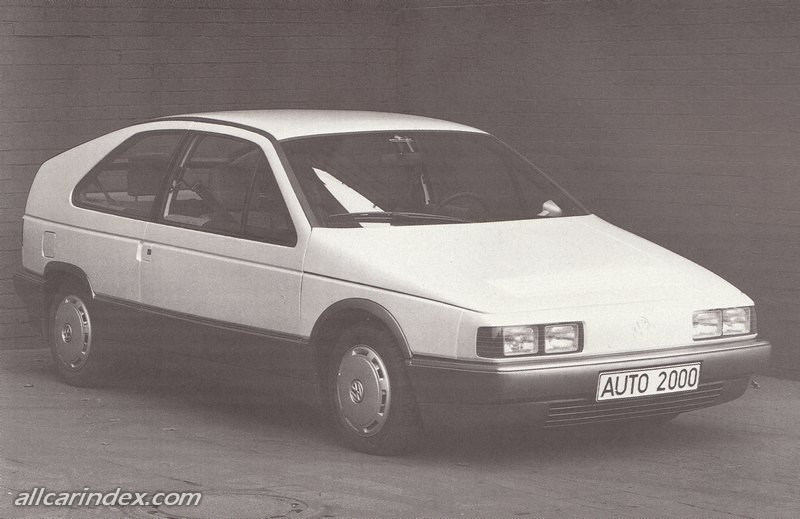
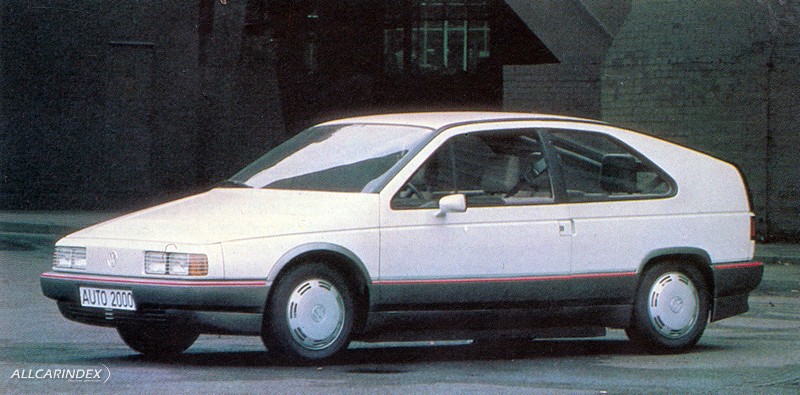
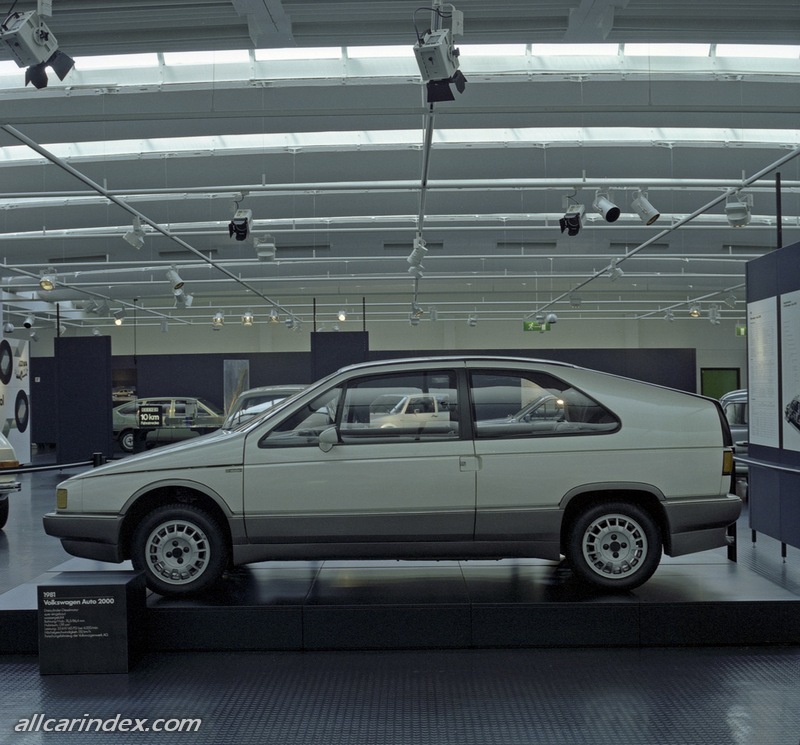
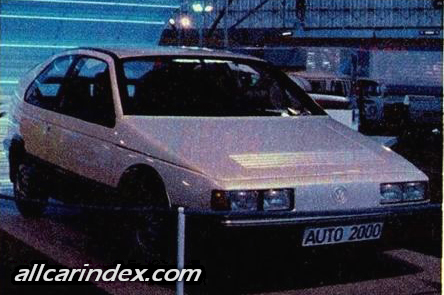
The Volkswagen Auto 2000 was a research concept developed as part of the "Auto 2000" project put out for tender by West Germany's Federal Ministry for Research and Technology (BMFT) in the spring of 1978. Audi, Mercedes-Benz, and a consortium of four technical university institutes (working under the name Uni-Car) also produced test-ready prototypes for the same program. Volkswagen described its contribution as an integrated, fully functional overall concept intended to project twenty years into the future, representing possible answers to economic, ecological, and social demands anticipated for the late 1990s, without claiming to be a pre-planned production prototype.
Since roughly 70 percent of passenger car demand fell into the mid-size segment, Volkswagen built the Auto 2000 to that scale, sizing it at about 4 meters in length to sit between the Golf and Passat. Achieving maximum fuel economy required compromises in performance. The result was a two-door, four-seat fastback saloon with a body shaped for aerodynamic efficiency, styled by the VW Design Center to echo existing production models; its grille-less front anticipated the styling of the Passat launched in 1988, and several other Volkswagen design cues were previewed on the car. Wind-tunnel development achieved an extreme drag coefficient of under 0.20 before being adapted into practical proportions, including cooling air ducted under the bumper and out through the hood in a manner drawn from racing practice, flush-fitted windows, a smooth underbody, and covered wheel caps, yielding a final drag coefficient of 0.25.
The body used an unconventional three-component hybrid construction rather than a conventional welded steel monocoque, comprising floor/front, side sections, and roof assemblies joined together, onto which preassembled plastic parts -- front end, rear end, tailgate, and wheel-arch sections in GRP with a polyurethane outer skin -- were bolted after painting. This approach targeted both greater rigidity and higher production automation. The suspension derived from the Golf, with lightweight alloy components and a rear axle made from GRP, and composite plastic wheels reduced weight by 40 percent, though thermal loading under braking remained a noted issue. Safety features included an anti-lock braking system called ABV, automatic tire pressure monitoring, and VW's automatic restraint system with belts and knee pads.
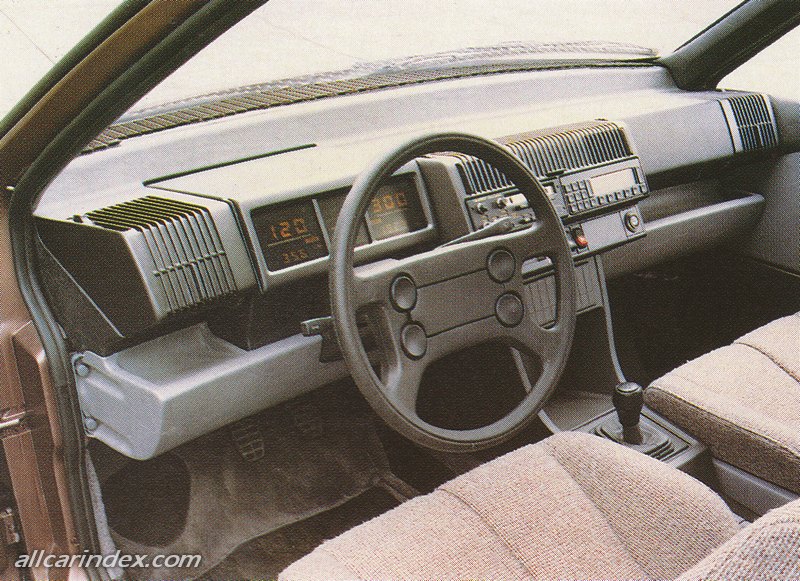
Two economy-focused powertrains were developed: a turbocharged 1191 cc three-cylinder direct-injection diesel producing 45 hp at 4000 rpm and 98 Nm at 2500 rpm, reaching 150 km/h with 0-100 km/h in 20 seconds and fuel consumption as low as 3.3 l/100 km at a steady 90 km/h; and a supercharged 1050 cc four-cylinder petrol unit with 75 hp at 5800 rpm and 106 Nm at 4000 rpm, reaching 180 km/h with 0-100 km/h in 12 seconds. The diesel used a five-speed gearbox with an economy fifth gear and flywheel-assisted automatic clutch, while the petrol version used a three-speed torque-converter automatic. Weighing 780 kg with a 2450 mm wheelbase and dimensions of 4020 x 1670 x 1350 mm, the car featured digital liquid-crystal instrumentation, a trip computer, a driver information system with synthetic speech output, automatic climate control, and glass-fiber-reinforced thermoplastic seats. Twenty-eight supplier firms contributed to its development.