
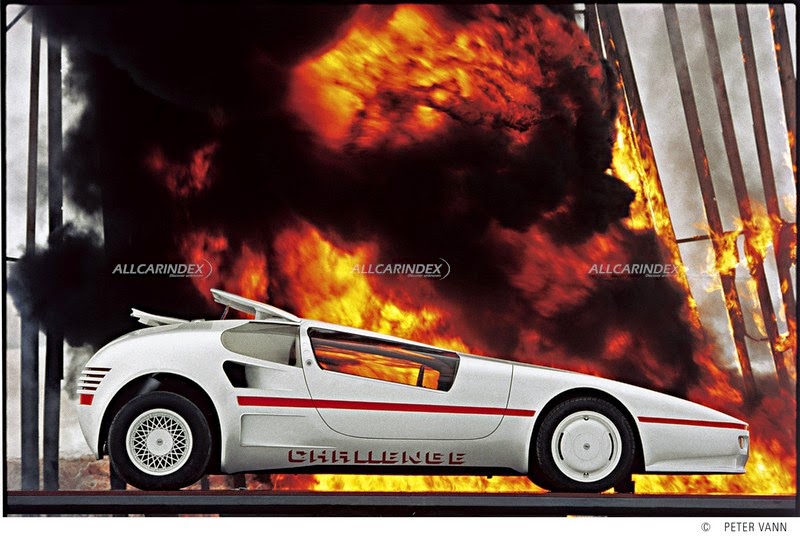

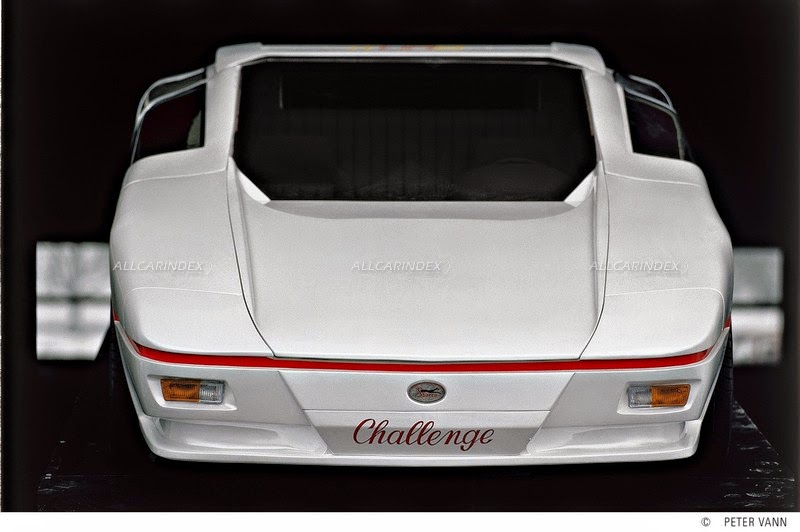
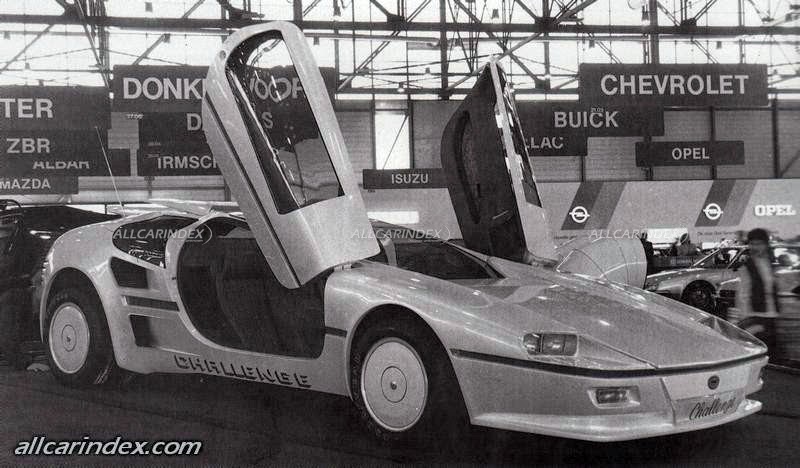

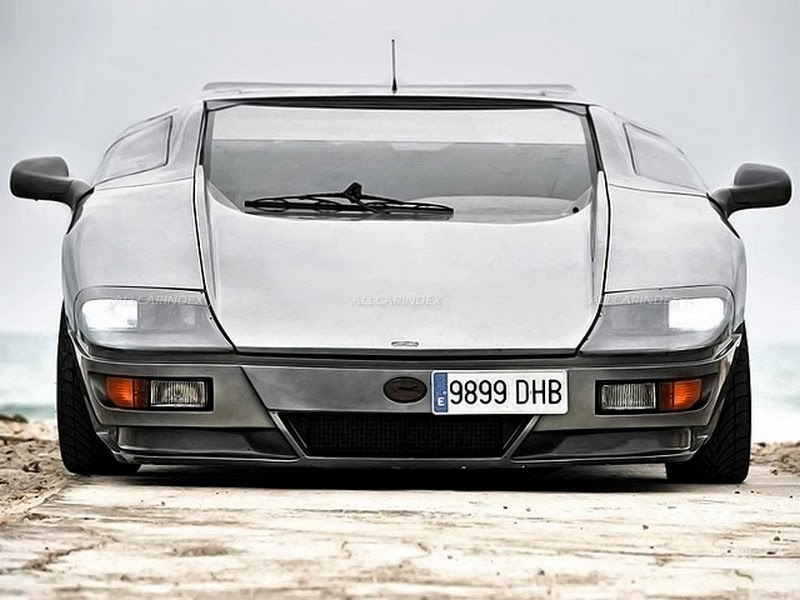
The Sbarro Challenge is a mid-engined sports coupe built by Franco Sbarro, unusual among his creations in that it was offered for sale in a small series rather than as a single one-off. Development began immediately after the 1984 Geneva Motor Show, with Sbarro working intensively over about six weeks on a concept intended to break from the conventions followed by mainstream manufacturers. Initial plans called for a run of ten cars priced from 180,000 francs, and Sbarro sought out a buyer from his existing client list only after the design had taken concrete shape, in contrast to his usual practice of building cars in close consultation with the customer from the start.
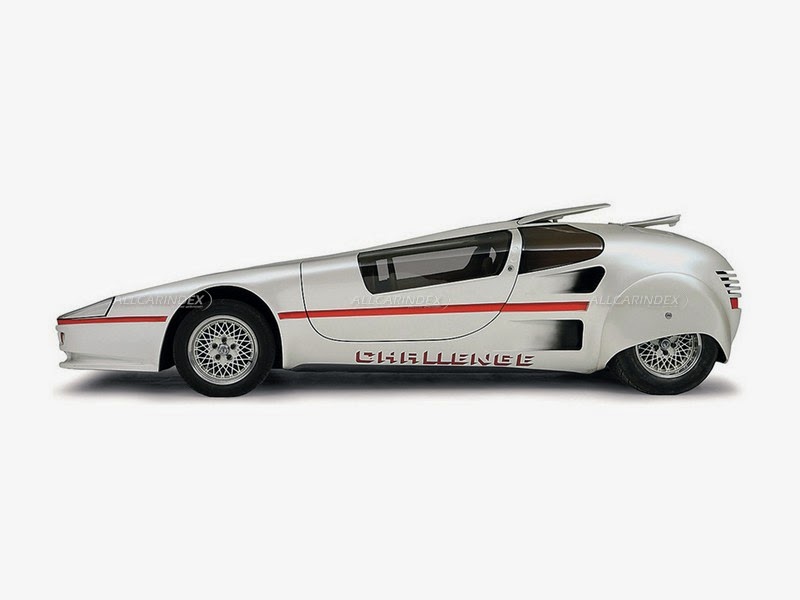
The Challenge was a one-volume wedge-shaped coupe with a drag coefficient of 0.25, a figure confirmed after earlier scale-model wind tunnel testing at Citroën had registered a coefficient of 0.16. It used a Mercedes-Benz 5.0-litre OHC V8, fitted in reversed orientation together with a four-speed Mercedes automatic transmission within a purpose-built chassis, giving a mid-engine layout in which both engine and tubular frame carried structural loads in monocoque fashion. Drive went forward through a Borg-Warner transfer and reduction gearbox to the front wheels, and rearward via a second propeller shaft to the rear wheels, giving four-wheel drive. The engine, fitted with two IHI turbochargers running up to 0.5 bar of boost building from 2000-2500 rpm, produced between 350 and 360 hp, up from a base output of 231 hp. Early test running on a closed circuit in the second half of 1984 showed the reduction gearing capable of 130 km/h at 6000 rpm in Drive, with a theoretical top speed of 310 km/h without the reduction ratio engaged. Sbarro noted that the four-wheel-drive and reduction-gear combination was intended to deliver strong acceleration even below 100 km/h, and stated that the car could alternatively be fitted with the 4.7-litre OHC V8 from the Porsche 928 S or a ZF five-speed gearbox.
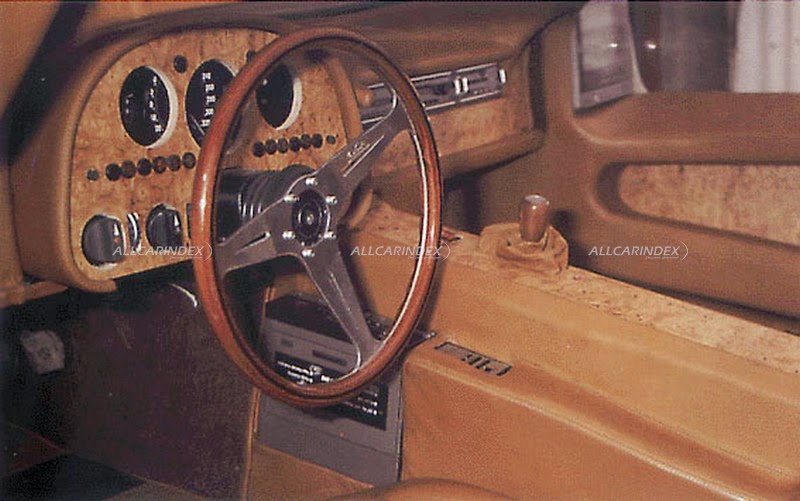
The first car used unequal-diameter JJD twin wheels shod with Pirelli tyres in 125x16 and 215x16 sizes, requiring differing axle ratios front and rear, while suspension on the first example used double wishbones and radius arms; later cars switched to four MacPherson struts and differed in other details. Weight was around 1400 kg for the first car, with 1300 kg planned for subsequent examples; the rolling chassis alone weighed 500 kg, and the one-piece GFK (fibreglass) body was mounted on ten rubber and foam supports. A pair of automatically deploying brake flaps at the rear of the roof, 42 cm long and 120 cm wide, extended at up to 20 degrees at the front and 16 degrees at the rear under braking or manually, adding calculated downforce. Other features included a sliding windscreen combining the function of a sunroof, capable of lowering 40 cm, a rear-view camera system feeding two screens mounted in the doors in place of mirrors, electrically adjustable pedals, steering column and Recaro-style inflatable seats, power steering, remote central locking, and glass side windows curved into the roofline by the Swiss firm Troesch. As shown at the 1985 Geneva Motor Show, the car cost a quarter of a million francs.
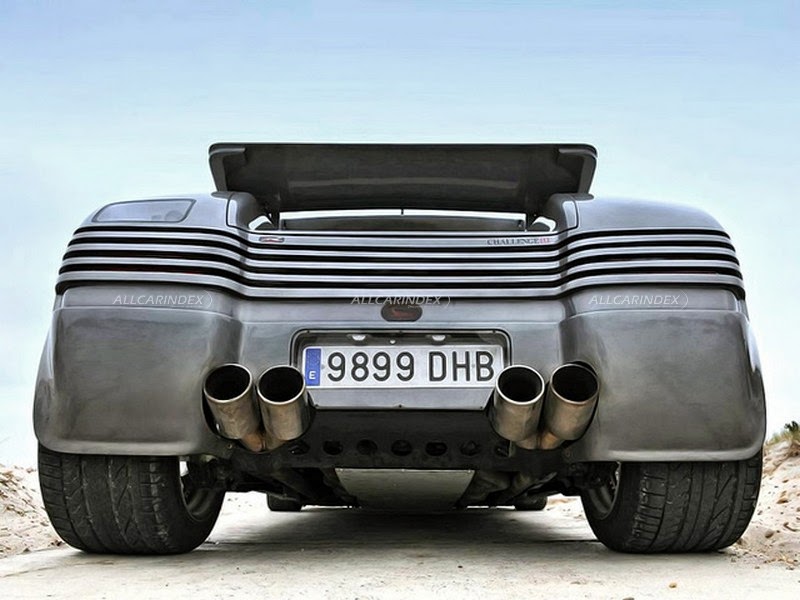
Several further versions followed. The Challenge 2+2, shown at Geneva in 1986, looked identical externally but added rear child seats and switched to a Porsche 911 Turbo engine mounted ahead of the rear axle, without four-wheel drive. The Challenge II, shown in 1987, used a 3.3-litre Porsche 911 Turbo engine tuned to 400 hp, with Alpine audio, video and anti-theft equipment, priced at 320,000 francs. The Challenge III, also from 1987, was built on a production Porsche 911 Carrera Cabriolet platform with its 3.2-litre boxer engine retained, priced at 160,000 francs, and designed so a Sbarro supercar could be registered in Switzerland. A two-thirds-scale motorized Baby Challenge was also built in 1986. By mid-1991, eight Challenge cars had been produced in total.