
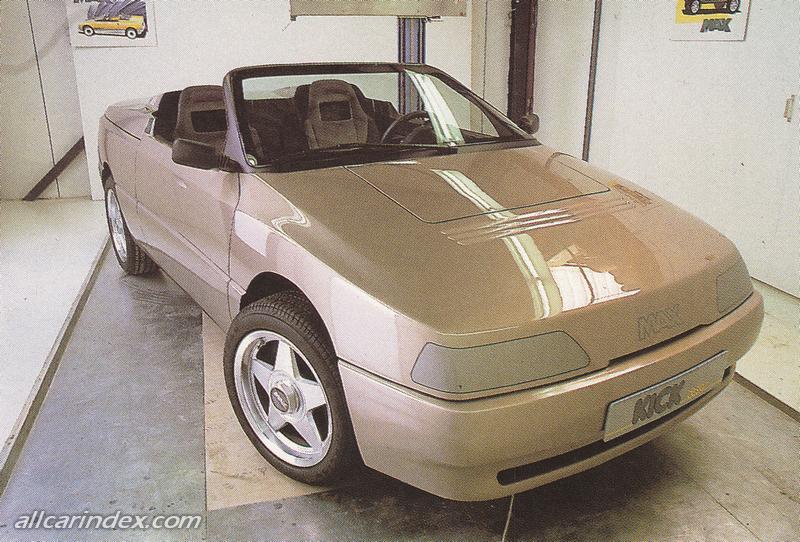
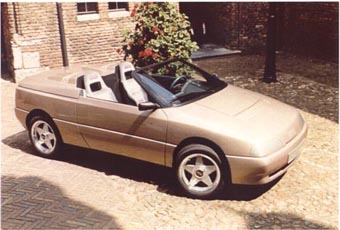
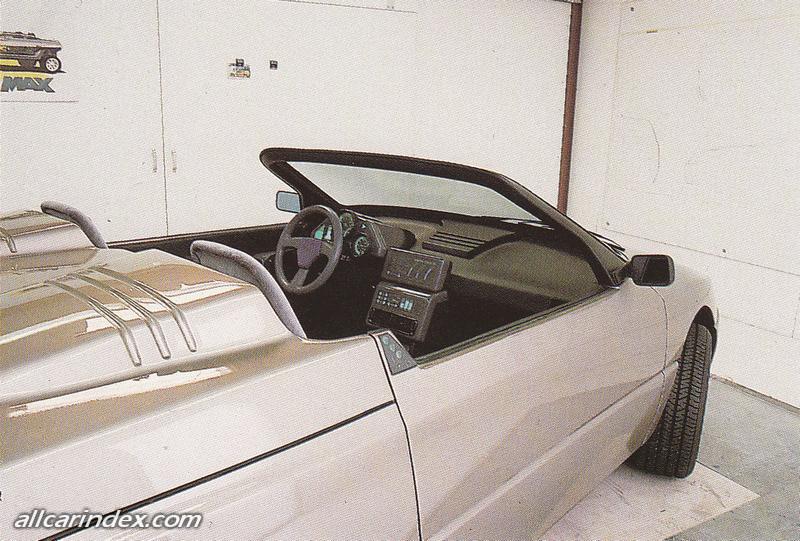
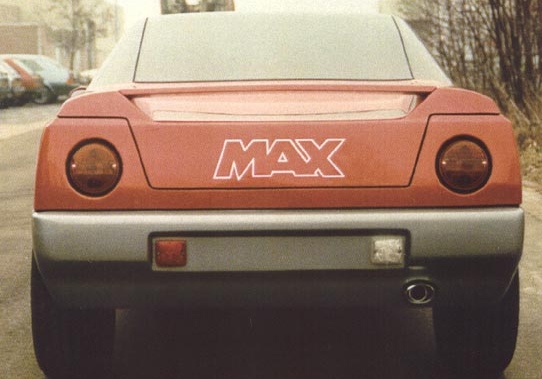
The Max was a small open sports car developed by the Dutch designer Eric Spronk through his studio Kick Design, which had been producing form and styling work for companies worldwide since 1984. Conceived from the outset as a prototype for a possible small-scale production run, the Max was intended to showcase new structural approaches and materials. In its base form it was a two-seat, two-door open car, with a rear deck covering shaped as extended headrest fairings recalling earlier racing designs.
The design used a modular approach, allowing the rear covering to be exchanged for a hardtop or a sports estate body, and offering a choice of different engines. In 1987 planners considered engines ranging from 1.2 to 1.5 liters, including turbocharged versions, with the aim of pricing the car no higher than a Renault 5 GT Turbo or a Peugeot 205 GTI. Spronk envisioned it as a modern successor to the Austin-Healey Sprite "Frogeye" and the Triumph Spitfire. A separate Max model was also shown by General Electric in 1987 to promote plastics.
The concept evolved through several development phases, with a refined front end, before the Citroën AX was adopted as its technical base, fitted with 185/60 HR 14 tires. A French small-car manufacturer joined as a partner in 1990, and in February 1991 the newly formed Max Motors BV, based in Helmond, presented a definitive production version at the Amsterdam RAI show, alongside plans for a sports estate and pick-up variant. Only a limited number were eventually built, powered by the Citroën AX's 1361 cc four-cylinder engine producing 80 hp, giving a top speed of 190 km/h. It measured 3550 mm long, 1610 mm wide, and 1200 mm high, with a 2285 mm wheelbase and a weight of 725 kg.