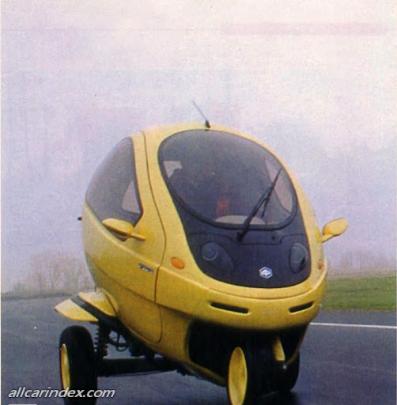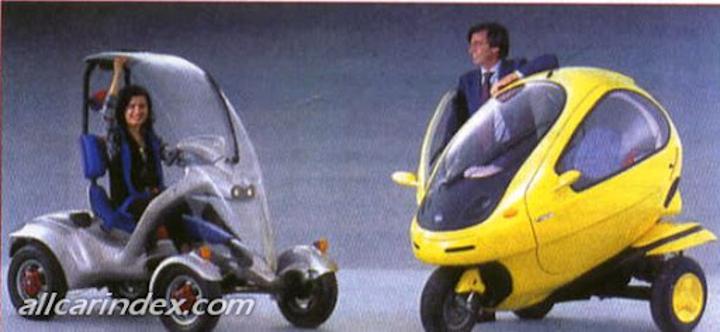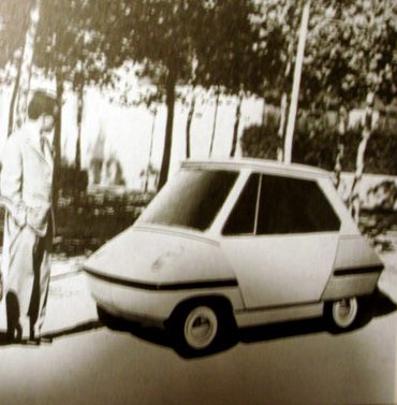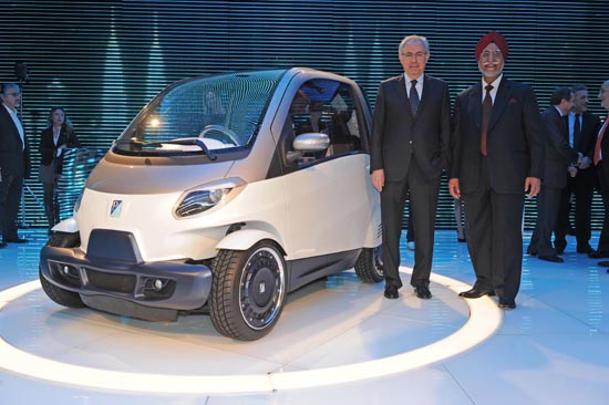

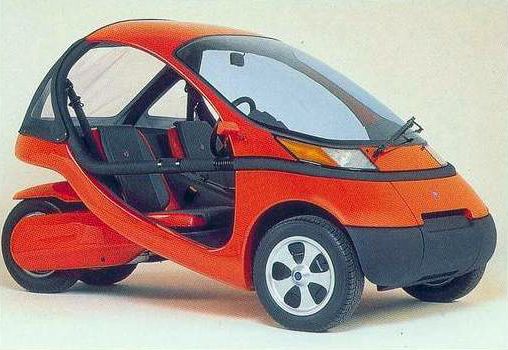
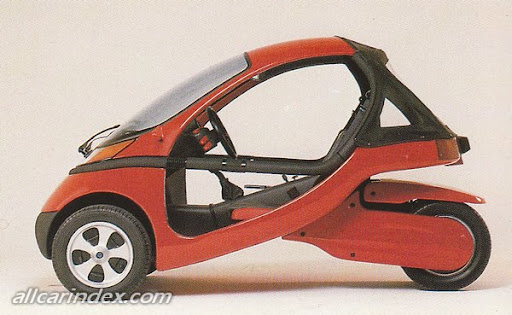
This Piaggio was a concept vehicle shown as an experimental study at the International Fahr- und Motorradausstellung in Cologne, developed by the maker of the well-known Vespa scooters and light commercial vehicles. It was presented with a view toward possible series production and was conceived as a city and commuter vehicle for the future. Although its egg-shaped, aerodynamic body gave the impression of a three-wheeler, it was in fact four-wheeled, with twin rear wheels mounted with some spacing between them and without a differential.
The vehicle used a mid-mounted single-cylinder, four-stroke, air-cooled 280 cc engine producing 20 hp at 6500 rpm, driving through a continuously variable transmission. The engine and drive unit formed a swing-arm arrangement at the rear, while the front used MacPherson struts. Braking combined front drum brakes with a single rear disc brake. Controls followed a motorcycle-like layout but were paired with a car-style steering wheel. The plastic bodywork was built around a protective roll cage, with thick tubes used as side barriers in place of doors. Behind the simple two-seat arrangement there was some luggage space and a lockable compartment, while the spare wheel was hidden beneath the aerodynamically shaped front end.
Two further variants were also planned: a sportier 350 cc four-valve version, and an environmentally oriented "Bimodale" variant combining a motorcycle engine with an electric motor. The vehicle measured 2450 mm long, 1400 mm wide and 1400 mm high, weighed 320 kg, and had a top speed of 95 km/h.