

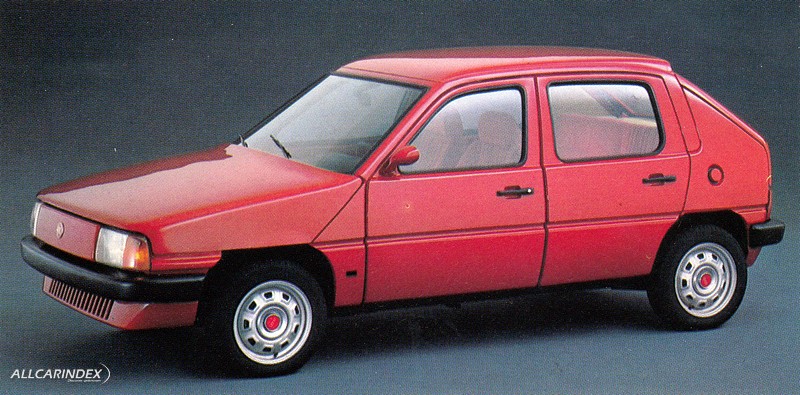
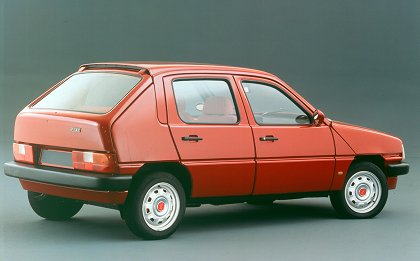
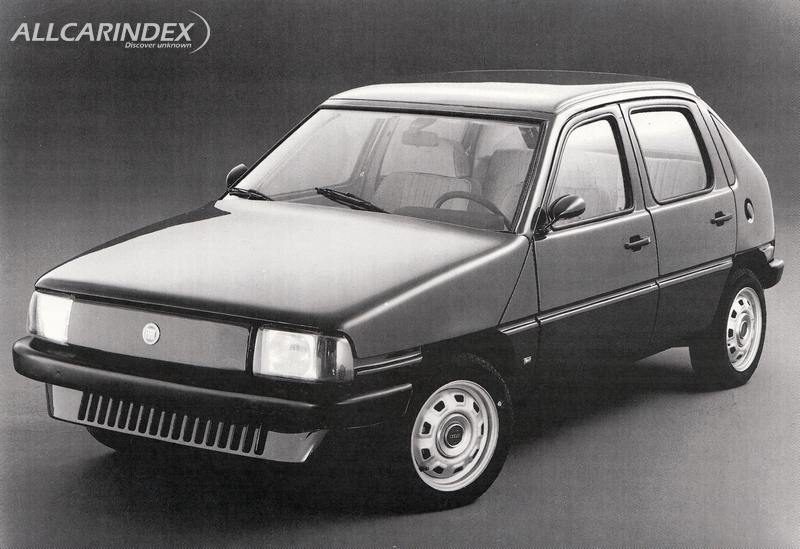
The Fiat Ritmo VSS was a research vehicle presented in 1981 by the Turin manufacturer, built as a technical study rather than a production model. It was based on the mechanical structure of the compact Ritmo, and its name stood for Vettura Sperimentale a Sottosistemi, meaning an experimental vehicle assembled from subsystems. The car was realized by the design firm Idea, and Fiat suggested at the time that a version of the concept could reach series production during the second half of the 1980s, though this never happened.
The VSS was conceived as a study in long-lasting car construction, focused on eliminating corrosion and reducing weight through extensive use of plastics. Its underlying structure was a rigid, cage-like cell made of galvanized steel sheet, which carried the suspension mountings, supported the body panels, and provided occupant protection. Around this steel cell, the outer body was built from a variety of different plastic materials chosen for their specific properties rather than a single uniform composite. The front section and bumper were made of polycarbonate, which offered elasticity and resisted damage in minor impacts. The hood, extending down over the wheel arches, weighed around 12 kg and was made of 3 mm glass-fibre-reinforced polyester foam. A triangular body insert between the hood and doors used 2.5 mm unsaturated polyester SMC, a method also applied to the partial fenders and the tailgate, where the window frame, a sealing rib structure, and adhesive bonding provided rigidity. The doors were built from bonded inner and outer shells stiffened with integrated steel reinforcements, while the entire rear section around the tailgate, including the trunk floor and rear bumper, was a single polycarbonate piece. The roof used 3 mm polyester foam, and plastic also formed the multi-part dashboard, combined with the firewall, ventilation ducts, and spare wheel support, as well as the fuel tank.
Visually the VSS departed noticeably from the standard Ritmo, with smaller window areas, a distinctively structured rear roof pillar, small aerodynamic cutoff edges at the roof end and tailgate, and an air intake relocated into a front apron beneath the bumper.
Fiat reported that the plastic body cut weight by 68 kg to 250.5 kg, a 21 percent reduction, with the doors down 32 percent and the hood 29 percent. Producing the plastic parts was said to require roughly half the energy of equivalent steel components, though a Ritmo-class car built this way was expected to cost about 1.5 percent more, an increase Fiat argued would be offset by an estimated 20-year body lifespan and lower depreciation. Several international chemical companies took part in the underlying research, which also considered recycling scrapped plastic components for use in construction.