

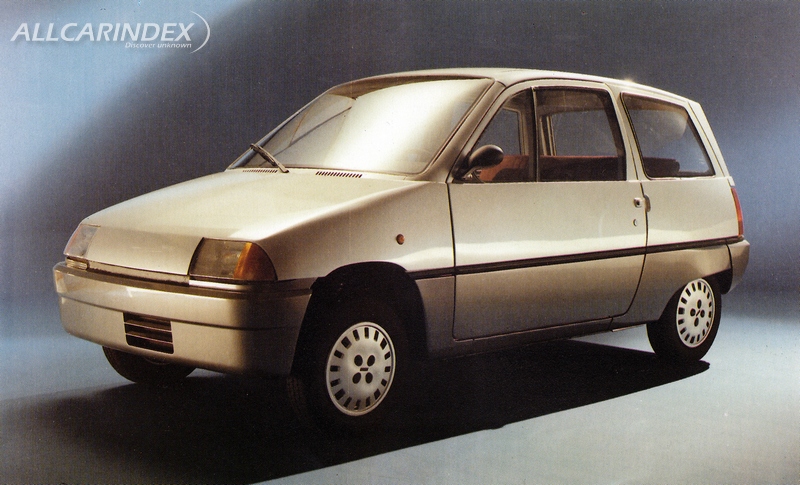
The Fiat CNR was an experimental research car developed under the Progetto Finalizzato Trasporti of Italy's national research council, CNR, with the Fiat research centre as main participant alongside Fiat Auto, Alfa Romeo and Molding System, a branch of the Fiat rocket subsidiary SNIA-BPD. It had already been shown at the world exposition in Canada before receiving its European premiere in May 1987 at a technical congress in Hannover. At the time it was suggested that the small experimental car could reach series production during the 1990s, at a point when Fiat was known to be working on a new "Topolino" positioned below the Panda, and when the rear-engined 126 built by FSO in Poland was due to be replaced by a new design in 1991.
The CNR was a three-door, five-seat small car built with a combination of steel sheet and glass-fibre reinforced plastics, partly assembled using special adhesives, resulting in a weight of only 550 kg. Its drag coefficient of 0.245 was considered notably low for a small car. Length was 343 cm.
Power came from a 707 cc two-cylinder turbodiesel engine producing 30 PS, driving through a continuously variable CVT transmission using a V-belt system rather than the steel-link belt already fitted in the production Fiat Uno Selecta. Top speed was 135 km/h, with average fuel consumption quoted at 2.5 litres per 100 km. The CVT and the rear air suspension, which maintained automatic ride-height control, were both electronically managed. A petrol version with manual transmission was also built alongside the turbodiesel variant.