
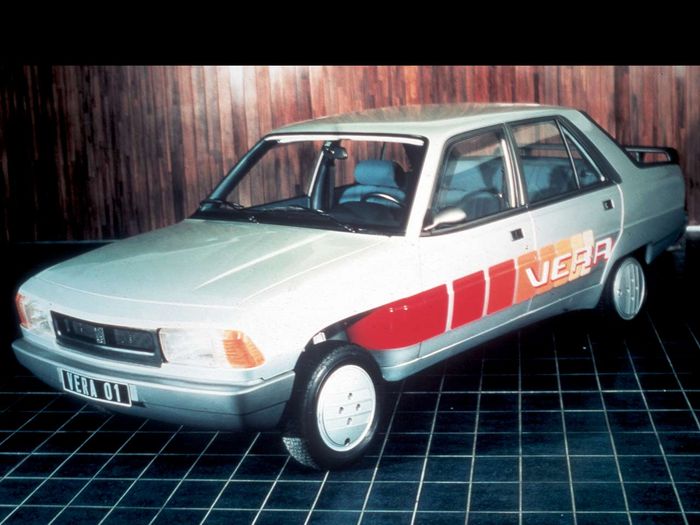
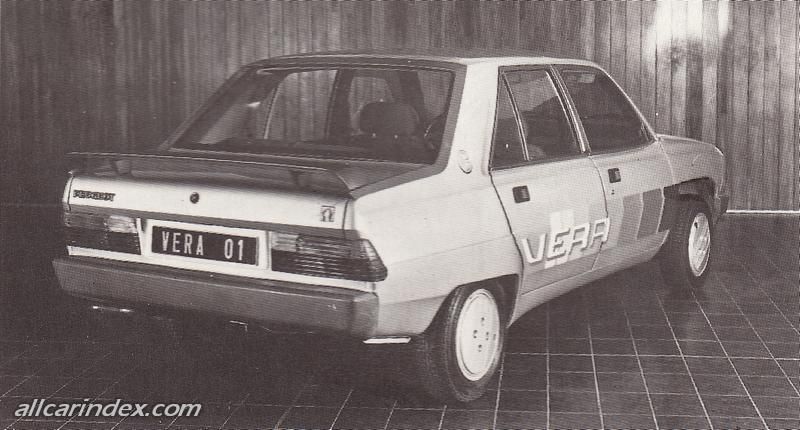
The Peugeot Véra was a research vehicle built by Peugeot in response to a commission from the French energy-saving agency AEE (Agence pour les Economies d'Energie), which had tasked both Peugeot and the state-owned Renault with developing low-consumption experimental cars. The project was first shown at the "J'economise l'Energie" exhibition at the Paris motor show in October 1980, though its detailed results were not released until spring 1981. Its name stood for Véhicule économe de recherche appliquée, meaning an economical vehicle of applied research. Rather than creating a new body as Renault had done with the R18, Peugeot refined the existing 305 bodyshell, in production since late 1977, with the goal of cutting average fuel consumption by a quarter.
Through step-by-step wind-tunnel optimization without altering the basic silhouette, Peugeot reduced the drag coefficient from 0.44 to 0.318, a 28 percent improvement. Early gains to cw 0.40 came from a raised boot lid with a rear spoiler, front and rear glass fitted without external seals, revised interior air outlets at the rear roof rail, and the removal of rain gutters. Further refinements included wind deflectors along the front door window edges, a front bumper combined with a belly skirt, flush-mounted headlight lenses, better-sealed front bodywork, a revised radiator grille, reshaped wheel arches, underbody panelling behind the rear seats, an air-guiding frame around the rear window, flat wheel covers, and low-rolling-resistance tyres.
Weight was cut just as systematically. High-grade sheet steel alloys, aluminium doors, and SMC glass-fibre-reinforced plastic for the bonnet, front section and other panels saved about 52 kg, while fibre-reinforced polypropylene front seat frames, polycarbonate headlight lenses and acetate resin door handles removed a further 25 kg. Replacing the 1.3-litre engine of the Peugeot 305 GL with the 1.0-litre unit from the Peugeot 104 saved another 18 kg. That engine itself was further lightened with a plastic valve cover, a magnesium carburettor and lighter electrical components, alongside slimmed-down mechanical parts and a specially developed rear axle; Michelin contributed resin tyres and an emergency spare rather than a full-size one. Overall weight fell from the 305's 925 kg to 750 kg, a reduction of 175 kg, or 19 percent.
Engine changes included a compression ratio raised to 10.2:1, revised valve timing, two fewer camshaft bearings, relieved valve springs and a Peugeot-developed electronic ignition storing optimal timing for each operating condition. Output was 63 hp at 4500 rpm, slightly below the 305 GL's 65 hp, but torque rose from 94 to 116 Nm and arrived at 2500 rpm instead of 3750 rpm, matched to a five-speed gearbox with revised ratios. Fuel consumption at 90 km/h, 120 km/h and in the urban cycle was 4.2, 5.6 and 6.3 l/100 km, against 6.5, 9.1 and 9.5 l/100 km for the 305 GL. Top speed rose from 143 to 156 km/h, with 0-400 m and 0-1000 m times improving to 18.5 and 34.9 seconds.
A second version, the Véra 02, appeared at the Geneva show in March 1982 with what Peugeot called the smallest four-cylinder turbodiesel engine in the world, achieving a specific consumption below 180 g/PS/h. Weight rose to 790 kg but drag fell further to cw 0.315, with 61 hp, 114 Nm and a top speed of 158 km/h. On 5 June 1982 a Véra 02 covered the Pau-Paris route using 20 litres of diesel, equivalent to 2.53 l/100 km at an average speed of 62.2 km/h. The Véra measured 4240 mm long, 1630 mm wide and 1400 mm high, with a 2620 mm wheelbase.