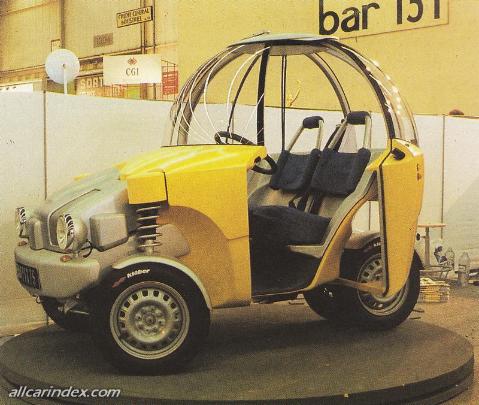

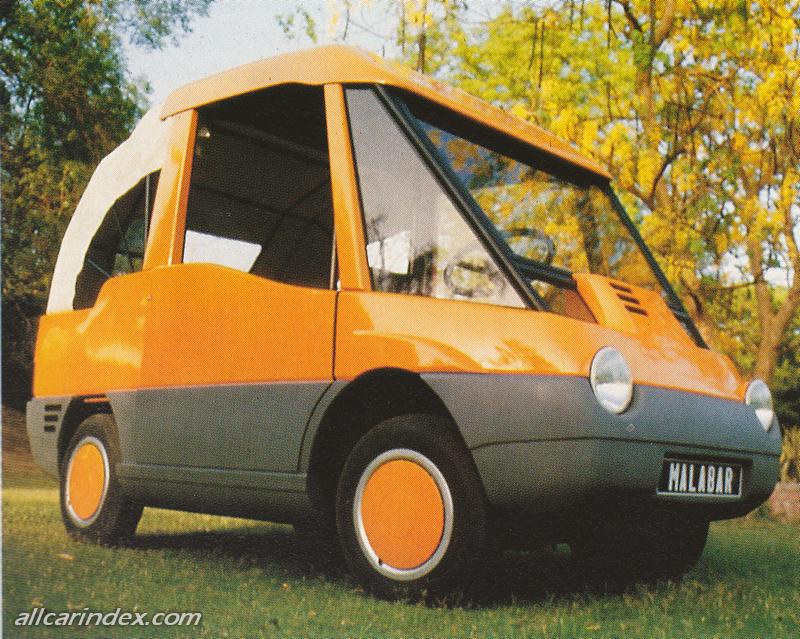
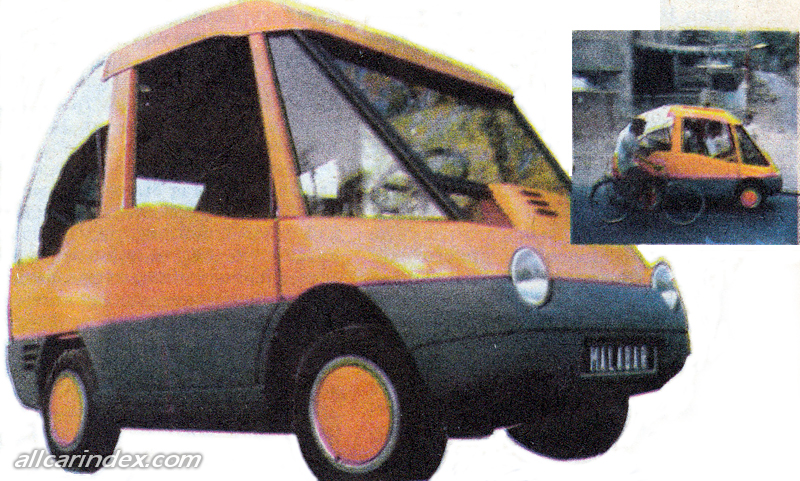
The Malabar was a concept vehicle developed by Les Ateliers Ensci, a design studio associated with the Ecole Nationale Superieure de Creation Industrielle in Paris, in collaboration with the National Institute of Design (NID) in Ahmedabad, India. The project began in March 1988 and was aimed at addressing the basic transportation needs of India. The completed study traveled to India, where it drew attention in the local press, before being presented in France in November 1989.
The goal of the project was to create a vehicle suited to a different culture and to economic and traffic conditions unlike those found in the West, rather than one that showcased advanced Western automotive technology. A full-scale model was built with the involvement of five Ensci students working at France Design Henri Heuliez. Four of the students then traveled to India for two months with the Malabar model so that its functionality could be tested and critically assessed at the National Institute of Design.
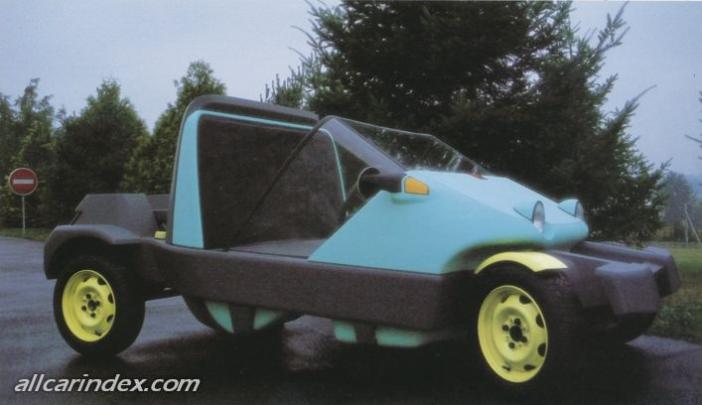
The Malabar was conceived as a multifunctional vehicle capable of carrying an entire family or transporting goods, targeted at India's middle class. Two versions were planned: a basic chassis-and-cab model intended for tradespeople and merchants, envisioned at around 15,000 francs, and a more fully equipped version for family use, envisioned at around 25,000 francs. The vehicle used a simple tubular steel chassis with a rear-mounted 700 cc engine producing 26 hp. All four wheels had independent suspension, with transverse springs at the front and coil springs at the rear. The body was made of fiberglass-reinforced plastic, with a roof doubling as a roof rack and lockable storage compartments built into the floor.
The three-piece windshield was made of PVC for cost and practicality, and the sides had no windows. A simple folding top could be stretched over the rear section and attached to the cabin roof, giving the body a one-box landaulet-like form. Protective bumper surfaces extended into the flanks to guard against minor collisions typical of urban traffic. Seating followed an unconventional layout: a fixed central driver's position accompanied by five removable seats, including two folding chairs flanking the driver, a rearward-facing seat behind the driver, and two seats at the rear.
A parallel Indian design team at NID, working from the same specification, produced a far more conventional proposal, with a front-mounted engine under a separate hood, two side doors and a tailgate, two front seats, and a three-person rear bench, along with a steel body instead of fiberglass. The two teams eventually compromised on certain elements, such as placing the drivetrain beneath the front seats without central steering. The Indian students criticized the French version for its rear folding top, which they felt resembled an auto rickshaw.
The Malabar measured 315 cm in length, 150 cm in width, and 188 cm in height, with a wheelbase of 180 cm, and weighed 450 kg. It remained a concept vehicle and was not put into production.