
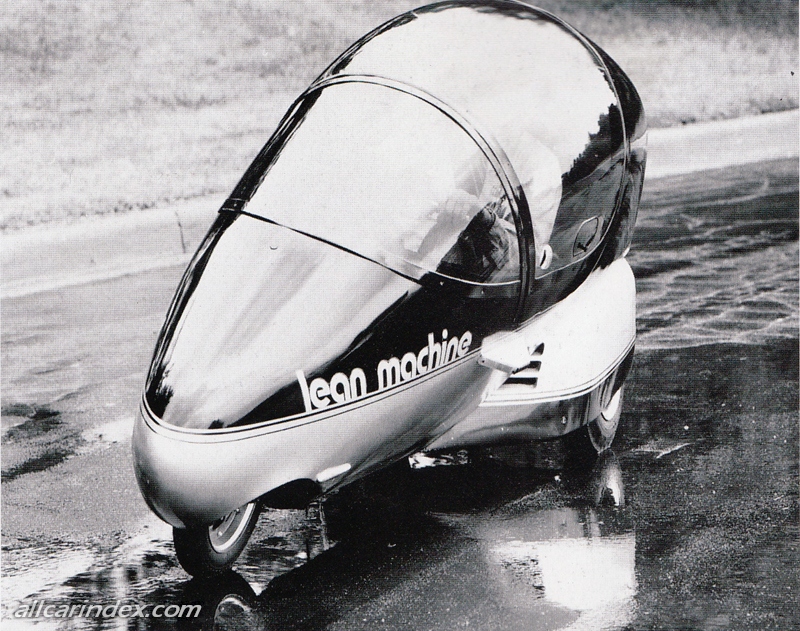
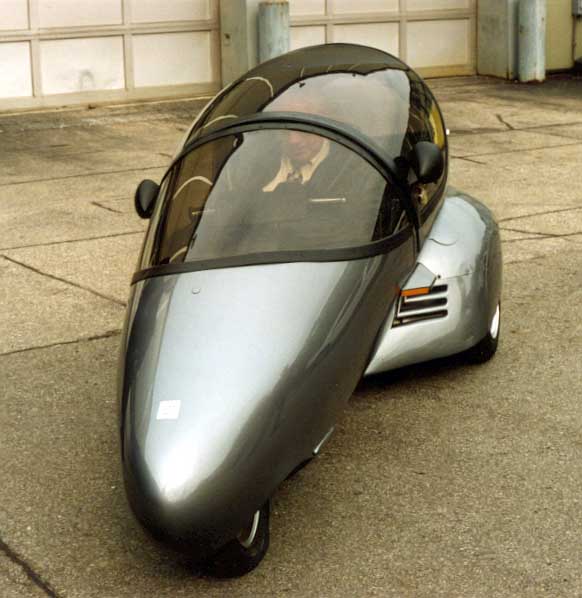
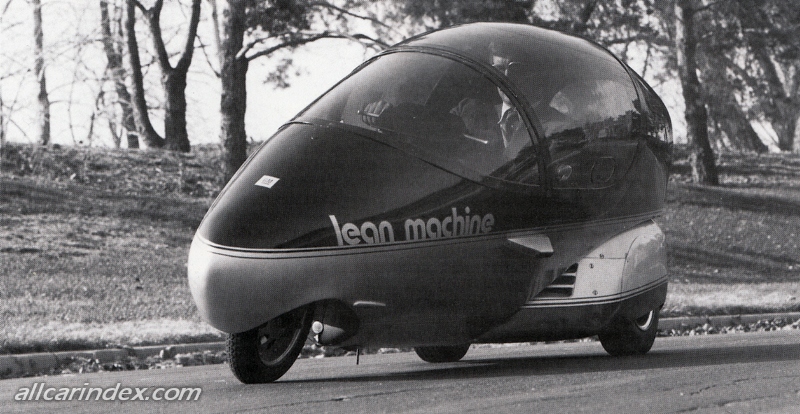
The Lean Machine was a three-wheeled experimental vehicle built by General Motors, first officially announced in December 1982 and displayed as part of the World of Motion exhibit at Epcot at Walt Disney World in Florida. It was also shown publicly at the Los Angeles Motor Show in early 1983, where some journalists were allowed to try it on a large parking lot. The vehicle combined characteristics of a car and a motorcycle, and as its name suggested, it leaned into corners like a two-wheeler.
The project traced back to the Arab oil embargo of 1973, which prompted Frank Winchell, General Motors' vice general director for engineering, to conceive a highly economical single-occupant vehicle. Reasoning that a motorcycle offered the best starting point but was impractical in poor weather, Winchell and a team of four colleagues designed and built the Lean Machine. It had a single-volume, arch-shaped body with a fully glazed upper section resembling the nose of an aircraft, mounted on a lower rear body section that enclosed the drivetrain. The glass canopy's middle section hinged upward to allow entry and exit, giving the driver full weather protection, unlike a conventional motorcycle.
The vehicle was powered by a Honda motorcycle engine, a 2-cylinder unit mounted at the rear driving the rear wheels, producing around 30 hp according to some sources and 38 hp according to others. At a weight of just 181 kg, it could accelerate to 60 mph (96.5 km/h) in 6.8 seconds, though top speed was limited to 112 km/h. Its streamlined bodywork, aimed at achieving a low drag coefficient, allowed General Motors to claim potential fuel economy of around 200 mpg, equivalent to about 1.175 to 1.18 l/100 km, provided the performance was not fully exploited.
The Lean Machine had a single seat and one entry hatch, and it was controlled with a handlebar in the manner of a motorcycle. Leaning was not automatic with steering input but was controlled by the driver pressing down with a foot on stirrup-like pedals, pressing the left foot to lean into a right turn and vice versa. This gave the driving experience a sensation compared to flying. Reported dimensions include a length of 3099 mm, width of 914 mm, height of 1219 mm, and a wheelbase of 1803 mm. The Lean Machine remained an experimental study and was never put into production.