


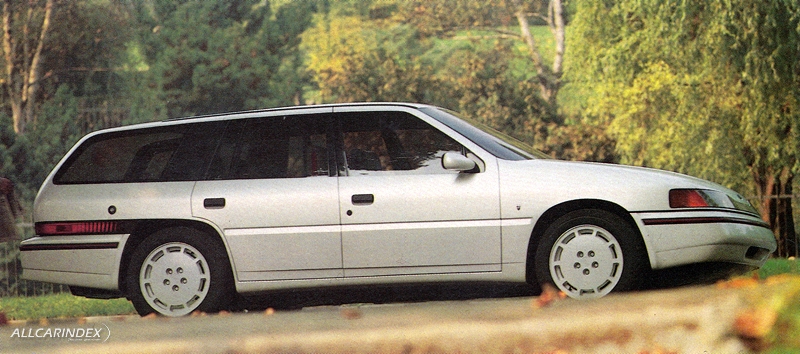
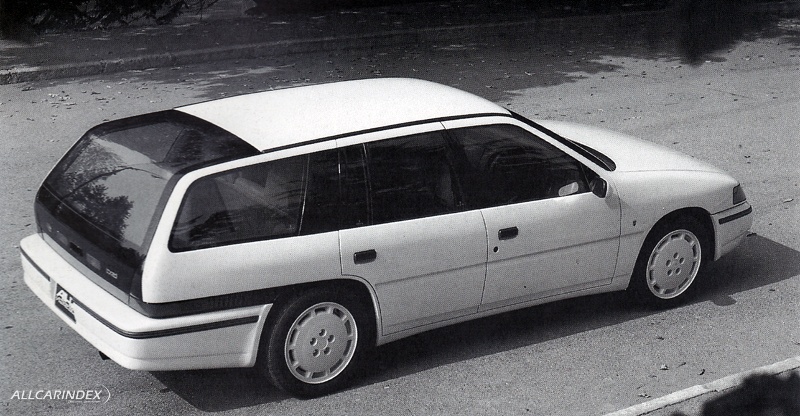
The Ford Vignale TSX-4 was a concept estate car produced under the Vignale name, revived by Ford's Italian design subsidiary Ghia following its earlier use on the Ford Mustang Ghia Vignale FF. The name TSX-4 stood for Touring Sport Extra 4-Rad-Antrieb, referring to the car's four-wheel-drive layout. Presented as a luxurious and sporting high-performance estate with a large load volume, it was conceived not as a simple styling exercise but as a fully engineered vehicle. It was built on the platform of the Ford Tempo, the American counterpart to the Ford Sierra, and used an experimental Ford four-wheel-drive system.
The car had a five-door, five-seat estate body constructed with lightweight materials and refined in Ford Cologne's wind tunnel to achieve a drag coefficient of 0.30. Its smooth bodywork featured flush-fitting windows, recessed rain gutters, headlights integrated into a low front end under a continuous plexiglass band, and a hatch cut deep into the roof with hinges positioned above the rear headrests, entirely glazed. The interior used light and dark grey leather with red contrast striping, a steering wheel with a broad vertical spoke, push-button code start ignition, a CD audio system, a rear-seat television, air conditioning, and a fold-out computer keyboard with screen in place of the glovebox.
Power came from a transverse 2.3-liter OHV four-cylinder engine producing 120 hp, compared with 85 hp in standard applications, driving all four wheels. The car had a wheelbase of 254 cm, measured 453/171/134 cm in length, width and height, and reached a top speed of 200 km/h.