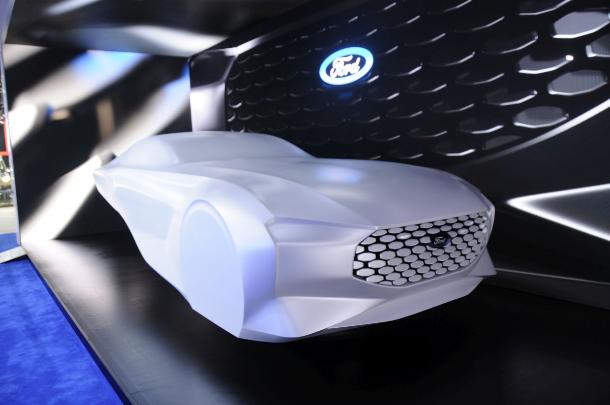

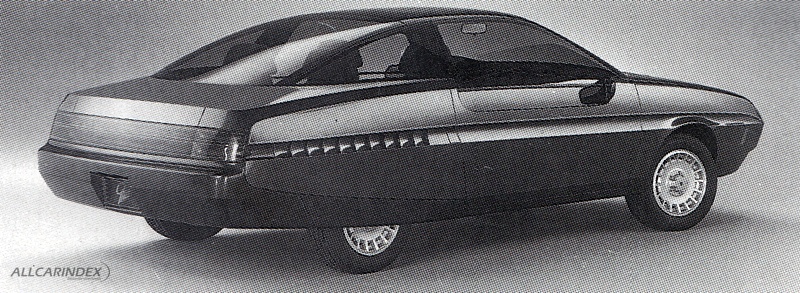
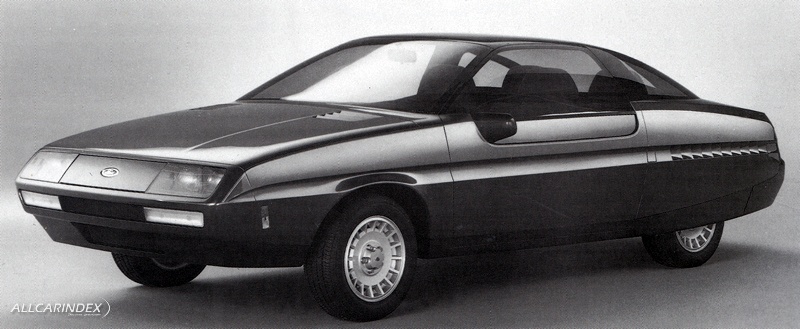
The Topaz Mustang was a concept coupé from Ford, shown at the international congress of the Society of Automotive Engineers (SAE) in Detroit. It resulted from a collaboration between Ford's design center in Dearborn and Ford Ghia Operations, the design studio in Turin. The car was built on the platform of the American Ford Escort, using the same drivetrain, and never entered production.
Mechanically it relied on the Escort's 1597 cc four-cylinder engine, producing 71 hp at 4600 rpm and 121 Nm of torque at 3000 rpm, the same engine used in the related 2+2 Escort-derived EXP coupé introduced in 1981. Compared with the EXP, the Topaz Mustang was considered more modern and visually striking, though it was smaller overall than the production 1982 Mustang. Its wheelbase measured 246 cm, 10 cm shorter than the production Mustang, while its body length matched that of the European Ford Capri (sold in the US for a time as the Mercury Capri).
Donald F. Kopka, Ford's deputy general manager and head of design, cited a drag coefficient of 0.33. Contributing aerodynamic features included a windshield raked 65 degrees with concealed wipers, an all-glass curved roof, a wedge-shaped nose with transparent headlight covers and a low-mounted cooling air intake, partial underbody covering, fully enclosed rear wheels, streamlined mirror housings, and flush body and window transitions. Kopka noted that flexible plastic headlight covers were being explored to allow more aerodynamic, forward-set lighting units without risking costly glass damage. The car used alloy wheels with 195/60 HR 14 tyres, a plastic body, three doors, and seating for four.