
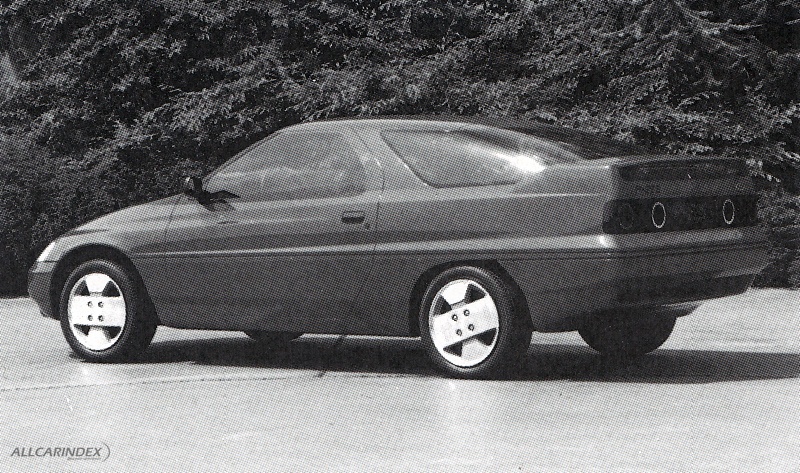
The Ford P-229 was a design study created in 1983 at Ford's studio in Cologne, Germany. It began as one of the many full-scale design models produced annually by studios worldwide that are typically never shown to the public, but it was given an unusual afterlife when Ford Germany loaned it to the Verkehrshaus der Schweiz in Lucerne in March 1986. The museum, the most visited in Switzerland, included it in an exhibit on 100 years of automotive history, where it remained on display into the early 1990s. Ford described it as a 1:1 fiberglass model complete with wheels and tires, finished in red, with no mechanical components and no interior below the beltline.
The study was developed as a possible replacement for the Escort, sharing that model's wheelbase, though its coupe styling recalled the Ford Capri more than the Escort. Its features included an aerodynamically shaped front end refined in the wind tunnel, rear side sections that flowed seamlessly into a rear window extended well back, and a rear wing supported by fins. The project originated under French Ford chief designer Patrick Le Quement, who by 1986 had moved to Volkswagen and later became design chief at Renault.
The P-229 was built as a two-door, four-seat coupe body made of plastic. It measured 430 cm in length, 165 cm in width, and 130 cm in height, with a wheelbase of 240 cm. It was never put into production.