
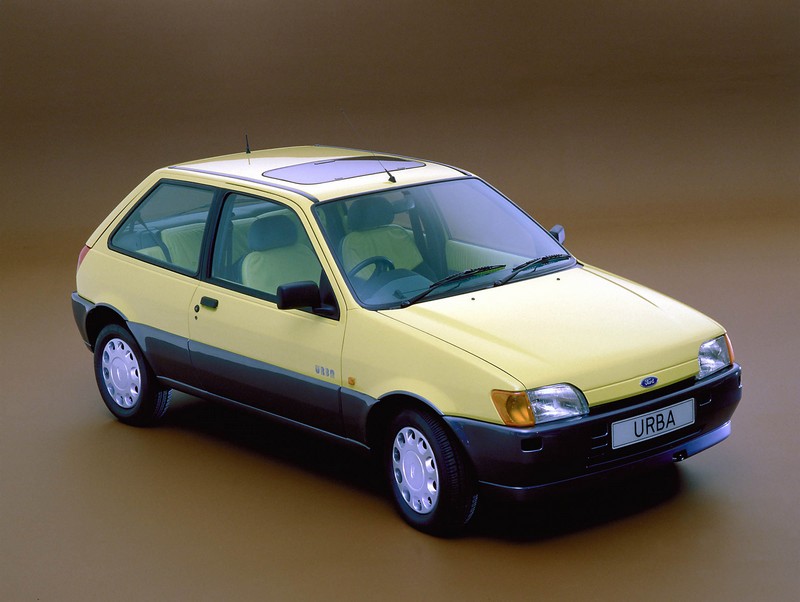
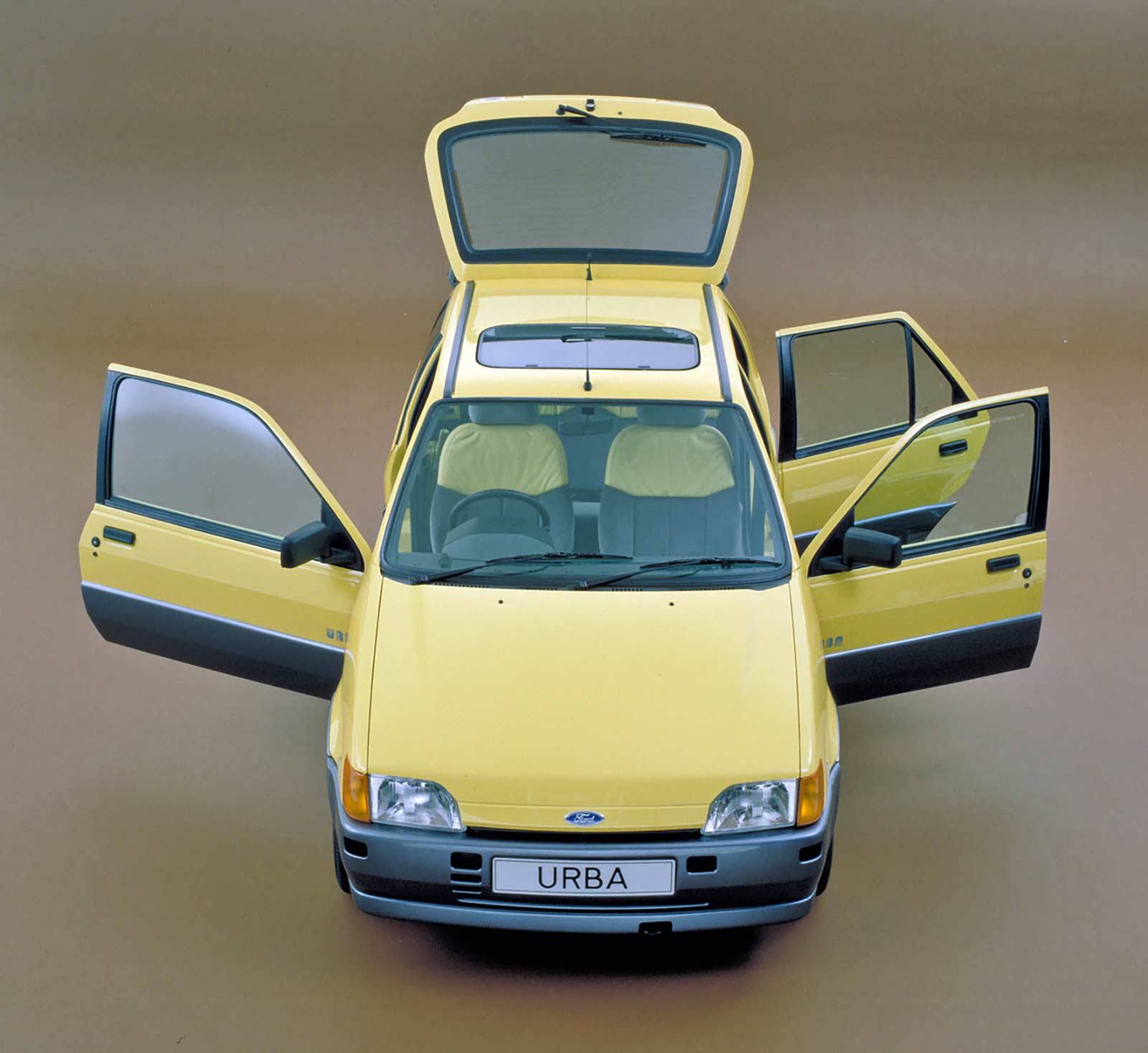
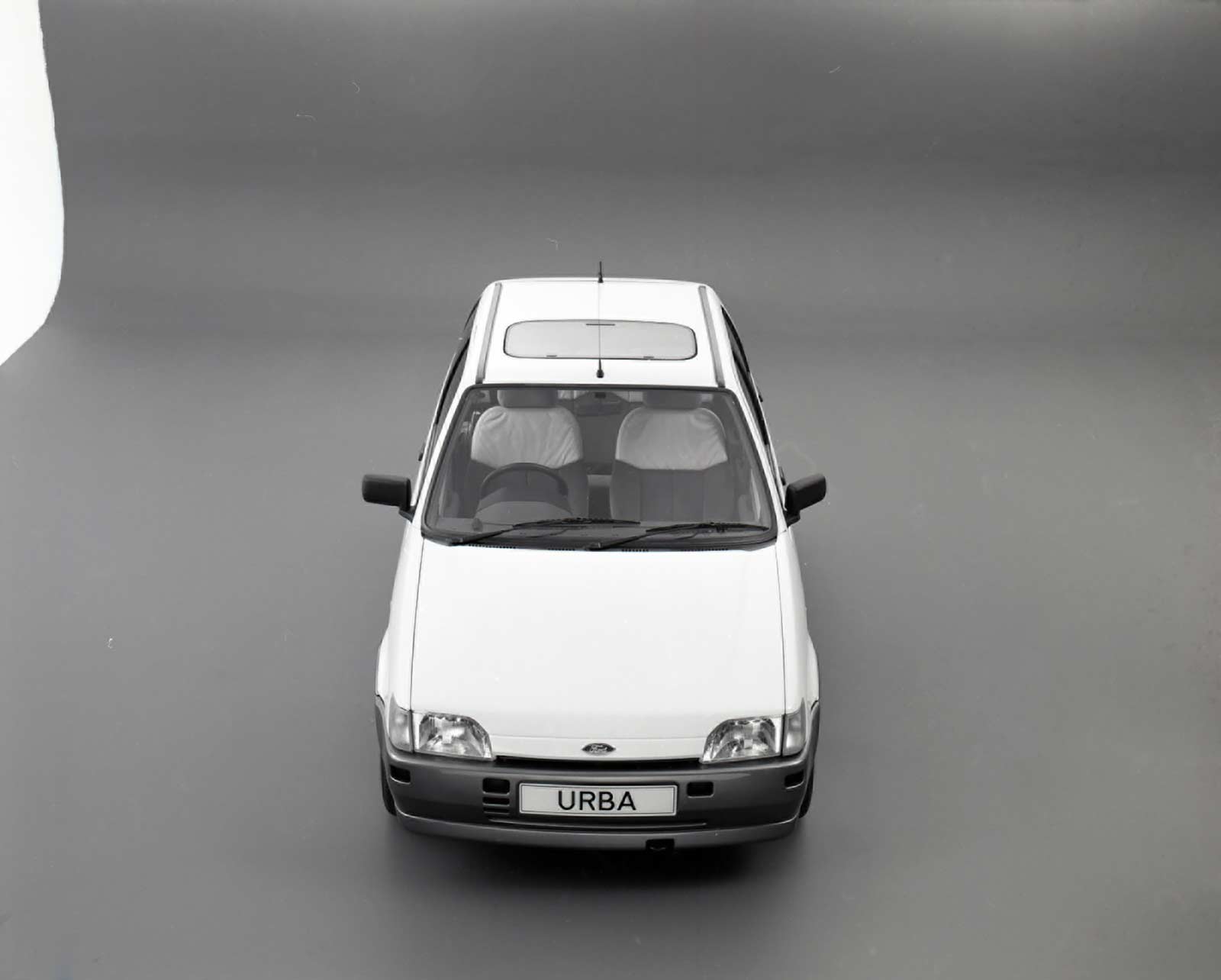
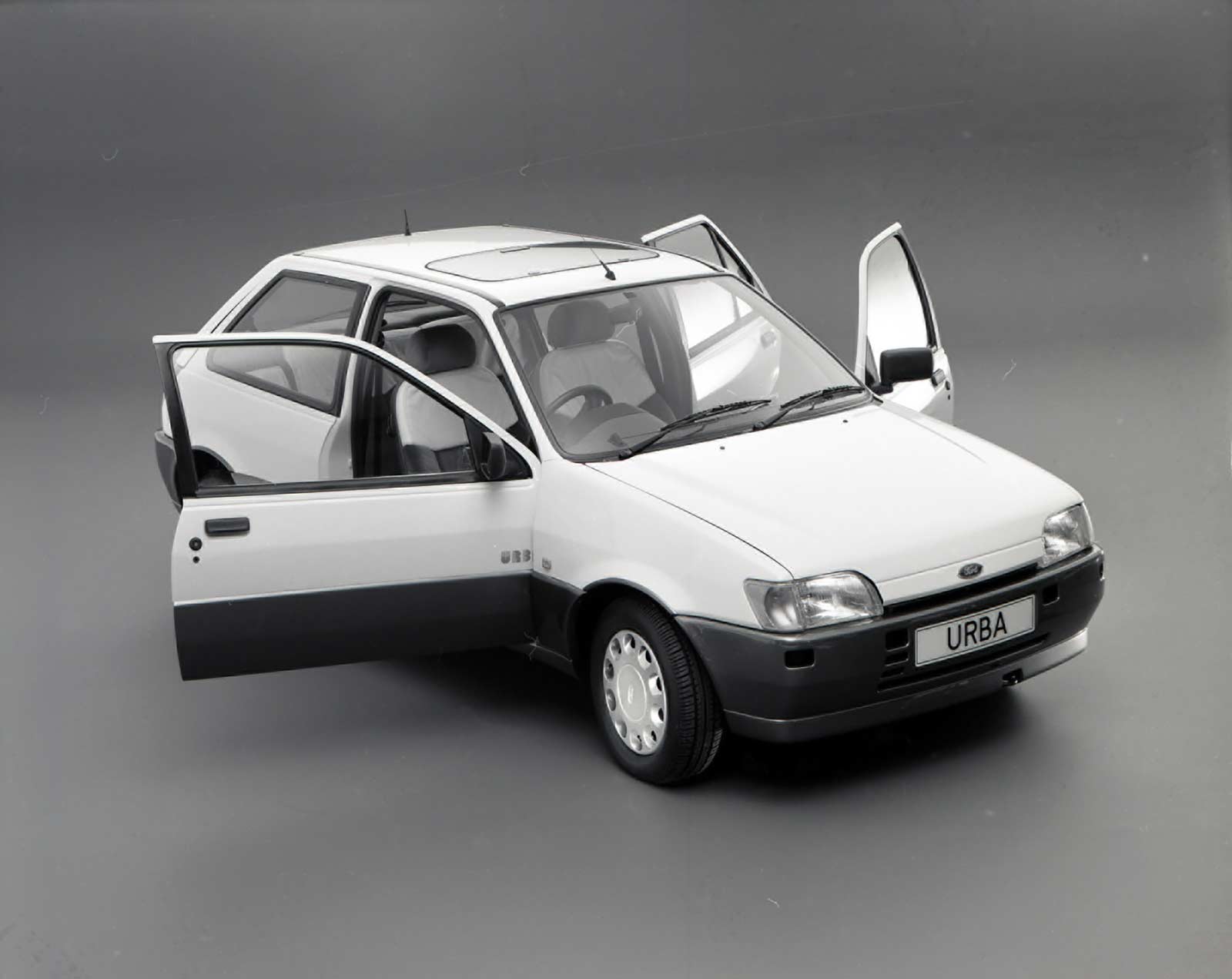
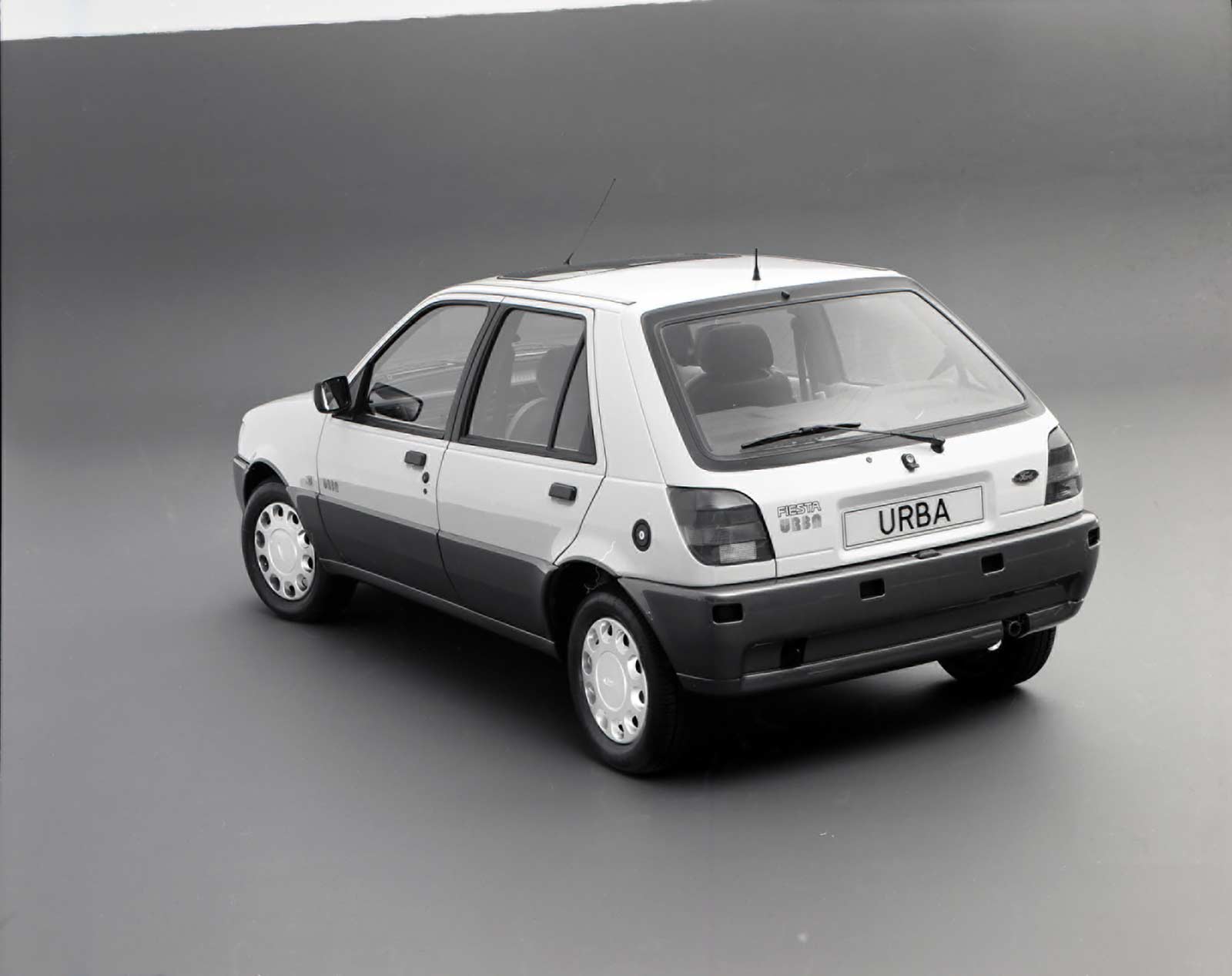
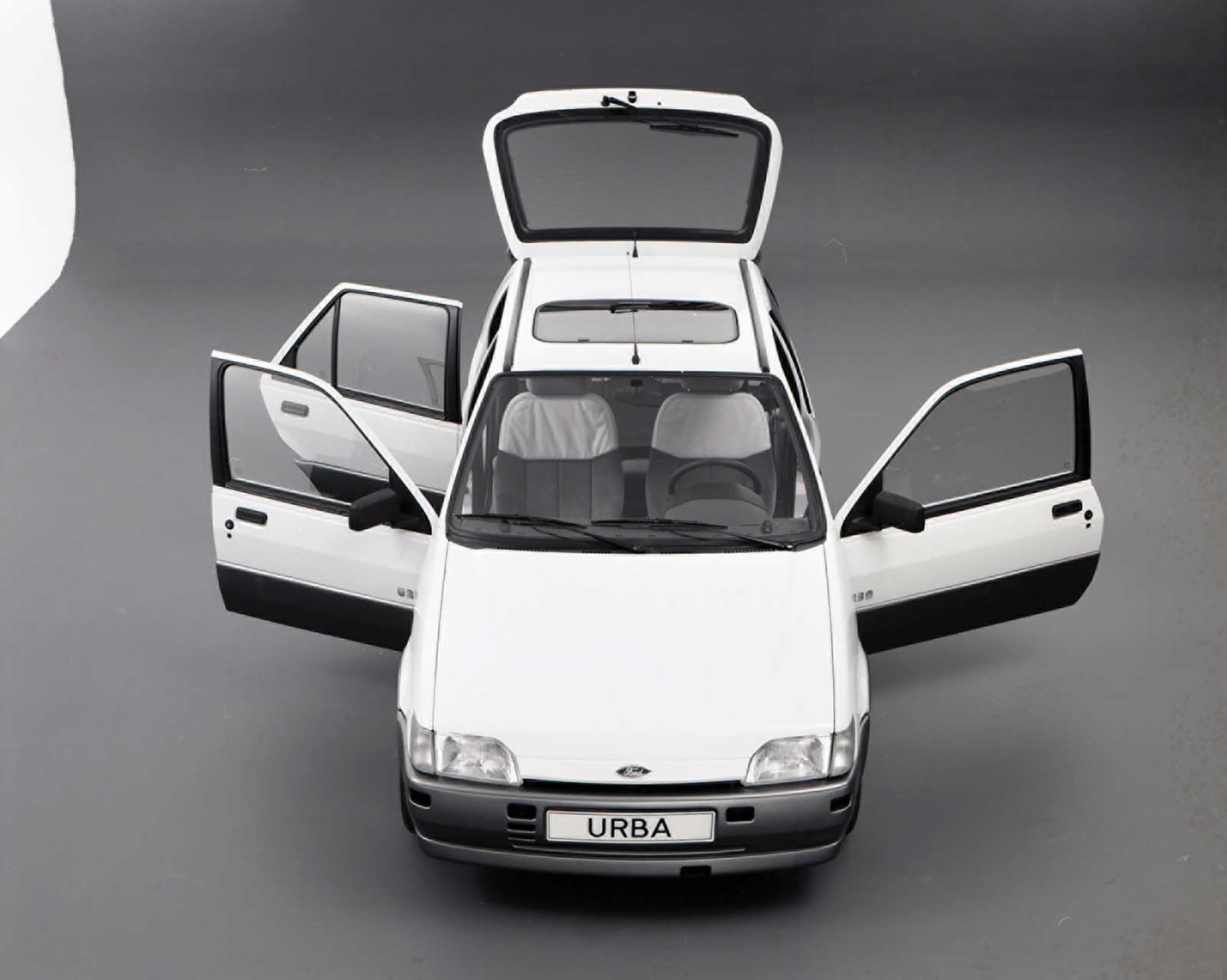
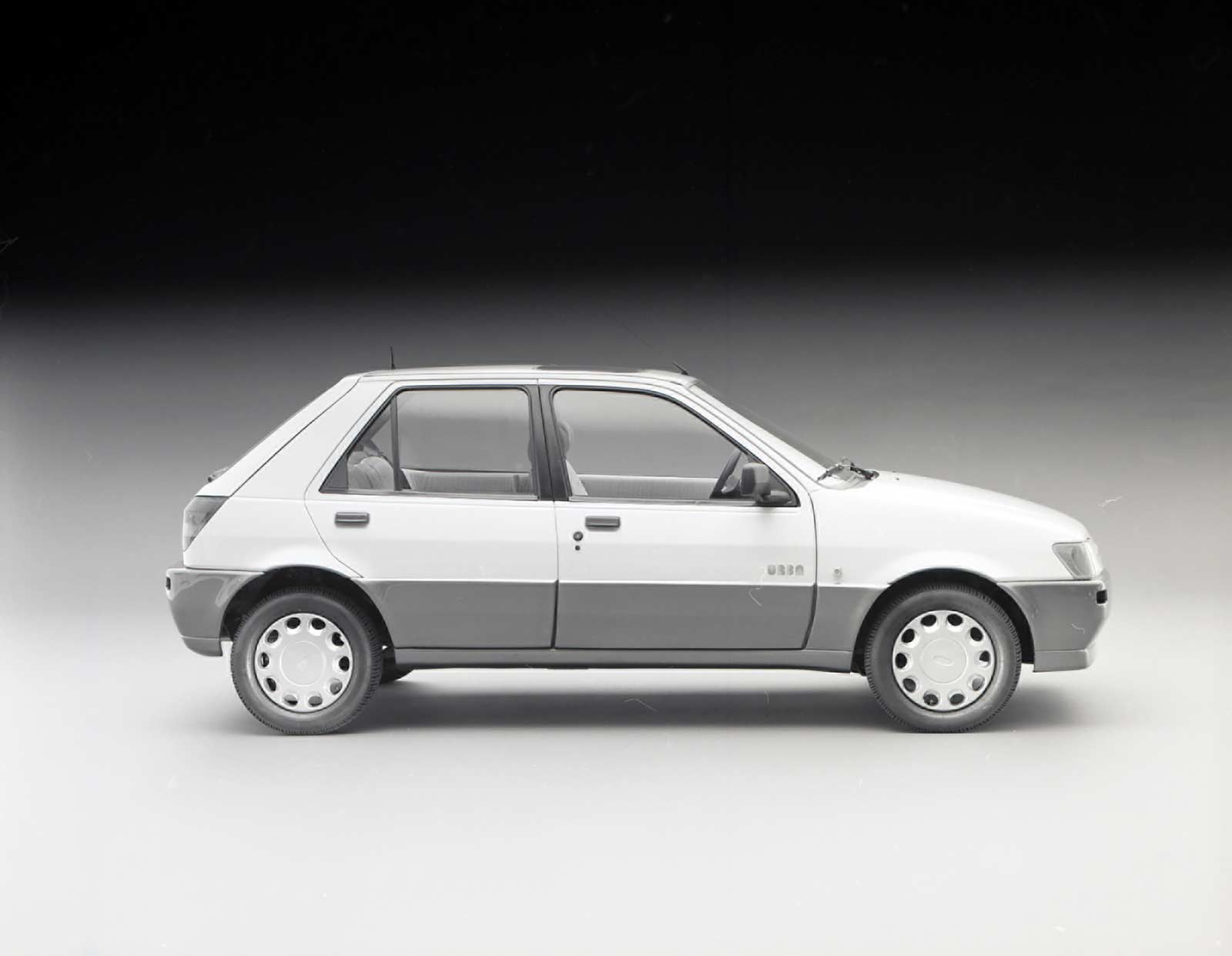
The Ford Fiesta Urba was a concept city car developed by Ford from the new Fiesta and shown publicly for the first time at the Geneva International Motor Show in March 1989. It was built as a small hatchback with an asymmetric door layout: a single door for the driver on the offside and two doors for passengers on the kerbside, giving the car four doors in total and seating for four or five occupants. Ford described the project as a study intended to gauge customer reaction to a new type of city car that would be easy to drive and park, secure when left unattended, and practical for everyday urban use, with particular appeal aimed at young people, including those who had recently taken on family responsibilities but still wanted a car that was fun to use. Andy Jacobson, Ford's European director of design, presented the Urba as an ideal city car for this audience.
The concept was based mechanically on the Fiesta 1.1 automatic. Its 4-cylinder engine displaced 1117 cc and produced 50 hp at 5000 rpm along with 83 Nm of torque at 2700 rpm, described as a lean-burn, low-emission HCS unit. Drive went through Ford's CTX continuously variable automatic transmission, controlled by a special push-button selector system rather than a conventional lever. The car also featured a variable-ratio, easy-park steering rack and an anti-lock braking system. Dimensionally, the Urba had a wheelbase of 2290 mm, a track of 136.5/132 cm, and overall dimensions of approximately 3700 mm in length, 1590 mm in width and 1335 mm in height.
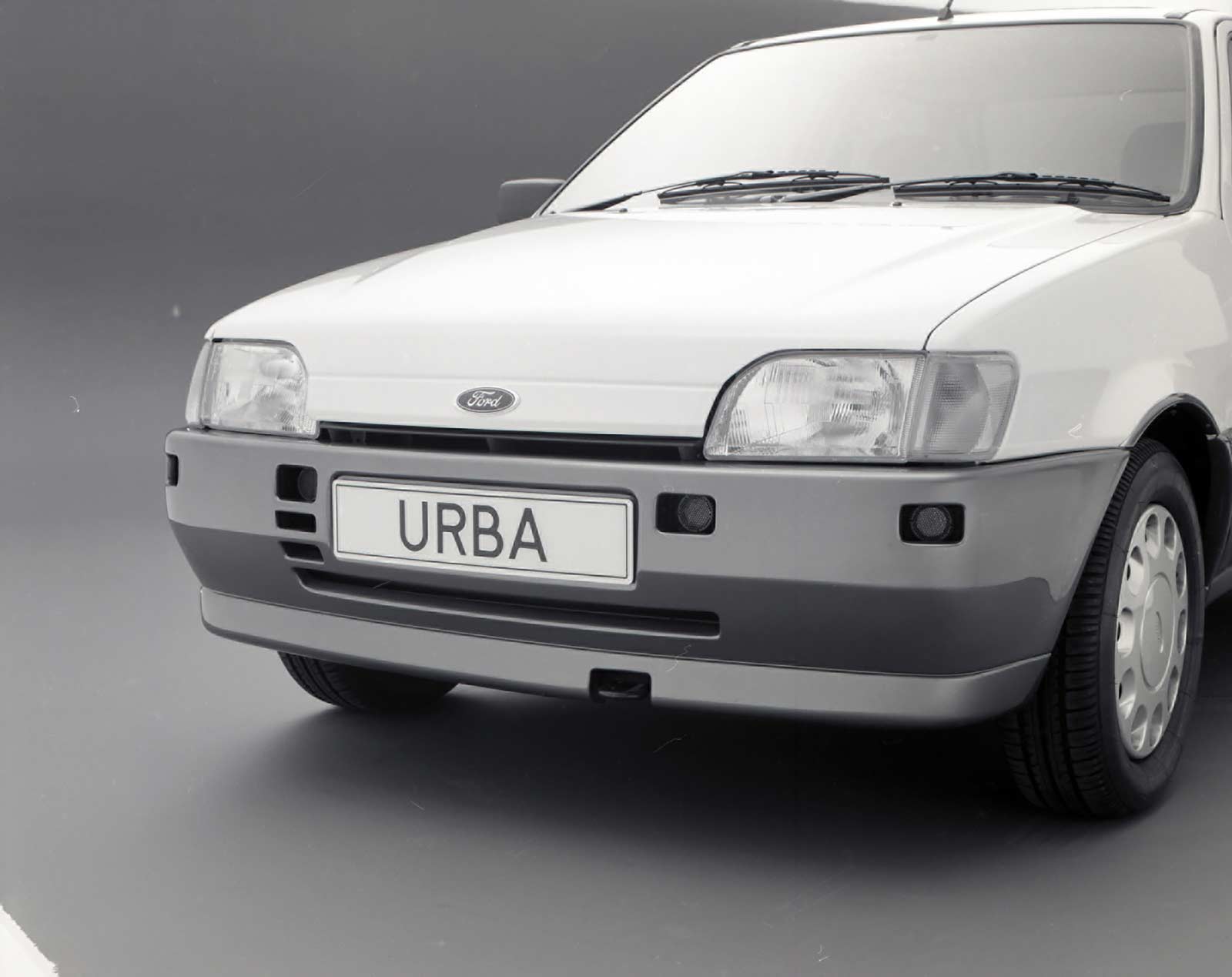
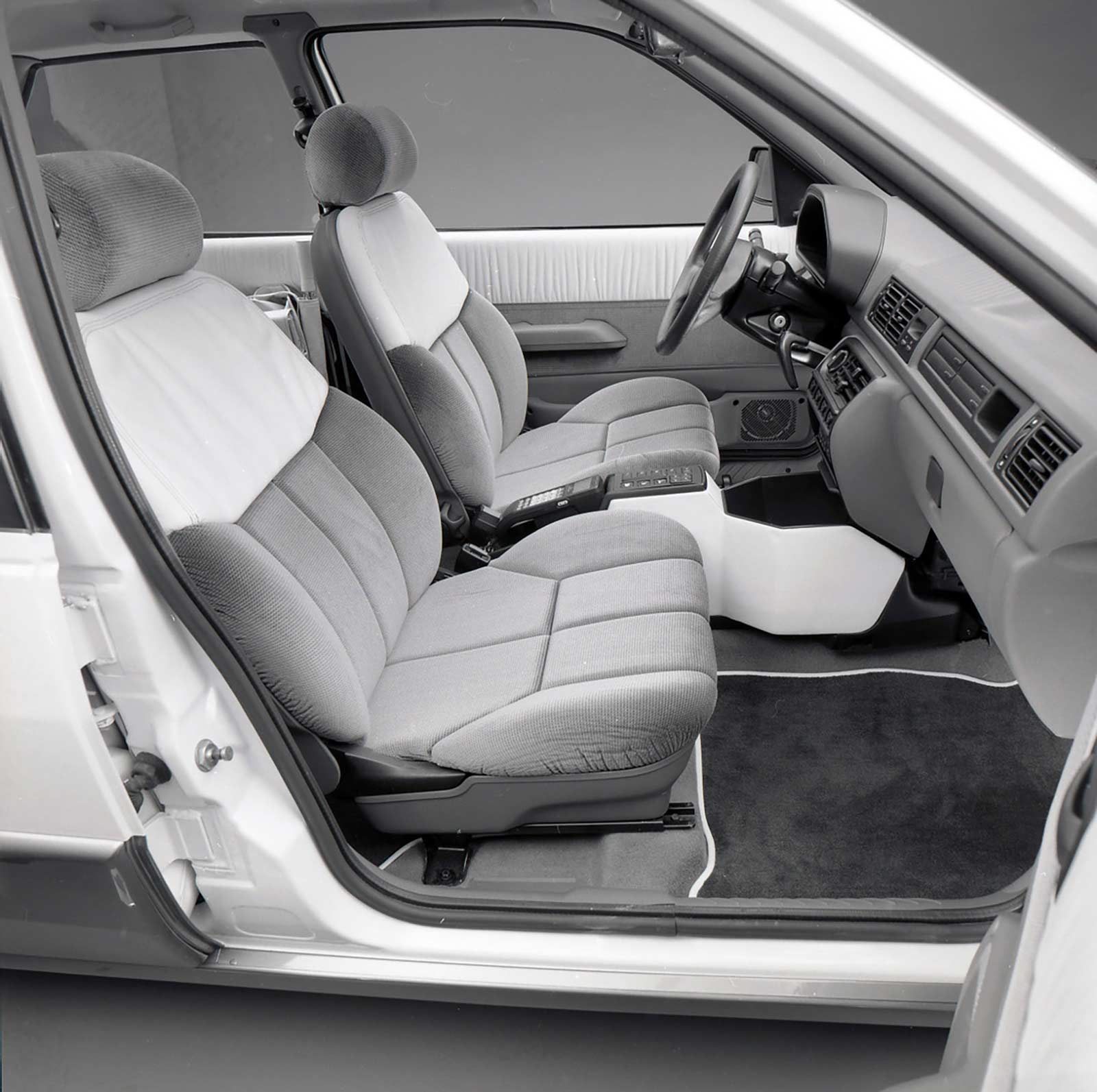
The unique door arrangement placed a childproof lock on the rear kerbside door, operated automatically but able to be overridden by the driver for around 60 seconds using a switch on the centre console. The tailgate could be released electrically by remote control. Parking assistance came from ultrasonic proximity sensors mounted in the front and rear bumpers, which emitted a bleep that increased in frequency as the car approached an obstacle; this system was activated by a switch on the facia, alongside a separate switch for a radio-controlled garage door opener. The bumpers themselves were finished in metallic grey and equipped with these four ultrasonic detectors, with additional bodyside protection mouldings fitted to guard against minor knocks.
Security features included a remote infra-red central locking system linked to an anti-theft alarm, which unlocked the doors and switched on the interior light before the driver reached the car so the cabin could be checked for a hidden intruder. The glovebox was converted into a heavy-duty safety deposit box with a combination lock for protecting valuables, and the radio/cassette player carried an anti-theft security code. Practical touches for city use included a rapid electric windscreen de-icer, aspheric door mirrors designed to eliminate blind spots, and door-mounted lighting that also served as puddle illumination when opening the doors at night.
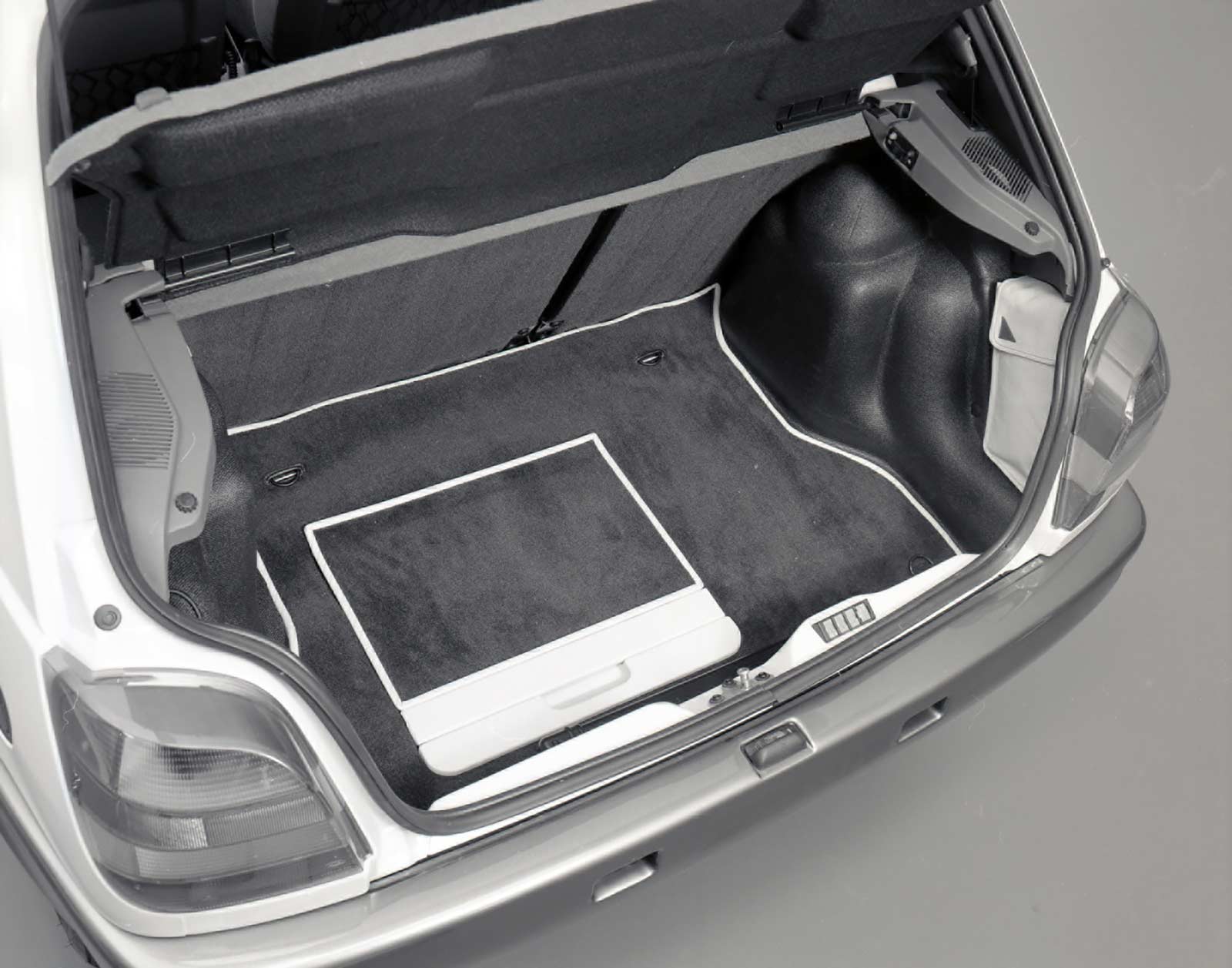
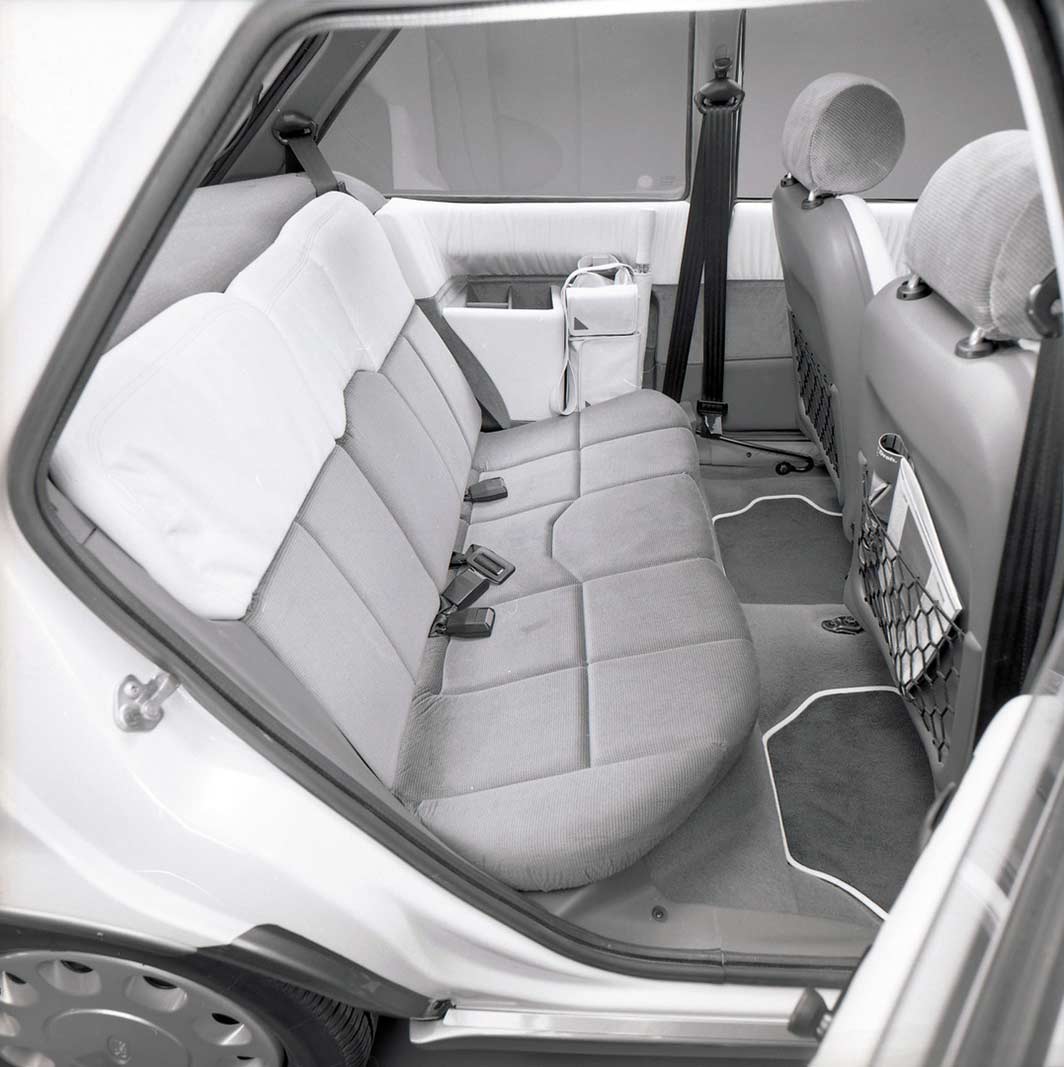
Storage and comfort features were extensive for a concept of this size. Behind the driver's door, in the fixed rear quarter panel, Ford created a dedicated storage area to hold a bright yellow leather "designer" shopping bag matching the car's exterior color, sized to carry personal items such as an organiser, a personal stereo and a telescopic umbrella. The luggage floor housed an electrically controlled storage box that could keep food either warm or cool. Additional space for bottles and cans was built into the passenger compartment. A filter was fitted to the heater air intake to reduce the effect of traffic fumes, with an optional scented insert available. The seats and seatbelts offered height adjustment, and a hands-free car telephone was fitted as standard equipment on the concept.
The Fiesta Urba used a wheel and tyre system supplied by Continental, known as CTS, which allowed the tyres to remain seated on their rims even when deflated; Ford stated this eliminated the need for a spare wheel and allowed the car to be driven for a distance up to 300 km on a completely flat tyre, avoiding the need to change a wheel in a congested city street. The exterior was finished in a bright yellow paint chosen for visibility and safety, complemented inside by grey trim materials, including moulded seats based on XR2i contours trimmed in grey "Halley" fabric with bright yellow leather accents, a sports steering wheel, twin vanity mirrors, seatback stowage nets and floor mats edged in yellow leather. The car also had a tinted glass tilt-and-remove sunroof.
Ford's press materials at the time framed the Urba as built around the idea of a city shopping vehicle, offering equipment intended to support a day of shopping in an urban environment, combining its asymmetric door layout with parking aids, a remote garage door opener, refrigerated boot storage and various interior stowage solutions. The Fiesta Urba remained a design and engineering concept rather than a production model, used by Ford to display and test a range of city-oriented convenience and safety technologies rather than as a car intended for series manufacture.