
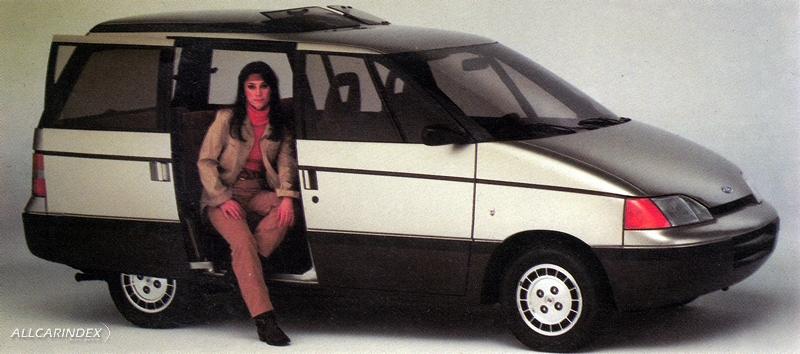
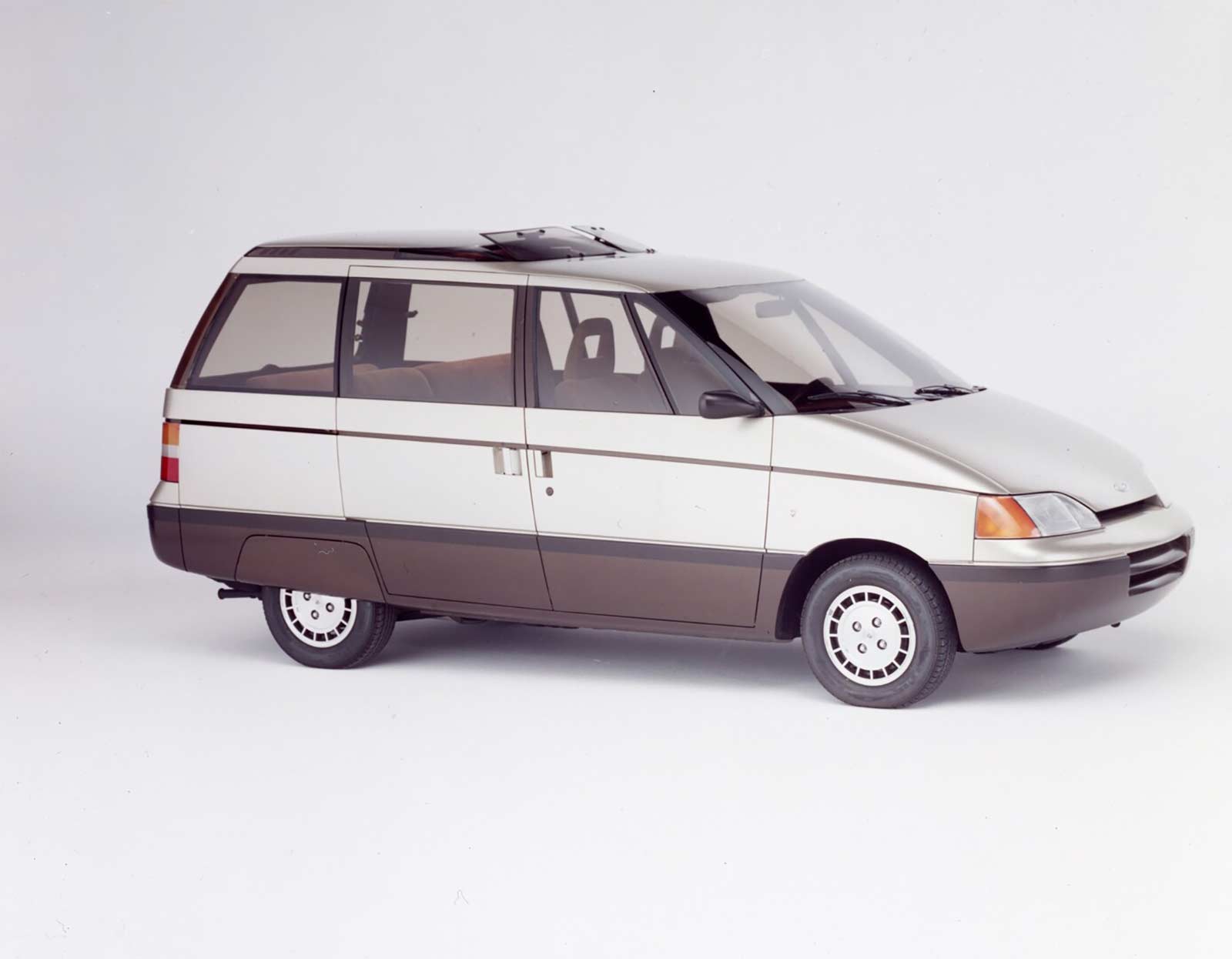
The Ford APV was a concept vehicle developed by Ghia of Turin and displayed on the Ford stand at the 1984 Geneva Motor Show. It was a one-off study rather than a production model, presented as an "extremely compact seven-seater for the 1990s." APV stood for All-Purpose Vehicle, and the concept anticipated the layout that would later become common in compact minivans, echoing themes already explored in Ford's smaller Aerovan study.
In overall footprint the APV was close to the Ford Escort Turnier estate, but its interior was far more spacious thanks to a height of nearly 170 cm. The rear cargo area held 453 litres, expanding to 2106 litres with the second and third seat rows folded flat, representing a 27 percent gain in luggage capacity over a comparable estate car. The extra room came from raising the seating position rather than lengthening the car: occupants sat with their legs less stretched out, and the driver sat 20 cm higher than in an Escort. A steeply raked, 60-degree windscreen ran in a continuous line with the bonnet, giving the APV a one-box (monovolume) shape. Flush-mounted windows and door handles, partial covering of the rear wheels, and rounded body contours helped the APV achieve a drag coefficient of just 0.33 despite its large frontal area.
From the middle seating row rearward, the roof featured a raised "vista-vision" section incorporating two tilting glass panels that could be removed entirely for stronger ventilation, with air extracted through vents at the rear edge of the roof. Access to the rear seats was through a sliding door on the right-hand side, a layout matching that used on the Nissan Prairie, the first modern compact minivan, launched in 1982; because the Prairie was built for both left- and right-hand traffic markets it used sliding doors on both sides, and when a new-generation Prairie appeared in 1988 its silhouette closely resembled that of the APV. The double-action tailgate could be raised to serve as a shelter when camping, while the rear window could also be lifted independently; lights built into either side of the tailgate illuminated the ground when it was open. The audio system comprised a radio, cassette deck and equalizer feeding four speakers, with the rear pair removable and usable outside the car via extension cables.
Power came from an experimental 1.6-litre four-cylinder petrol engine driving the front wheels through a five-speed manual transmission; no output figures were quoted, though a diesel engine of the same displacement was also said to be possible. The car rode on 330 mm cast alloy wheels fitted with 175/70 SR13 tyres. Inside, the ten principal controls were grouped into two satellite pods on the steering column, reachable by the driver without letting go of the wheel. Generous glass area gave good visibility, although the wedge-shaped nose could not be seen from the driving seat, requiring some adjustment in driving position.
The APV measured 4094 mm long, 1676 mm wide and 1688 mm tall, with a 2405 mm wheelbase, and weighed approximately 1088 kg. Later in 1984 the design was shown at the "Drive Forward" exhibition staged by the British Design Council, opened by Prime Minister Margaret Thatcher, who criticized the poor forward visibility caused by the sloping bonnet; the resulting press coverage gave the seven-seat study unexpected publicity in Britain. Ford nonetheless waited a number of years before entering a compact minivan project of its own in Europe.