
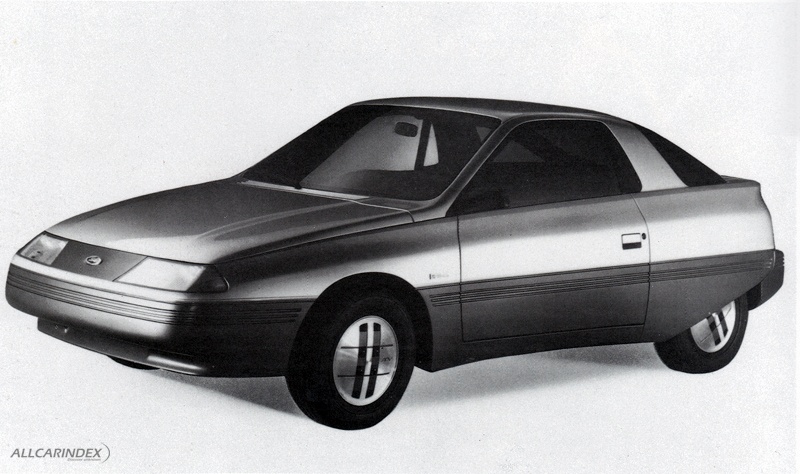
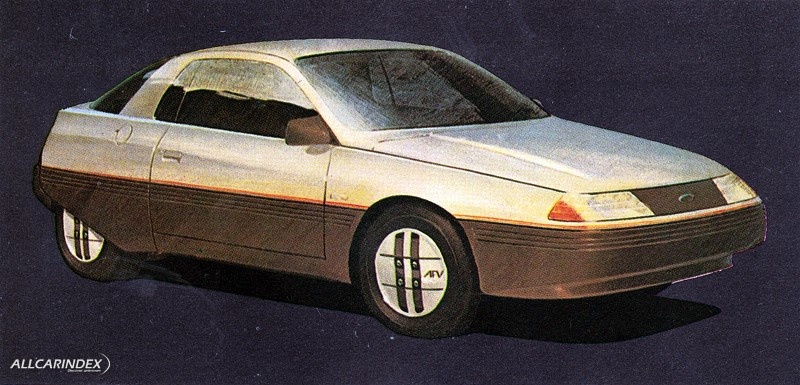
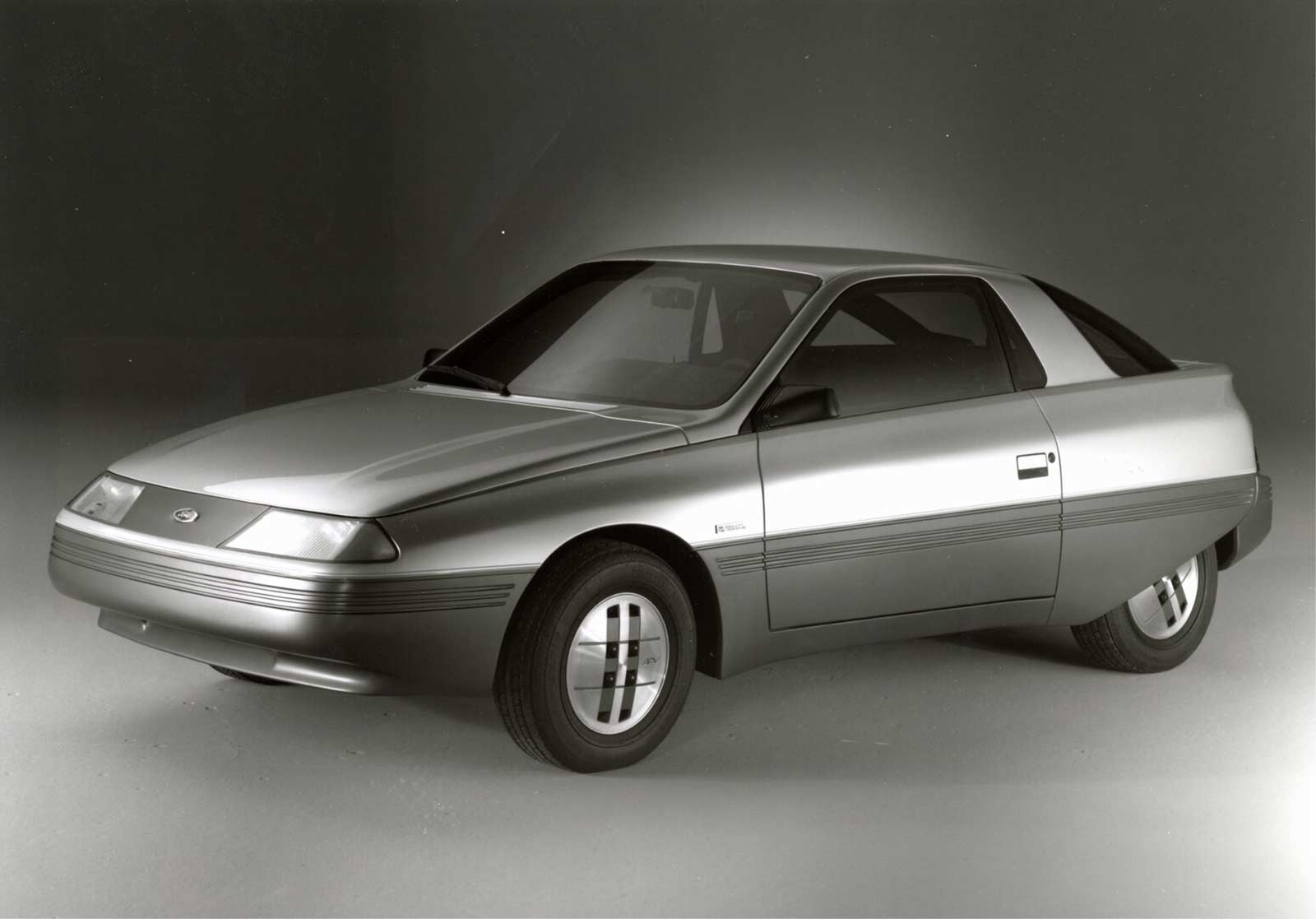
The Ford AFV, short for Alternative Fuel Vehicle, was a two-passenger concept car built by Ford Motor Company to demonstrate the feasibility of running an automobile on fuels other than gasoline, including natural gas or methane, methanol, ethanol and propane. It was unveiled at the Ford Design Center in Dearborn, Michigan, and was announced to make its public debut at the Detroit Auto Show before appearing later that year as a highlight of the Ford exhibit at the Knoxville World's Fair. It was presented as a concept rather than a production vehicle.
Ford Research Vice President Dr. W. Dale Compton described the AFV as a symbol of the company's commitment to developing alternative fuels, stating that the goal was to show that a petroleum shortage need not force Americans to change their basic style of living, given the country's abundant alternative energy resources such as coal, natural gas, lignite, tar sands, oil shale and solid wastes, as well as renewable resources including grain and vegetable matter. He noted that U.S. natural gas resources were estimated at 1,000 trillion cubic feet, enough to last 50 to 60 years at then-current consumption rates, and that Ford intended to be able to build vehicles running efficiently on whichever fuel or fuels eventually replaced or supplemented gasoline.
Thomas J. Feaheny, Ford's vice president of Vehicle Research, said methanol, or wood alcohol, was seen internally as having the greatest long-term potential as a petroleum replacement because it could be produced from coal, but noted that natural gas, or methane, was already available in volume across virtually every urban area of the United States and was cheaper than gasoline even accounting for anticipated price increases from deregulation. He said the equivalent cost of methane at the time was comparable to paying 90 cents a gallon for gasoline, and that even after decontrol of methane prices by 1990 it was expected to remain 15 to 20 percent less expensive than gasoline.
At the time of the AFV's unveiling, Ford noted it had already begun production of propane-fueled Ford Granada and Mercury Cougar models for sale in Canada, with the same vehicles due to be offered in the United States, and had started production of propane-fueled medium- and heavy-duty trucks the previous year, described as the first factory-engineered propane vehicles offered by a North American manufacturer. Ford also stated it had sold more than 40,000 ethanol-fueled cars in Brazil and was collaborating with the State of California and Los Angeles County on a fleet of 40 methanol-fueled Escorts.
Mechanically, the AFV used a Ford CVH 4-cylinder engine of 1597 cc mounted at the front and driving the front wheels, modified to run on alternative fuels. To take advantage of the higher octane ratings of alcohol and gas fuels compared with gasoline, methane's octane rating of 130 versus gasoline's 91, the compression ratio was raised from 8.4:1 to 13.6:1. The carburetor was replaced with a fuel-metering system designed to handle gaseous fuel, a pressure-reducer regulator was added, and the camshaft was modified to improve low-end torque. For methanol operation, the fuel-delivery system had to be altered separately from the gas-fuel configuration.
Because methane has relatively low energy density, it was stored on board at high pressure, 2500 psi, to achieve a workable driving range; this provided an energy equivalent to 6.6 gallons of gasoline. The AFV was estimated to achieve the equivalent of 32 miles per gallon in city driving, giving a cruising range of about 210 miles in city conditions. Three tank cylinders for methane storage were mounted transversely to the vehicle's axis in a fully shielded compartment behind the two individual seats, with aluminum fuel tanks isolated from the passenger compartment by a sheet-metal casing so that any fuel leakage would vent harmlessly outside the vehicle. Ford also presented a compressor unit that would allow owners to refuel the car with natural gas or methane at home, using the same fuel used to heat homes, freeing owners from reliance on gasoline stations. Ford stated that refueling this way would take about four hours, half the time needed to recharge a conventional electric car's batteries, while offering two to four times the range and considerably more performance than an electric vehicle, with a lower cost anticipated in mass production.
In terms of design, Ford Design Vice President Donald F. Kopka said aerodynamics guided the AFV's development from its earliest sketches, with the objective of creating a sporty urban car. The result was a wedge-shaped coupe with a sleek, rounded look, flush glass, a front spoiler, rear fender skirts and a sloping hood, along with a dome-like wraparound rear window and largely enclosed rear wheels. Because the AFV was front-wheel drive, there were limits to how sharply the hood could slope; to maximize this, engineers developed a side-draft fuel-metering system that reduced engine height by at least two inches, helping achieve the lowest possible hood line. Kopka noted that Ford measured aerodynamic efficiency using a metric called aero horsepower, the power required to move a vehicle at 50 miles per hour on level highway, calculated from the frontal silhouette area, the coefficient of drag and a constant air-density factor. He compared the AFV's rating of 5.0 aero horsepower and drag coefficient of 0.32 to a mid-sized car like the Ford Fairmont at around 7.7 aero horsepower, and to the Mercury LN7 subcompact, one of the best in the domestic industry, at 5.3. Kopka said further modifications, including an underbody shield, a radiator support flange shield, a mid-chassis underbody shield for the exhaust tunnel, and a rear deck edge treatment, could reduce the AFV's drag coefficient to 0.28 and its aero horsepower to 4.4.
The AFV's compact body was a three-door coupe seating two occupants. Without the methanol tank configuration, the packaging was said to have allowed room for two additional child seats, or alternatively for the installation of a mid-mounted engine.
Dr. Compton acknowledged that significant obstacles remained before alternative fuels could be adopted at scale, chiefly the capital required to build production and distribution infrastructure, particularly for alcohol fuels. He said Ford preferred a free-market approach to financing such infrastructure but acknowledged the market might not react quickly enough to prevent supply interruptions, suggesting government could help by fostering dialogue between energy producers and automakers. He noted Ford had already held preliminary discussions with alcohol and natural gas producers and found shared interest in these issues. The AFV remained a concept vehicle and was not put into production.