
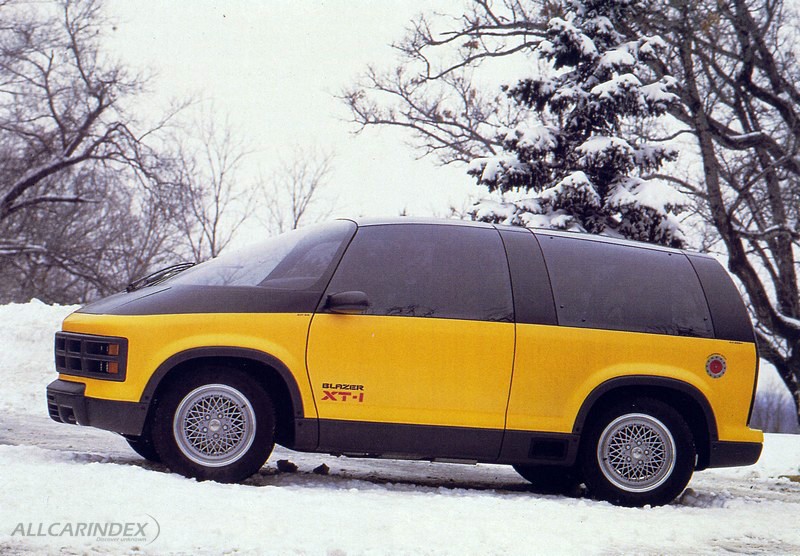
The Chevrolet Blazer XT-1 was a concept vehicle created by the Advanced Vehicle Engineering team within General Motors' Truck & Bus Group, developed at a time when concept studies were uncommon in the sport utility vehicle segment. The project moved from initial design to road testing in about a year, with involvement from more than a dozen GM divisions and suppliers. In size it sat between the Blazer S-10 and the Astro. Visually it appeared relatively conventional apart from its heavily glazed, curved upper body, though its far-forward panoramic windshield gave it the profile of a one-box design.
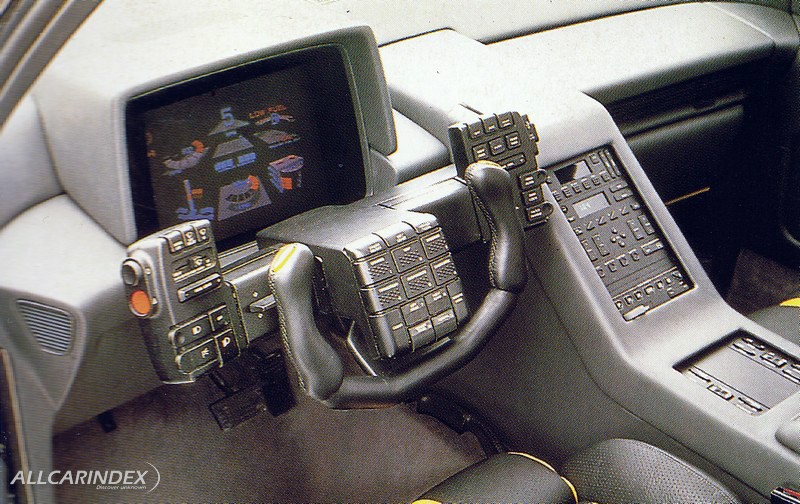
Unlike production Blazers, which used solid axles and part-time front-wheel drive, the XT-1 featured independent suspension at all four corners and automatic four-wheel drive. It also used a steer-by-wire four-wheel steering system with no mechanical linkage, operating each wheel independently through four 24-volt motors, with steering angle calculated electronically based on driver input, wind effects, road gradient, speed and other factors. Instead of a steering wheel, the driver used a semicircular aircraft-style control handle. Front wheels could turn up to 35 degrees and rear wheels up to 18 degrees, improving stability, easing tight-space parking, and reducing tire wear and cornering noise. The system was paired with Goodyear P225/65 RH17 tires suited to mixed off-road and on-road use, four-wheel disc brakes with ABS and front slip control from Delco Moraine, and a self-leveling system that could lower the body to 2.5 cm off the ground for easier entry or raise it about 10 cm for off-road clearance.
Power came from a newly developed 4.3-liter aluminum V6 from the CPC Truck Engine Group, derived from the Vortec V6 used in the Chevrolet Astro and C/K pickup, fitted with port fuel injection and distributorless ignition, producing 205 hp at 5000 rpm and 345 Nm at 2500 rpm. It drove through a new electronically controlled four-speed automatic from the Hydra-Matic division and a Borg-Warner transfer case with a 2.48:1 low-range ratio, engaging four-wheel drive automatically via sensors and computer-controlled torque distribution of up to 30 percent to the other axle.
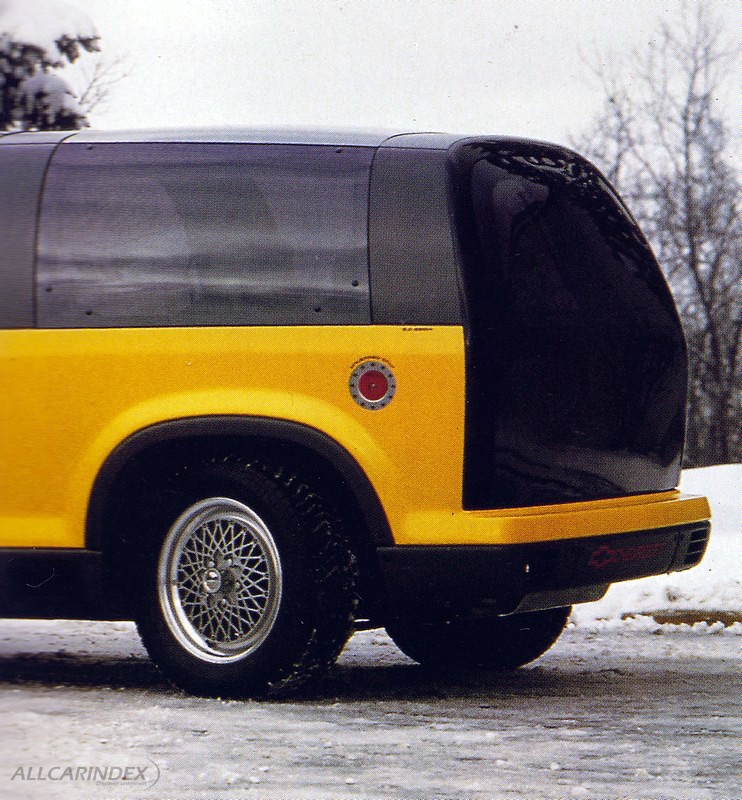
The interior featured a three-dimensional instrument display called Futurevision, using flat CRT monitors to show speed, drivetrain, steering, suspension and electrical data, plus a compass and diagnostic functions, supported by around 30 onboard computers, a multiplex wiring system, and an unusual 24-volt nickel-zinc battery system. Additional features included remote/electronic door locks, climate and audio controls, partly removable side windows, quad-headlamp clusters within a Blazer-style grille, distinctive taillights, a pop-up roof-mounted spotlight, and an all-glass tailgate. The body combined a steel structure with fiberglass panels inside and out, some plastic underbody components, and rear suspension arms derived from the Corvette using graphite-reinforced fiberglass. It measured 431 cm long, 187 cm wide and 170 cm tall, with a 262 cm wheelbase, and rode on a three-door, four-seat layout.