


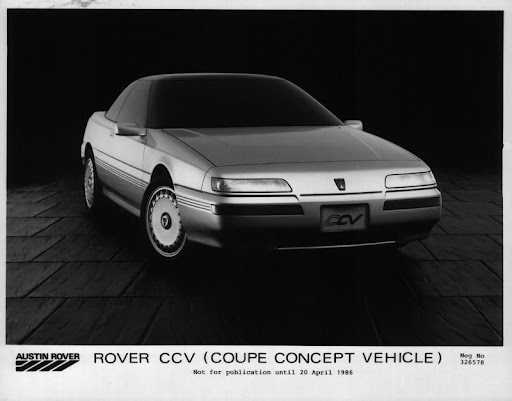
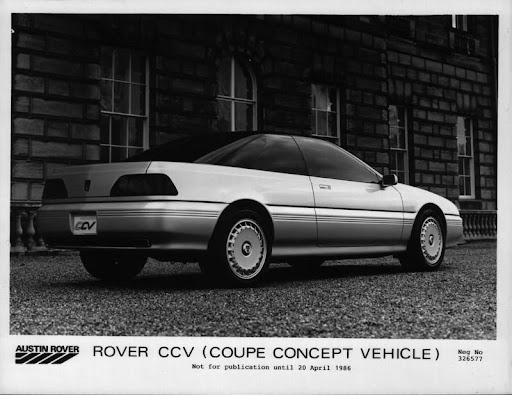
The Rover CCV, or Concept Coupé Vehicle, was a design study shown by Austin Rover at the Turin motor show, appearing three months before the world premiere of the Rover 800, which had been developed jointly with Honda. Turin was chosen for the unveiling because the city was regarded as a center of automotive design, and Austin Rover wanted to demonstrate its design capability there. The CCV was created by the same design team responsible for the MG EX-E, which had been presented around half a year earlier at the Frankfurt IAA. Unlike the forward-looking EX-E, the CCV stayed close to a production model that was imminent, and designer Richard Hamblin suggested the coupe could have entered production in 1989 depending on market reaction. Its front-end styling drew stylistically on the Fastback Rover SD1, while the car was effectively a coupe successor to the Rover 800, whose development had begun three years earlier.
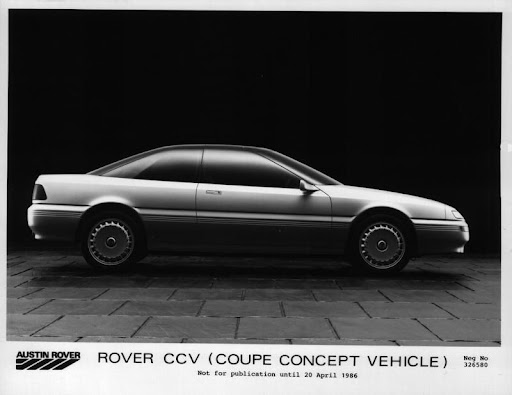
The four-seat coupe was built with a plastic body and had a drag coefficient of 0.27. It shared its 276 cm wheelbase and alloy wheels with the production Rover 800 and Honda Legend saloons, though the plastic bodywork and longer doors differed from the standard car, and the bumpers were made of deformable plastic material fitted with shock absorbers. Power came from the same drivetrain as the Honda Legend/Rover 800, a transversely mounted 2.5-litre V6 producing 165 PS at 6000 rpm and 210 Nm at 4500 rpm, while the suspension was Rover's own design. The CCV added a computer-controlled damping system that switched automatically between comfort and firm settings, adjustable ground clearance, an adjustable front spoiler angle, and speed-sensitive power steering. Entry was controlled by an Austin Rover-developed magnetic key system with memory settings for four users, adjusting seats, mirrors and climate control automatically.
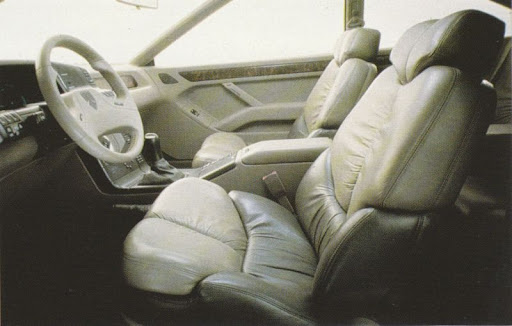
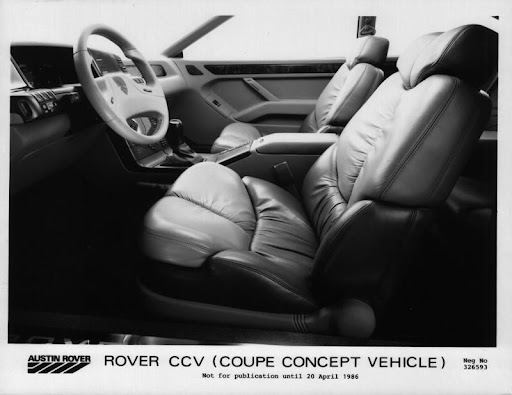
The cabin featured specially made leather seats with horizontally split cushions and backrests, mounted on lowered Rover 800 seat frames, along with walnut wood inlays on the dashboard and door interiors. The electronic LCD instrument display resembled that of the MG EX-E but used circular main gauges surrounded by additional monitoring displays. Front occupants had a telephone and a hi-fi system with CD player, while rear passengers were provided with a small television and video player. The car measured 470 cm long, 177.5 cm wide and 150 cm high, with a wheelbase of 276 cm, a track of 150 cm, and a weight of 1120 kg.


