
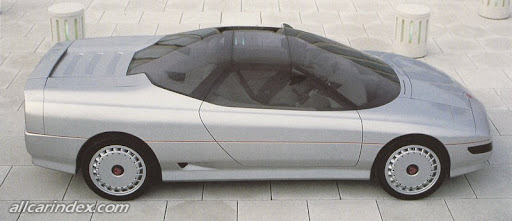
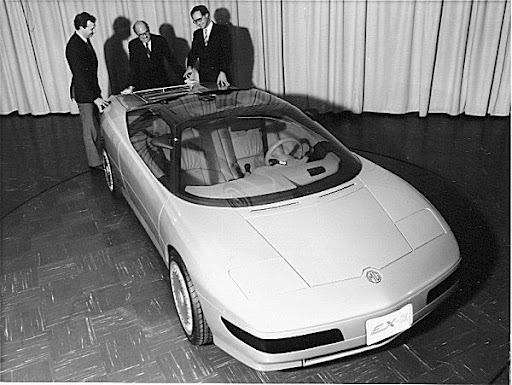
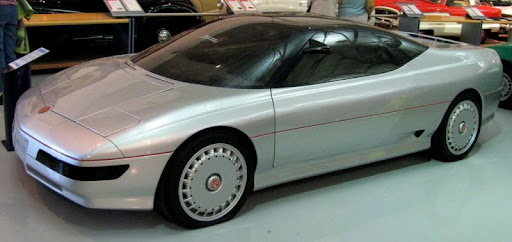
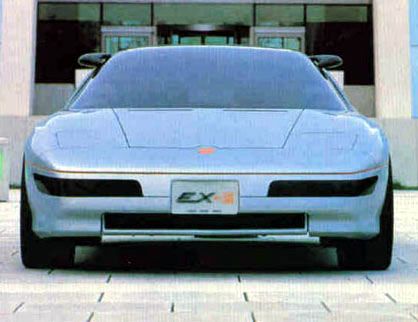
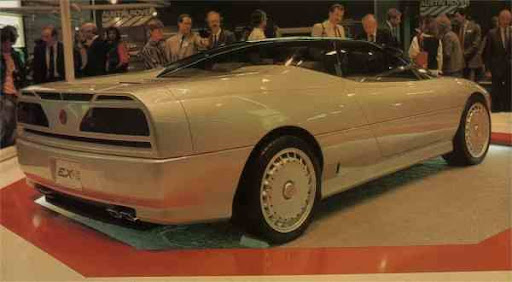
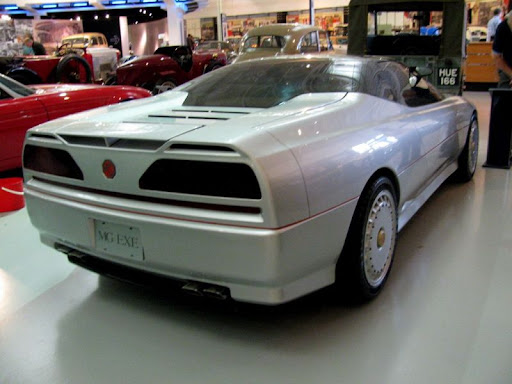
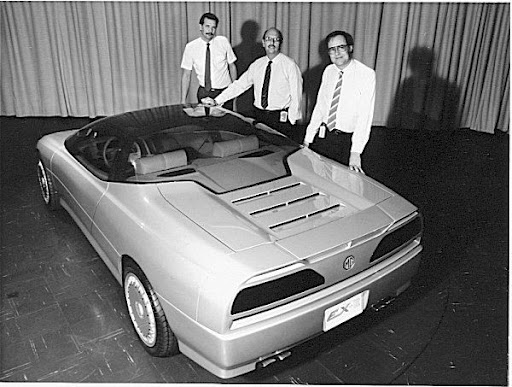
The MG EX-E was a two-seat, mid-engined concept coupe developed by the Austin Rover Group and shown as a world premiere at the Frankfurt International Motor Show in 1985. It was designed under Roy Axe at Austin Rover's studio in Coventry. The name combined "EX" for Experimental with an appended "E," continuing the postwar sequence of MG two-seaters that had begun with the MGA. Its appearance came at a time when MG had no sports car in production, the MGB having ended in 1980 and the related Triumph TR7 Cabriolet following in 1981, though Austin Rover gave no indication that the EX-E itself was intended for series production, even as the possibilities of building and marketing it were seriously studied internally.
The car used the drivetrain from the MG Metro 6R4, a Group B rally car with four-wheel drive. While the 6R4's 3-litre V6 produced 416 hp in rally trim, the EX-E's version of the same DOHC 24-valve engine, later associated with the R64 Clubman, was tuned to 253 hp at 7000 rpm and 305 Nm at 4500 rpm. This was claimed to give the aerodynamically efficient coupe a top speed of 275 km/h and acceleration from 0 to 100 km/h in under 5 seconds, a figure notably quoted in metric terms rather than the customary British 0-60 mph measure.
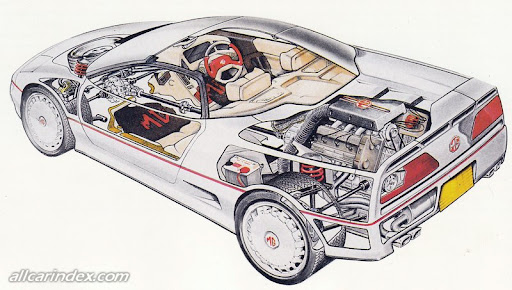
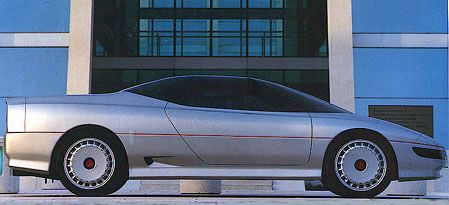
The body followed a wedge shape tapering toward the rear and achieved a drag coefficient of 0.24, developed through wind tunnel work on 1:4-scale models and requiring no separate front or rear spoilers, though a discreet wing was integrated into the tail. Construction relied on a bonded aluminium understructure clad with injection-moulded, coloured polypropylene panels, built up from three pre-assembled modules covering the powertrain and rear suspension, the passenger cell, and the front structure with its suspension and steering. The entire roof area was a removable transparent canopy of polychromatic plastic, tinted darker at the centre and lighter toward the beltline, giving a targa-like effect.
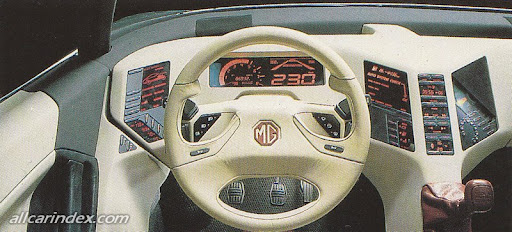
Permanent four-wheel drive was sent through a five-speed gearbox and a viscous-coupling centre differential, with differential brakes for front and rear wheels, double wishbone suspension with coil-over dampers at each corner, and adjustable ride height. Braking used ventilated discs front and rear with anti-lock control, and 215/45 x 17 tyres sat on wheels with turbine-style vaned openings for brake cooling. The interior featured a Vehicle Environment Management System using sensor-read magnetic cards for door entry and ignition, infrared remote central locking, automatic rain-sensing wipers, light-sensitive automatic mirror dimming and exterior lighting, a Reflex Information Monitor for the driver, and a separate passenger-facing screen for navigation and vehicle monitoring. The EX-E measured 4280 mm long, 1850 mm wide and 1170 mm high, with a 2485 mm wheelbase and a weight of 1000 kg. It remained a concept car and was never put into production.