

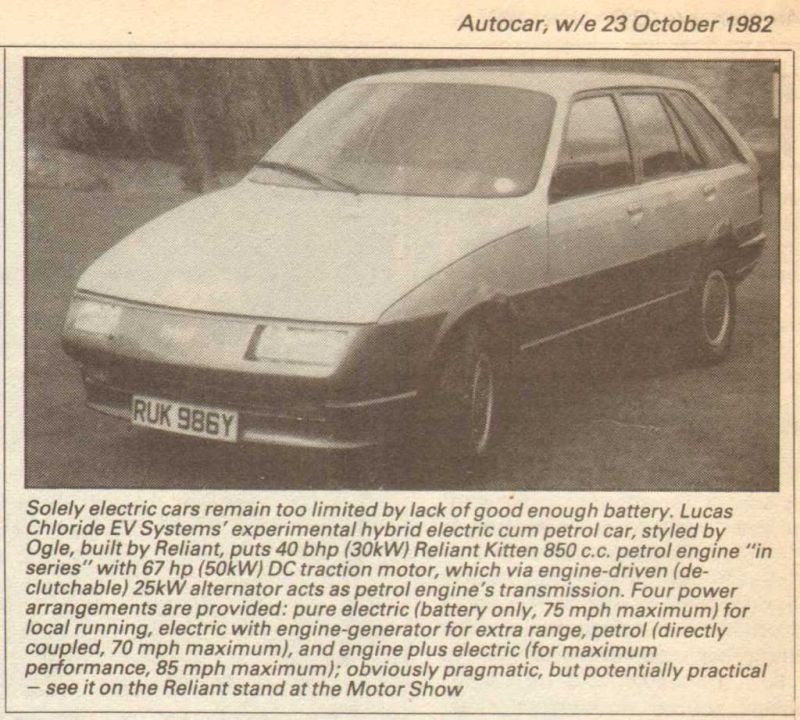
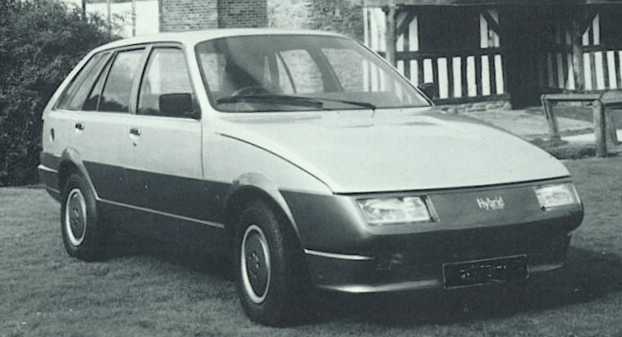
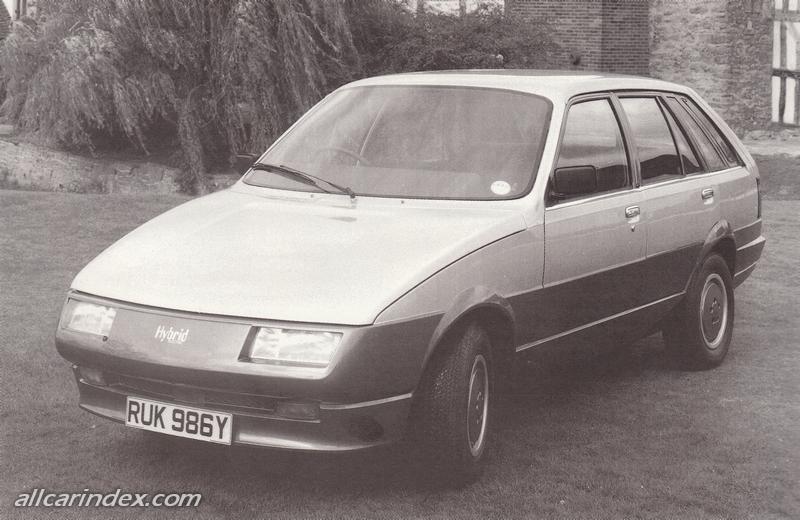
The Lucas Hybrid Electric Car was a research vehicle developed by Lucas Chloride EV Systems Limited, a subsidiary of the British Lucas electrical and automotive supply group, and shown at the Birmingham International Motor Show in autumn 1982. Its body was designed by Ogle Design, the company led by Tom Karen that had previously gained attention with a coupe-bodied Mini and a coupe version of the Daimler SP 250 shown at the 1962 London Motor Show, and which had also become known for its work with Reliant. Because of Ogle's close ties to Reliant, the car itself was built by Reliant, while Lucas supplied the hybrid drivetrain. The project also received financial support from the British Department of Industry.
The vehicle took the form of a five-door, five-seat estate-style body made of glass-fibre-reinforced plastic with steel reinforcement, mounted on a purpose-built box-frame chassis. A pull-out battery pack was integrated into the floor. Elements of the electric drive system, including the motor and its electronic controls, had already been proven in Lucas-electrified versions of the Bedford CF and Freight Rover vans, which had achieved top speeds of 80 km/h and ranges of up to 80 km between charges. Because pure battery-electric drive could not match the flexibility drivers expected from combustion-engined cars, the Hybrid Electric Car combined an electric motor with a petrol engine, aiming to minimize fuel use while maximizing the use of cheap off-peak electricity for daily charging, with the combustion engine extending range on longer journeys or providing higher sustained speed on motorways.
The drivetrain paired a 848 cc, 30 kW (41 PS at 5500 rpm, 62 Nm at 3500 rpm) Reliant petrol engine mounted ahead of the front axle with a Lucas CAV MT305/216/Y2 DC electric motor rated at up to 50 kW, joined by an electromagnetic clutch, along with a 25 kW three-phase generator also supplied by Lucas. Drive went to a rigid rear axle, and the battery pack, consisting of 18 twelve-volt units housed in a drawer between the axles, was positioned to aid weight distribution; an automatic fluid top-up system for the batteries was still under development. Braking used front discs and rear drums combined with regenerative braking that fed current back to the batteries. The body shape was refined through wind-tunnel testing, evident in its rounded front, angled headlamp covers set into the bumper, and a large windscreen with a single wiper arm.
On electric power alone the car could cover 64 km (40 miles) in typical urban conditions before recharging, accelerate from 0 to 80 km/h in 23 seconds (with 50 to 80 km/h taking 14 seconds), and reach 120 km/h; the Reliant engine alone gave a top speed of 113 km/h, while combined operation raised this to 137 km/h. The car measured 437 cm long, 173 cm wide and 158 cm high, on a 254 cm wheelbase with 145 cm track, and weighed 2240 kg. A broadly similar vehicle did not appear again until General Motors presented the HX3 minivan at the Detroit Auto Show in January 1991.