
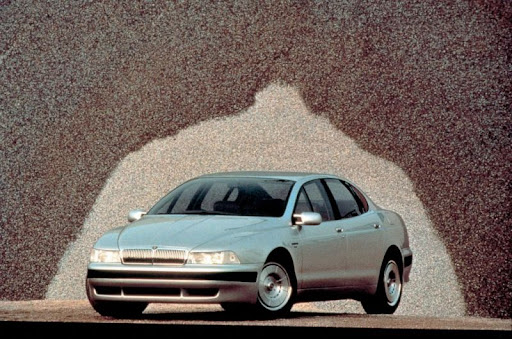
The Jaguar Kensington was a four-door, four-seat concept saloon designed by Giorgetto Giugiaro and his Ital Design studio as a study for a potential successor to the classic Jaguar saloon shape dating back to 1968, which at the time was still produced as the Jaguar V12 and Daimler Double-Six. Giugiaro stated that he created the Kensington on his own initiative, describing it as a gesture of appreciation and friendship toward Jaguar. Its name, chosen to sound distinctly English, referenced the London district.
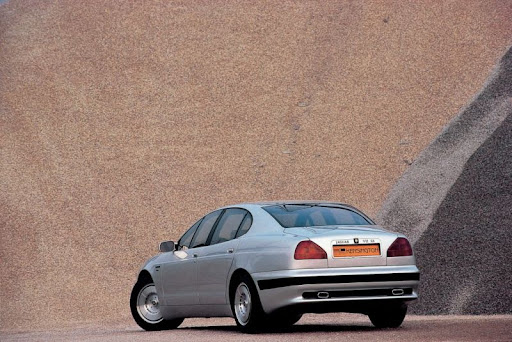
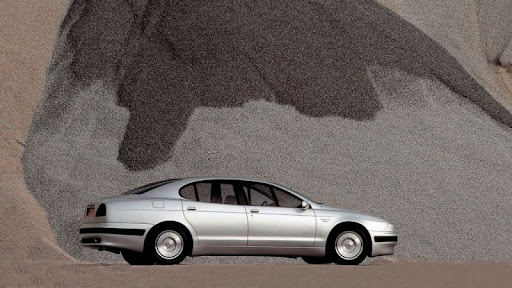
The design retained the four-window saloon body style of the large Jaguar saloons of the era and preserved the characteristic upward kick of the beltline over the rear wheel arch, which was further emphasized by a modern, raised tail. The brand's traditional grille was widened and gently curved to blend almost seamlessly into a rounded front end featuring rectangular headlamp covers wrapped around the corners and a large front apron with three continuous air intakes. Side skirts tapering downward and a rear apron gave the body a unified, enclosed look. The curved side glass echoed the rounded silhouette of the Jaguar Mark 2, while the rear roof pillars and windscreen were set at a notably steeper angle. Some observers noted a resemblance to the softer, curved styling of the BMW 7 and 5 Series of the period, as well as similarities in overall side-view shape to the smaller Seat Proto T concept shown at the 1989 Frankfurt motor show.
Giugiaro carried over the floorpan of the Jaguar V12 largely unchanged, but replaced its twin side-mounted fuel tanks with a single central 100-litre tank positioned behind the rear seats. This improved passive safety and weight distribution and allowed the rear overhang to be shortened by 18.5 cm, while significantly increasing luggage capacity. Because of the more aerodynamic nose, overall length was reduced by only 6 cm compared with the Jaguar V12, while the curved roofline increased overall height by 2.5 cm.
The leather interior carried Jaguar's design language, with the dashboard and door trim blended through smooth transitions and instruments grouped within an elliptical design element that was echoed in the shape of the glovebox opening. The steering wheel featured a new design while remaining Jaguar-like in character. Equipment included a JVC audio system with CD player, a mobile telephone, a fax machine housed in the continuous center console, and a cooled bar compartment under the rear armrest.
Technically the Kensington used the Jaguar V12 engine, a 5343 cc unit producing 295 hp at 5500 rpm and 432 Nm of torque at 3250 rpm, paired with a three-speed automatic transmission and rear-wheel drive. It had a wheelbase of 286.5 cm, a track of 148/149.5 cm, and overall dimensions of 490 cm length, 177 cm width and 140 cm height, with a top speed exceeding 235 km/h.