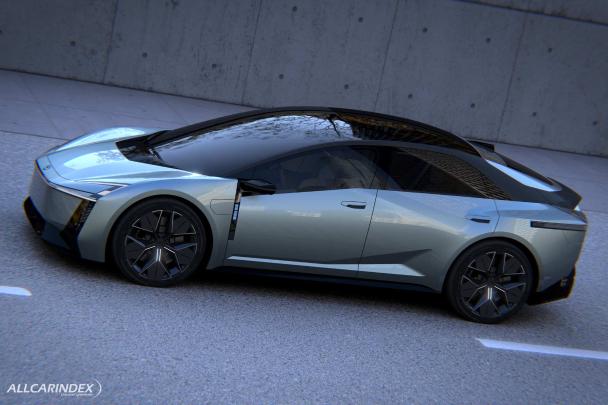

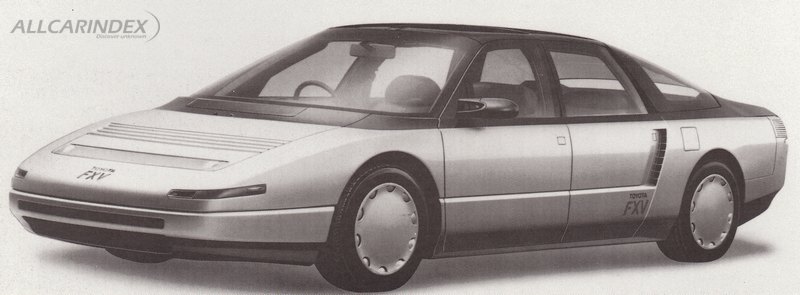
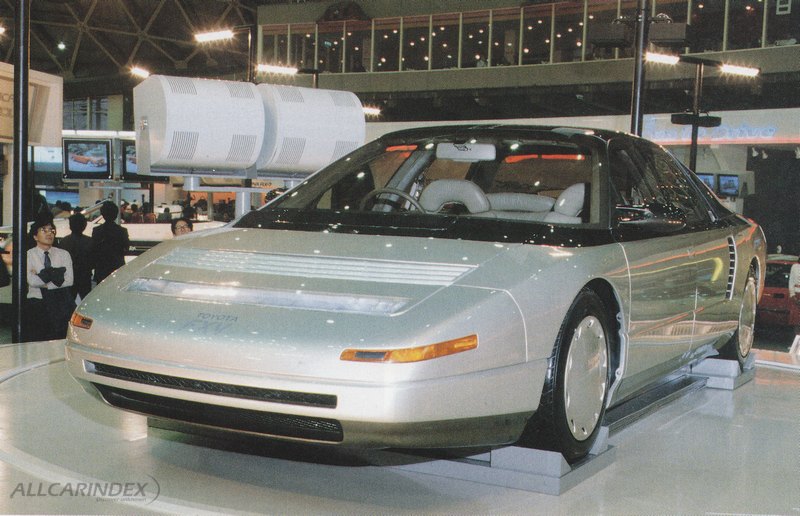
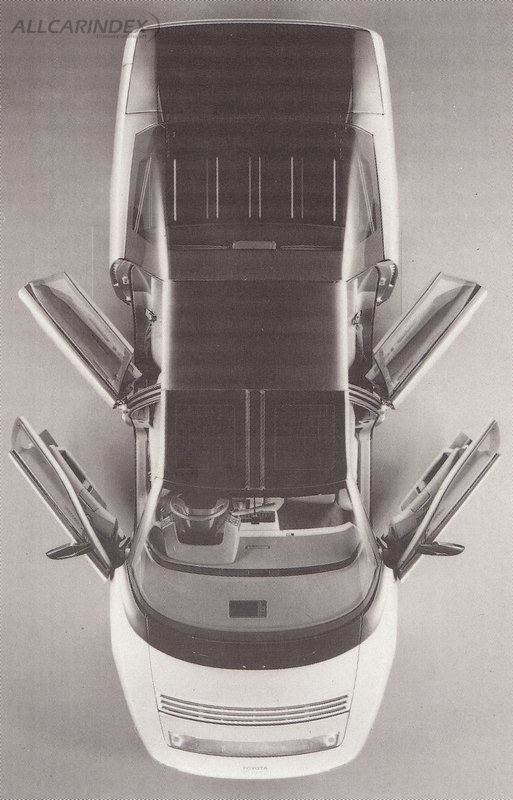
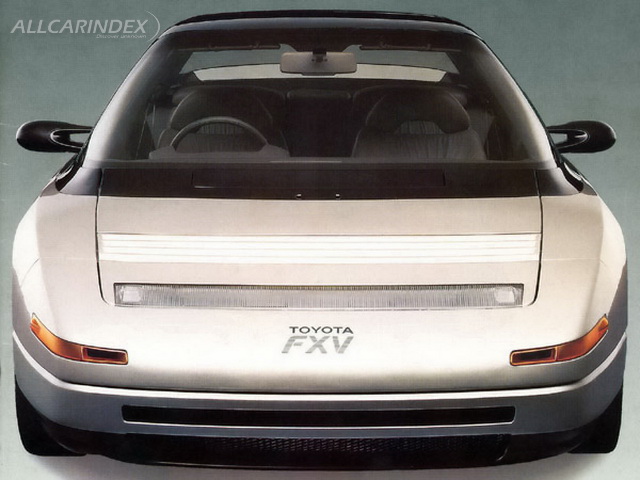
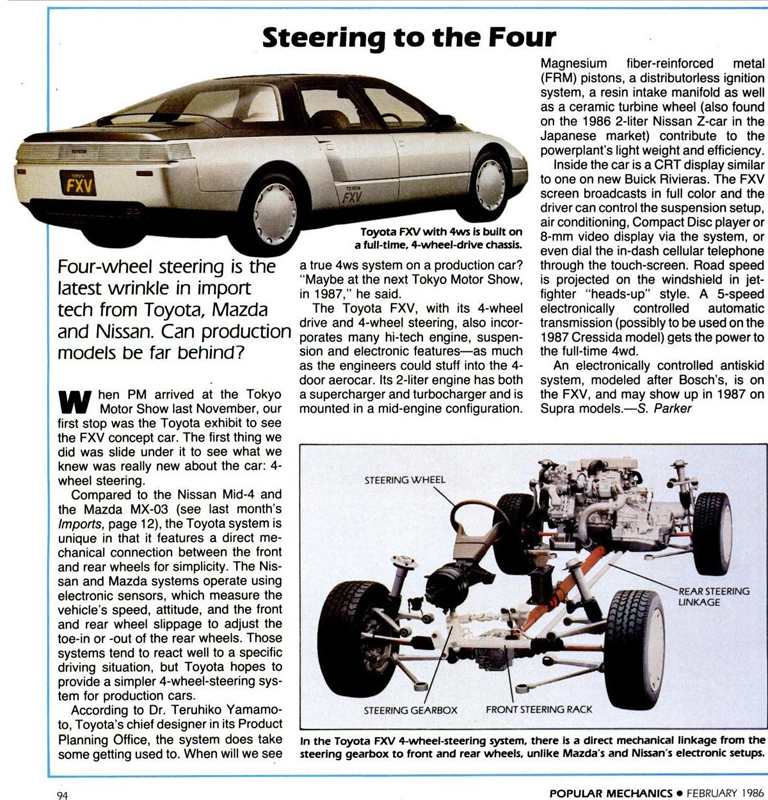
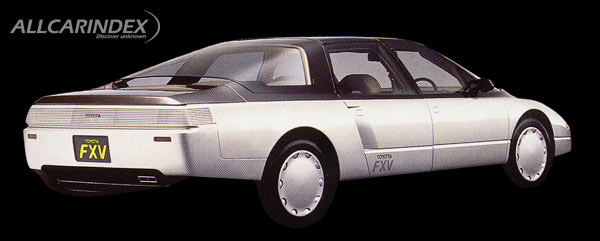
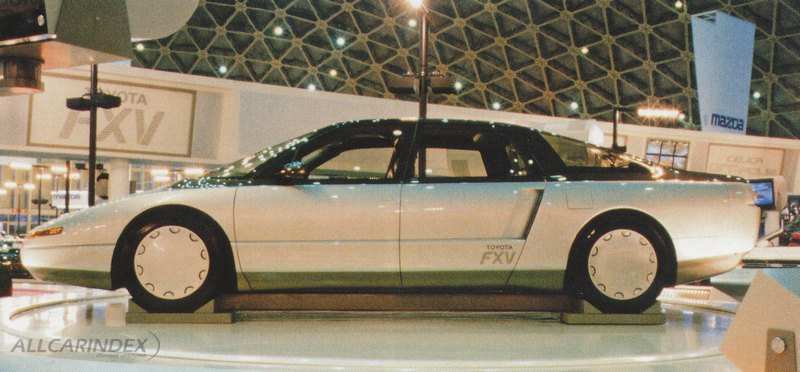
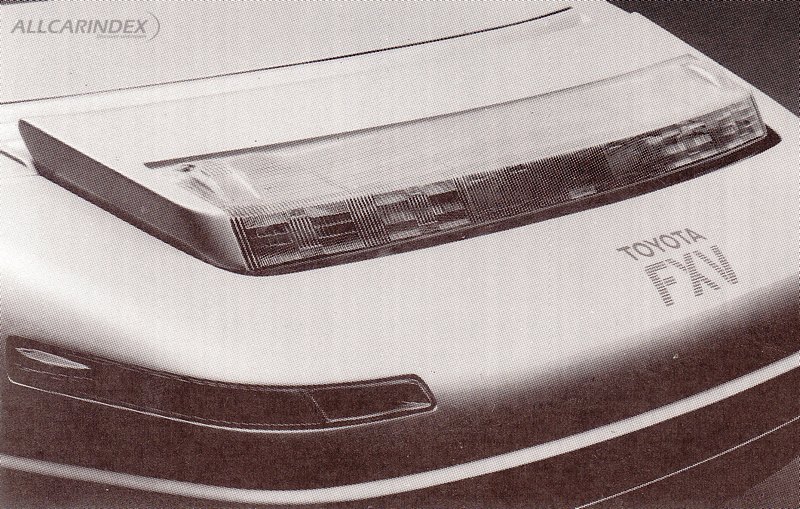
The Toyota FXV, whose name stood for Future Experimental Vehicle, was a concept car built as a large streamlined saloon with four doors and four seats. Its low front end and the side air intake ahead of the rear wheels signalled a rear-mounted engine layout, and its shape recalled the large streamlined saloons of Tatra. Despite this rear-engine configuration, the FXV was fitted with four-wheel drive along with a range of advanced technology. The body combined a metal structure with lightweight plastic outer panels and achieved a drag coefficient of 0.24 through details such as flush, rounded window glass, a flat nose, retractable headlamps, a wiper hidden beneath a flap, mirror housings with air vents, flat wheel covers and a flattened underbody that rose toward the rear. The front end lowered automatically at higher speeds, and, as on the earlier FX-1, a shape memory alloy system opened and closed the radiator grille according to cooling needs. A newly developed headlamp unit rose out of the front hood as a single housing when switched on. The window glass carried a heat-reflective metal coating, and 48 solar cells built into the glass roof charged the battery and triggered automatic interior ventilation in hot weather once the driver's door was opened. Liquid-crystal exterior and interior mirrors reduced glare, and the tail lights used LED technology.
The FXV was powered by a transversely mounted mid-engine positioned behind the rear seats, a 1998 cc four-cylinder DOHC unit with 16 valves, combining a Roots-type supercharger with an exhaust turbocharger and set up for partial lean-burn operation to deliver 230 hp at 6400 rpm and 295 Nm of torque at 4000 rpm. Special features included an electronic throttle, contactless ignition, a Karman-type air flow meter, magnesium FRM pistons, a plastic intake manifold, a ceramic turbine wheel and ceramic-coated exhaust pipes. Drive went through a 5-speed electronically controlled automatic transmission (ECT) to a permanent four-wheel-drive system with a center differential lock. Double wishbone suspension was used at all four corners, with parts made of forged aluminum to cut unsprung weight, along with electronically modulated hydropneumatic springing. Four-wheel steering worked in phase at higher speeds for stability and out of phase at low speeds for easier maneuvering, and the car rode on 220/55 VR 390 safety tires with an ESC-ABS system, with tire pressure loss shown through a multifunction display.
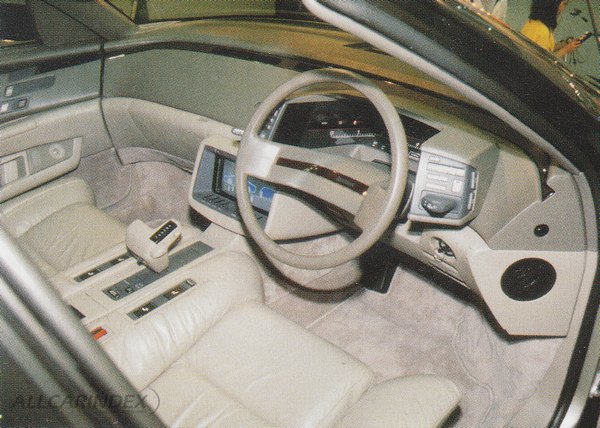
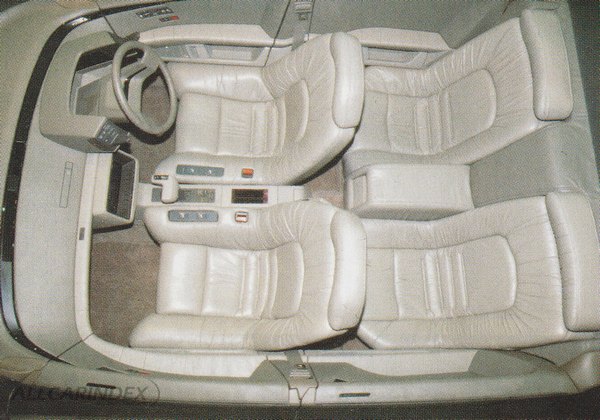
Inside, a 10-inch touchscreen on the center console linked a CRT computer, TV tuner with video, and CD player, serving as an information and navigation system, warning display, and control for audio, climate and the car telephone, with speed and warnings also projected onto the windscreen and relayed by synthetic voice. The automatic climate control could switch between fresh and recirculated air using an exhaust and dust sensor. The cabin held four individually shaped comfort seats, with doors that opened automatically at the touch of a switch, swinging outward and sliding forward, while roof sections above the front doors lifted upward and the driver's seat and steering wheel adjusted automatically for entry. The FXV measured 4785 mm long, 1800 mm wide and 1270 mm high, with a 2700 mm wheelbase and a track of 152 cm.