
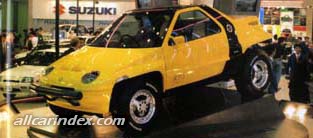
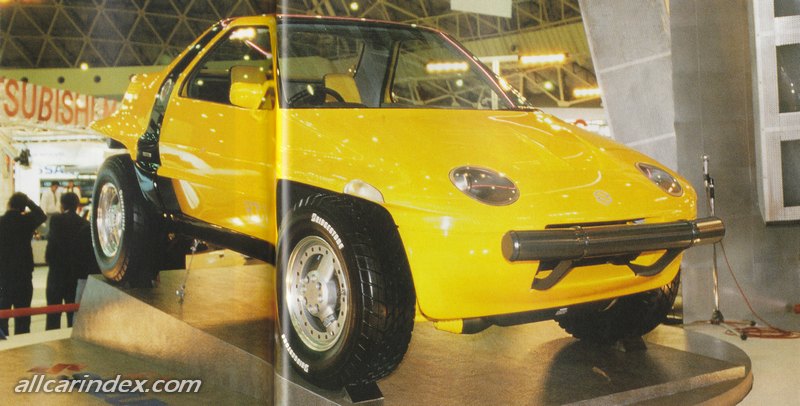
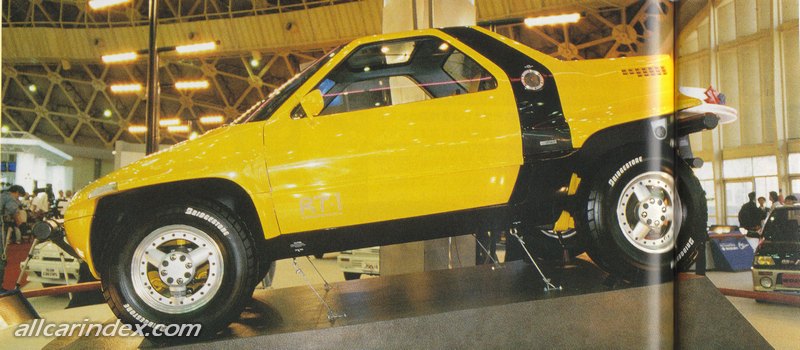
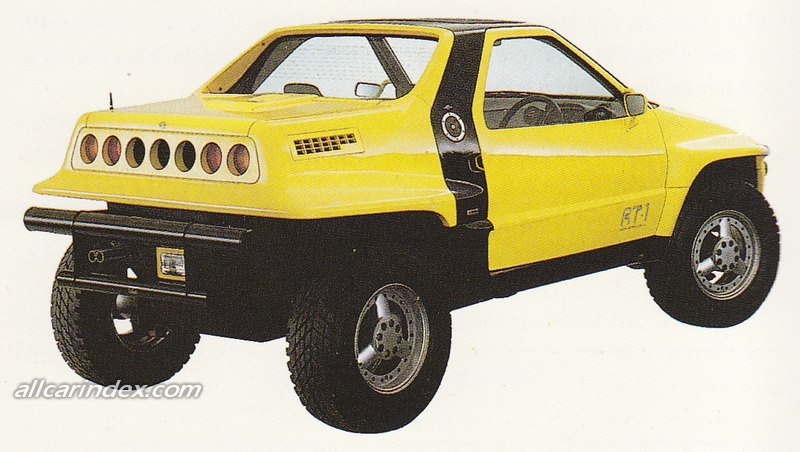
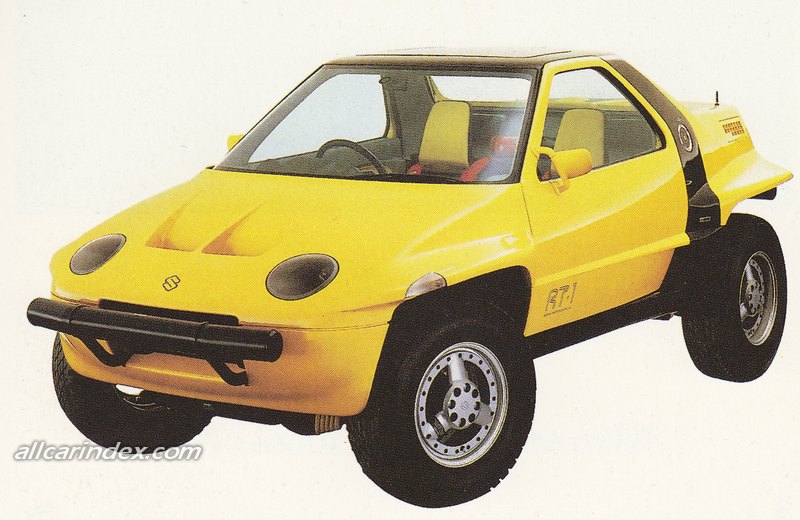
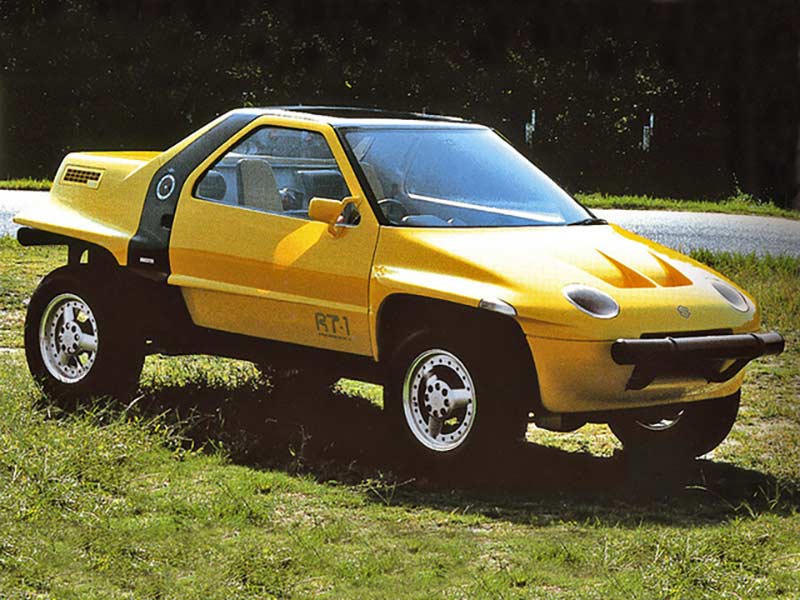
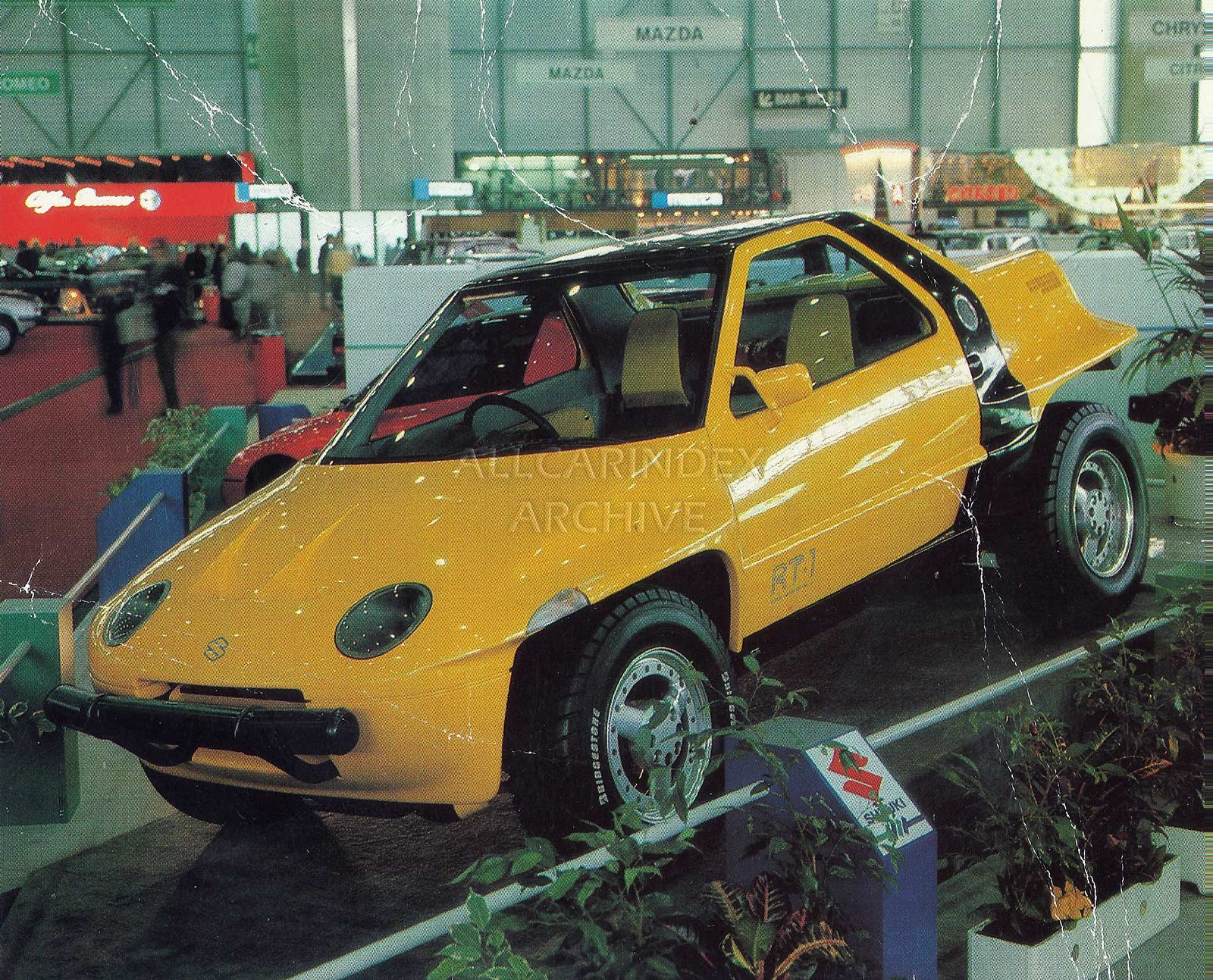
The Suzuki RT-1, known in Japan as the スズキRT-1, was a concept car shown at the Tokyo Motor Show toward the end of the 1980s, at a time when off-road sports cars existed mainly as show vehicles rather than production models. It was presented as a compact but capable off-road sports car, combining a raised ride height with an aerodynamic shape. Despite Suzuki's typically compact dimensions, the RT-1's overall length of 370 cm exceeded that of the Suzuki Escudo (sold in Europe as the Vitara and in the United States as the Geo Tracker), which launched in summer 1988. Unlike the Escudo, the RT-1 was not derived from a production platform and was instead built as a small mid-engined car.
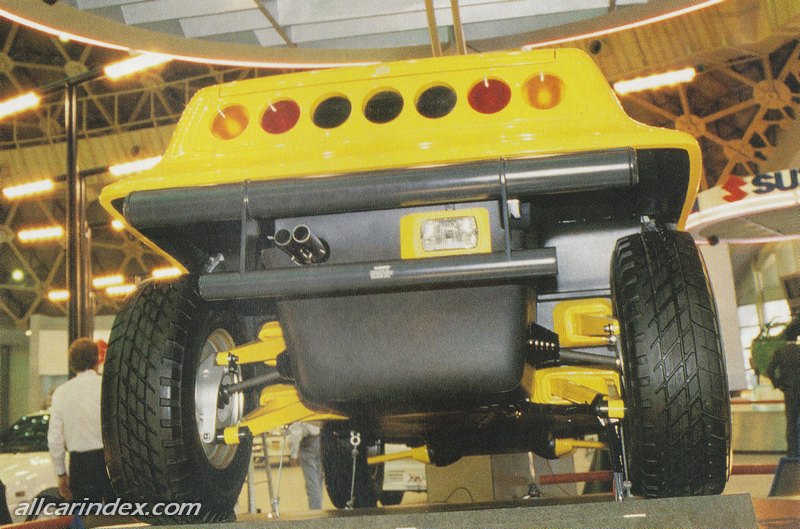
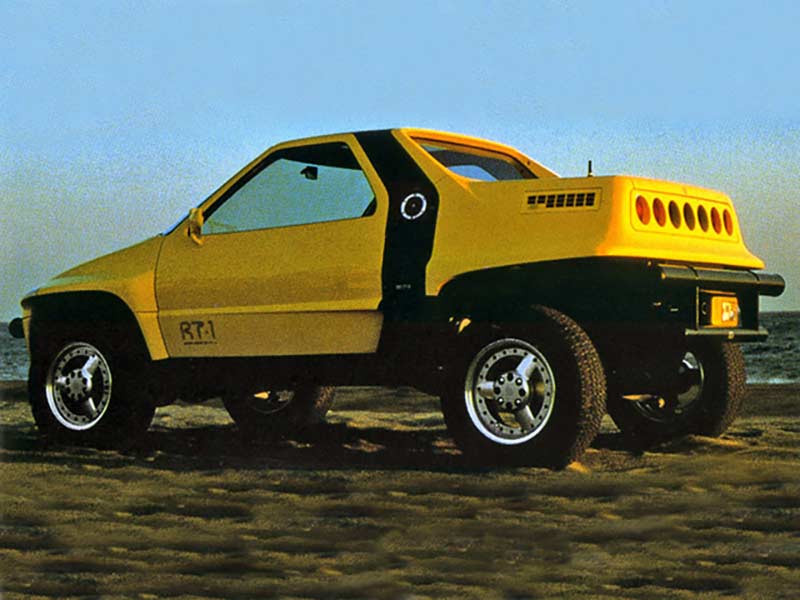
Its design featured a wedge-shaped front with a windscreen set almost in line with the bonnet, a rounded nose with a tubular bumper, and headlights housed under circular covers. Cooling air drawn in at the front was vented back out through the front of the bonnet, in the style of racing sports cars. Horizontally cut wheel arch bulges covered only the tops of the rear wheels, and a contrasting stripe running across the bodywork concealed a lightweight carbon-fibre rollover protection structure anchored to the chassis frame, forming an actual safety cage. The center section of the roof was removable.
The RT-1 used a newly developed 1.6-liter longitudinally mounted mid-engine with two camshafts and 16 valves; Suzuki did not disclose power output, though it was believed to produce well over 100 hp. Power went through a six-speed gearbox and a central differential to permanent four-wheel drive. The front wheels were located by upper and lower wishbones with horizontally mounted dampers to maximize ground clearance, while the rear used double trailing arms with variable camber, a configuration Suzuki's engineers described as an innovation in four-wheel-drive geometry intended to maintain grip even in hard cornering. A hydraulic self-leveling system was also fitted. Minimum ground clearance was given as 25 cm, and 30 cm under the floor.
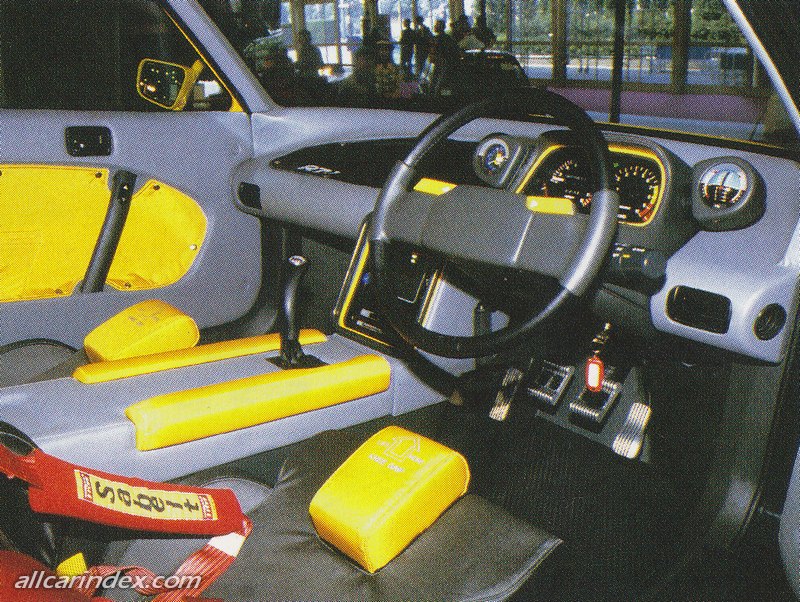
All four brakes were ventilated discs mounted inboard rather than at the wheels. Alloy wheels carried 225/75 R15 front and 245/75 R15 rear tires. The two seats were elaborately shaped and covered in a specially modified water-repellent, breathable material called Istofron, made by the textile company IST, and fitted with four-point harnesses. In addition to conventional instrumentation, the car featured a Play Assist System (PAS), incorporating a screen in the center console that Suzuki described as giving the RT-1 its own computerized route diagram, said to be possibly the only such system in the world. It allowed drivers to carry out various electronically logged driving exercises, including off-road, orientation, and rally-style runs, with a printer producing results and scores. The body was a two-door, two-seat off-road sports design, with a wheelbase of 235 cm and a track of 140 cm.