
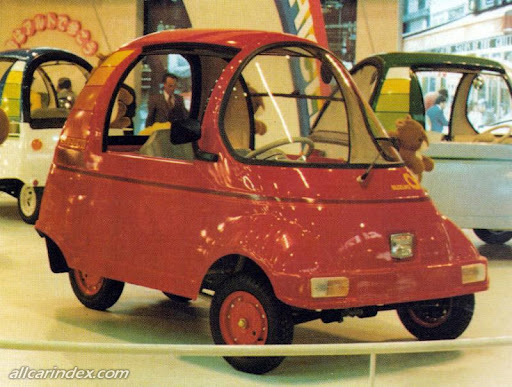
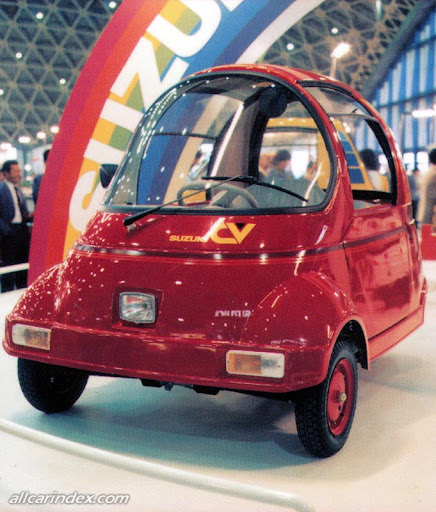
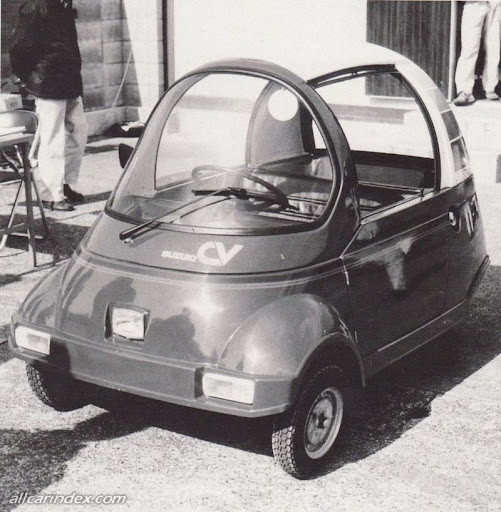
The Suzuki CV-1, whose original Japanese name was スズキコミュニティヴァークルCV-1 (Community Vehicle CV-1), was a one-off single-seat microcar concept shown by Suzuki at the Tokyo Motor Show in autumn 1981. Suzuki, known for motorcycle production and, since 1955, for its Suzulight small cars with two-stroke engines, displayed several examples of the CV-1 alongside its regular production models, presenting them on a kind of carousel rather than a conventional stand.
The CV-1 was a one-box microcar with a single door, fitted only on the left-hand side to suit Japanese left-hand traffic, and center-mounted steering for its lone occupant. It featured a panoramic front windscreen and a roof that curved in a bow shape along its length, and its right-side window could be slid upward into the roof. Its bodywork measured 1900 mm long, 1180 mm wide, and 1280 mm high.
Power came from a 49.9 cc single-cylinder two-stroke engine driving the rear wheels through an automatic three-speed transmission. The rear track was noticeably narrower than the front. The car weighed just 145 kg and was said to be limited to a top speed of 30 km/h. In 1982, Suzuki, then the second-largest motorcycle maker after Honda, reportedly considered production and export plans for the CV-1, aimed at minimal-car buyers and motorcyclists seeking weather protection, though the car's low performance limits made large-scale demand unlikely.