
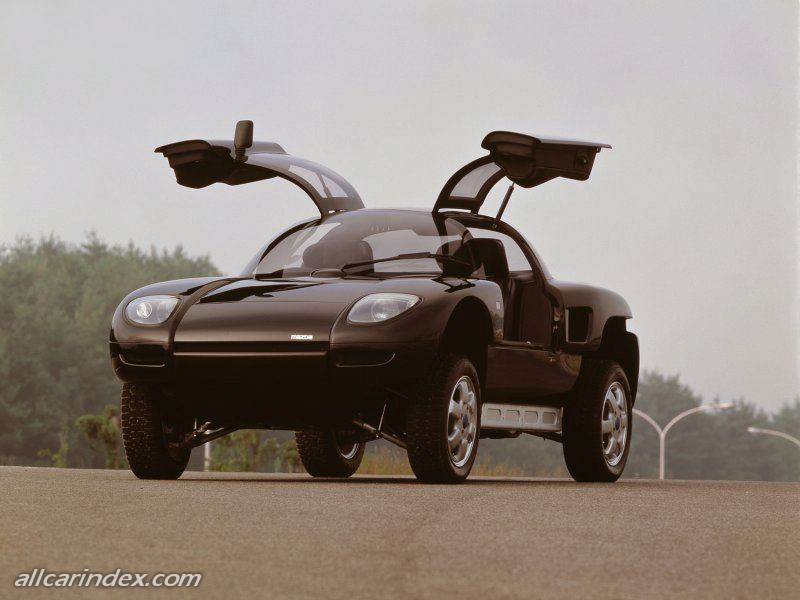
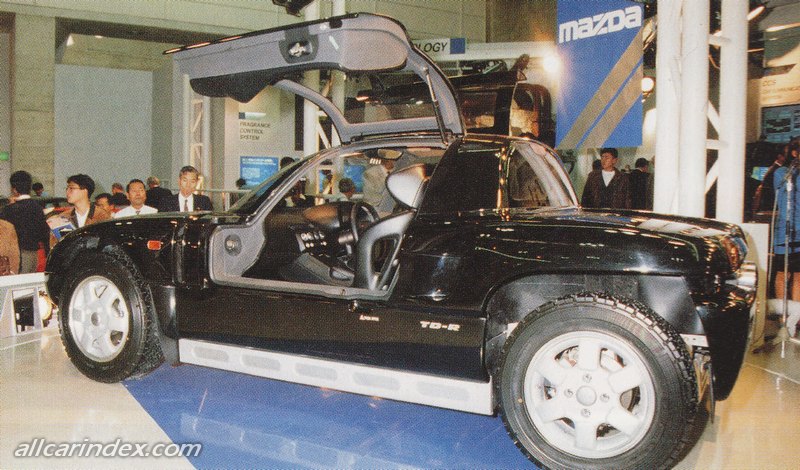
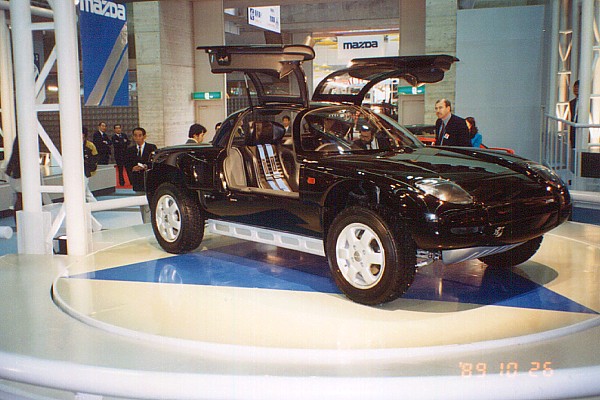
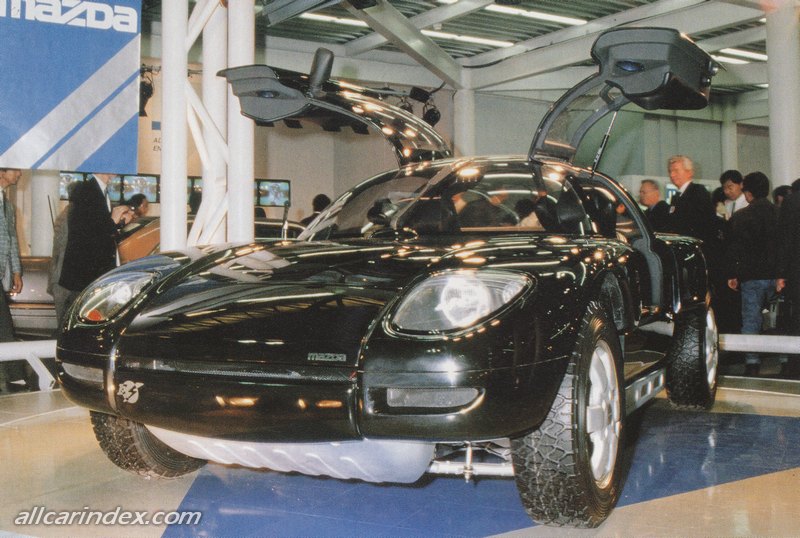
The Mazda TD-R was a concept car combining a rounded, aerodynamic sports car body with a raised, off-road-style underbody, intended to suggest suitability for desert rallying events such as the Paris-Dakar. For road and track use, its ride height could be lowered to normal levels. It was conceived purely as a concept study and never entered production. Mazda suggested it would have made an effective Group B rally car had that category still been permitted, and noted its layout could also have suited events such as the Pikes Peak hill climb in the United States; in competition, Mazda instead continued to campaign high-performance derivatives of the 323 4WD Turbo.
The TD-R used a longitudinally mounted 1.6-litre four-cylinder DOHC 16-valve turbo engine as a mid-engine, producing at least 140 hp, paired with permanent four-wheel drive splitting power 50/50 front to rear and a differential brake with viscous coupling. Suspension used long upper and lower wishbones together with a ride-height adjustment system offering 13, 18, or 23 cm of ground clearance. All four alloy wheels had ventilated disc brakes and 195/65 R15 off-road tyres. The body was built on a tubular frame with carbon-fibre-reinforced plastic panelling, featuring a low, heavily glazed roofline, headlights under Plexiglas covers, a dome-shaped windscreen, and glazed gull-wing doors. The two-seat interior had bucket seats and a functional instrument layout. It measured 3440 mm long, 1680 mm wide, 1315-1415 mm tall, with a 2300 mm wheelbase and weighed 800 kg.