
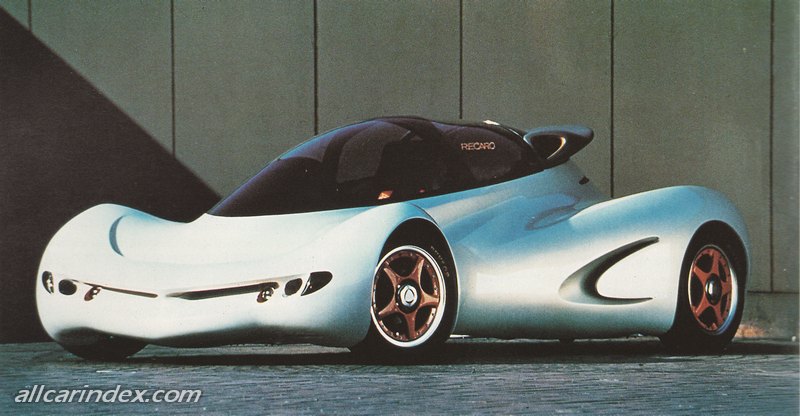
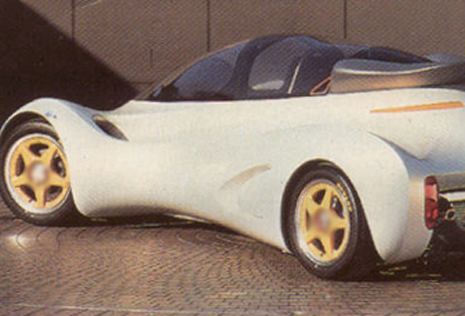
The Mazda E-Go, known in Japan as the マツダE-Go, was a concept car developed by an eight-person team made up largely of young Mazda staff. It was presented simply as a "new idea" rather than a defined production project, and no production run followed.
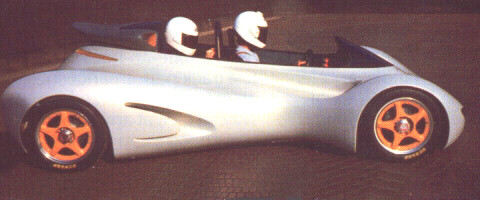
The design aimed to evoke a "motorcycle feeling," an effect heightened when its removable plexiglass roof was taken off, leaving only a low windscreen over which the occupants could see. In keeping with this theme, the E-Go had two seats arranged one behind the other, like a motorcycle, and its silhouette, with individually enclosed wheels, further suggested an aerodynamic two-wheeler. The bodywork took the form of a doorless spider.
Power came from a Mazda specialty, a twin-rotor Wankel engine of the 13B type, with a capacity of 2616 cc and an output of 170 hp, equivalent to the non-turbo engine used in the Mazda RX-7. It was mounted amidships in a lightweight tubular-frame chassis, with racing-style upper and lower wishbones front and rear. A target weight of 550 kg was intended to give strong acceleration, part of what the designers described as a "man/machine interaction" between driver and car.
The E-Go measured 3600 mm long, 1700 mm wide, and 1090 mm high, with a 2400 mm wheelbase and a track of 1440 mm.