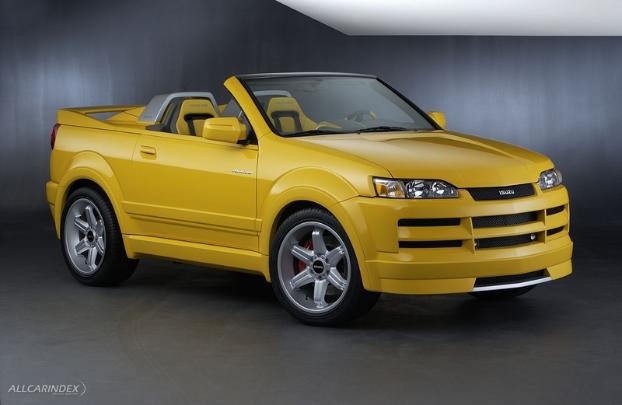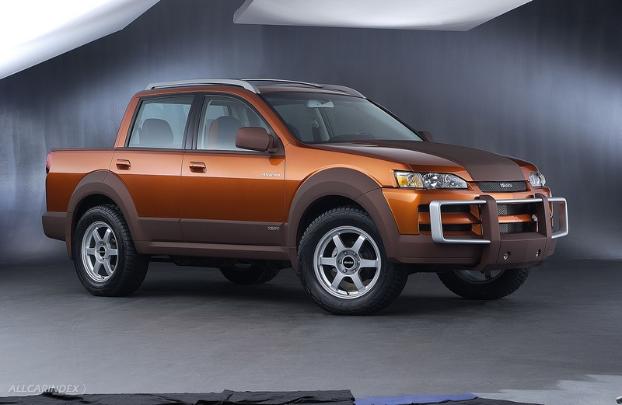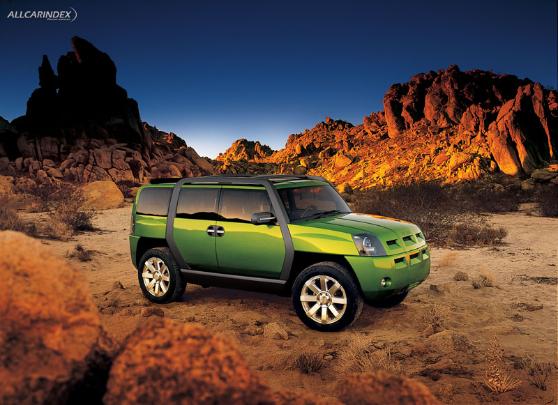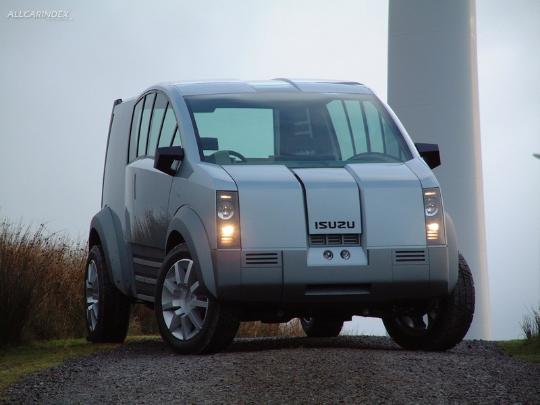

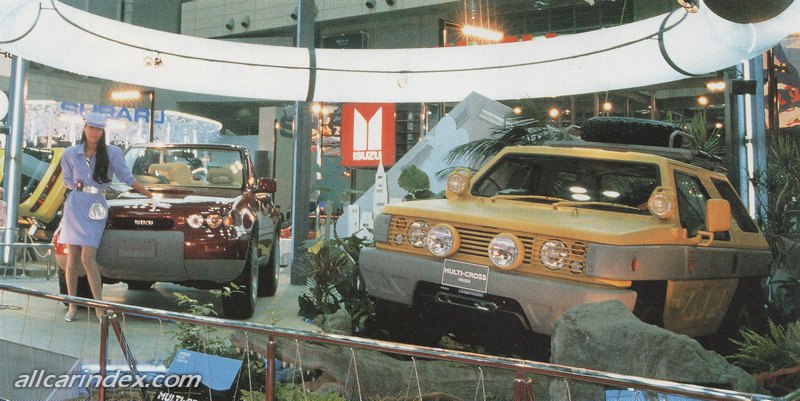
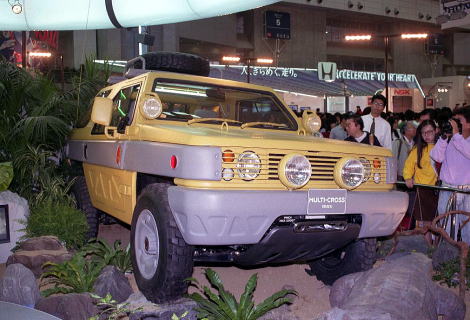
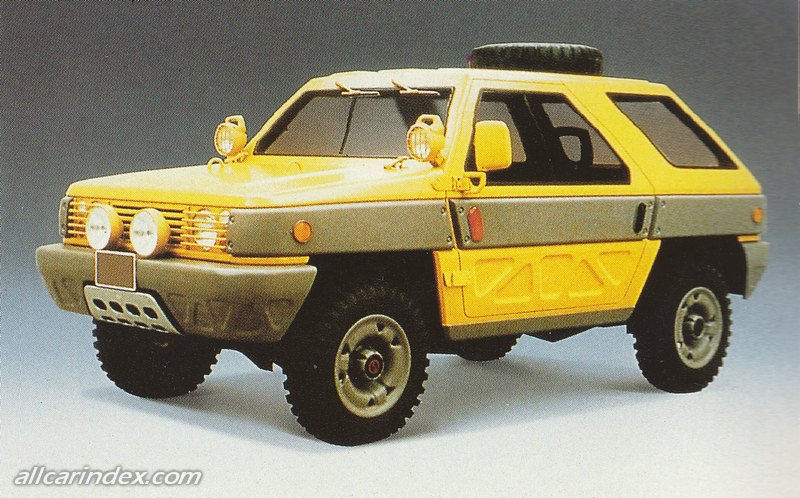
The Isuzu Multicross was a concept vehicle developed as a further derivative of the production MU/Amigo, created roughly half a century after the origins of off-road cars to pursue their original, function-first design intent. It was conceived as a hardcore off-road four-wheel-drive vehicle with rough-road driving capability as its primary objective.
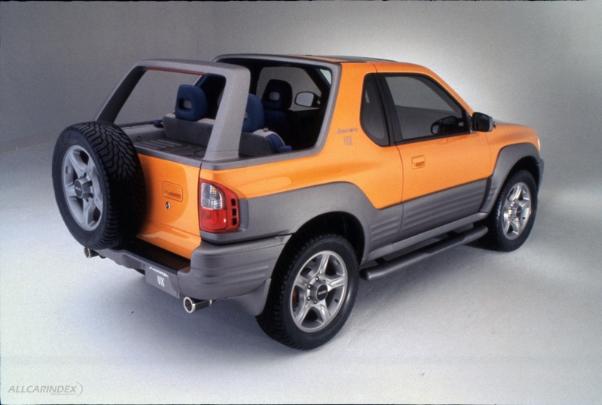
Compared with the related Costa concept, the Multicross had a markedly more rugged appearance despite its friendly yellow and grey color scheme, defined by an angular off-road styling with visibly high ground clearance. Its exterior shape was themed around a hexagon, considered the most stable geometric form, and finished in a matte paint color. The body was a closed, three-door construction with four seats, styled as an expedition vehicle: it featured a skid plate for underbody protection, main and auxiliary headlights shielded by grilles, a wide continuous side protection bar, and a spare wheel mounted on the roof. The design aimed for a simple, functional construction, with a flat windshield and center and rear roof rails angled distinctly forward.
The interior matched the functional character of the exterior, using an exposed panel design. It included features dedicated to rough-road driving, such as Recaro seats with 4-point seatbelts, a world-band radio, a 100V socket, and a large compass.
Power came from the inline 4-cylinder 2.8-liter turbo diesel engine also used in the Isuzu Trooper, with a total displacement of 2,772 cc producing 115 hp at 3,600 rpm and 235 Nm of torque at 2,300 rpm, driving all four wheels. This engine configuration received the Off-Road of the Year award in West Germany.
The Multicross measured 3,850 mm in length, 1,780 mm in width, and 1,695 mm in height, with a wheelbase of 2,330 mm and a track width of 1,500 mm.