
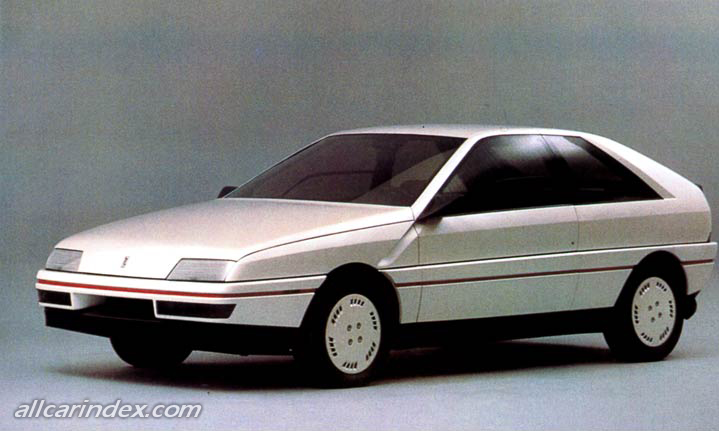
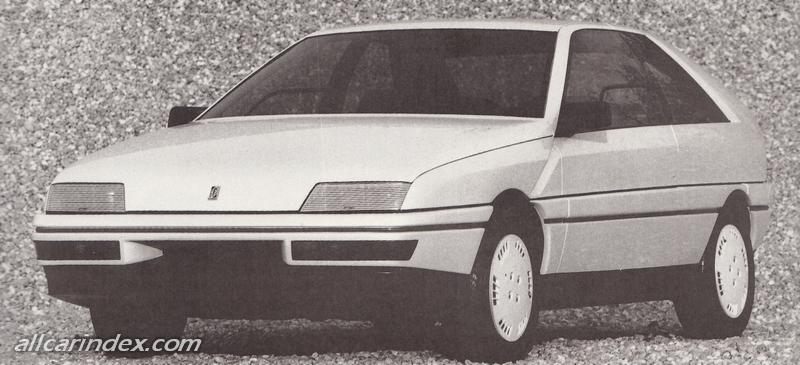
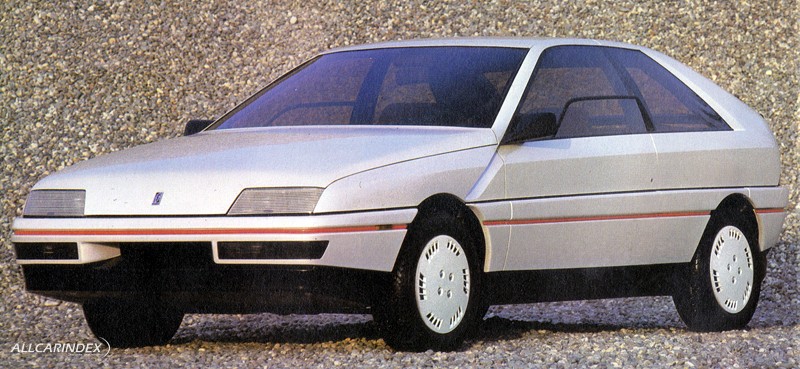
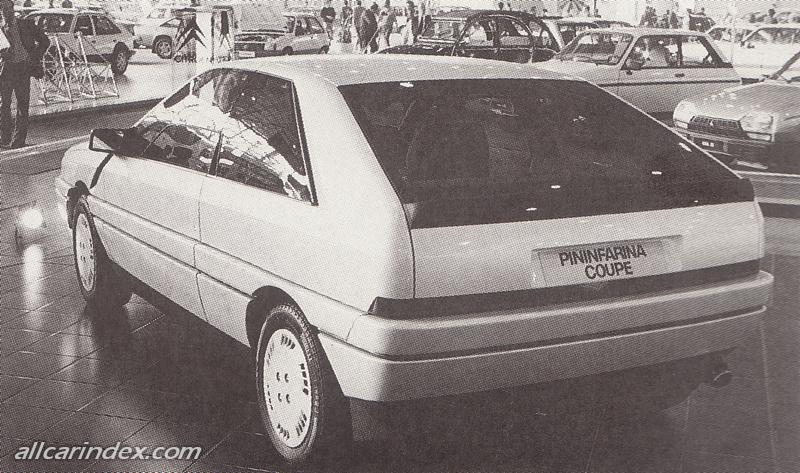
The Pininfarina Brio was a four-seat fastback coupé concept created by the Italian design house, shown as a running prototype at the 1983 Geneva Motor Show after being designed in 1981. It shared some stylistic kinship with the earlier Pininfarina Quartz, but unlike that car it was not based on Audi four-wheel-drive underpinnings, instead using the front-wheel-drive Fiat Ritmo Abarth 125 TC as its mechanical base. Pininfarina described the car as a preliminary prototype intended as a basis for further development that could lead to series production under the Pininfarina name, a badge already used for the continued production of the Fiat 124 Sport Spider, originally launched in 1966. No production version of the Brio materialized, though the project was carried further and found an extrapolation in 1988 in the Pininfarina Hit, based on the Lancia Delta Integrale.
The Brio combined contemporary wedge styling with a crease running from the steeply raked windscreen pillar to the wheel arch, which doubled as an engine bay air outlet and incorporated the door mirror, itself used for interior ventilation. Front and rear lighting units, developed with Carello, were concealed behind body-colored louvres when not in use. Headlamp washers were integrated into the bumpers and the rear wiper into a spoiler. The car achieved a drag coefficient of 0.29.
The interior featured liquid-crystal and LED instrumentation in digital and analog form, a main instrument cluster adjustable with the steering wheel, and a secondary display with audio system and trip computer on the center console. Rear seatbacks folded individually. The 1995cc DOHC four-cylinder engine produced 125 hp at 5800 rpm and 172 Nm at 3500 rpm, giving a top speed of 200 km/h. The car measured 4060mm long, 1680mm wide and 1330mm high, with a 2440mm wheelbase. It was later referred to simply as the "Coupé 2+2."