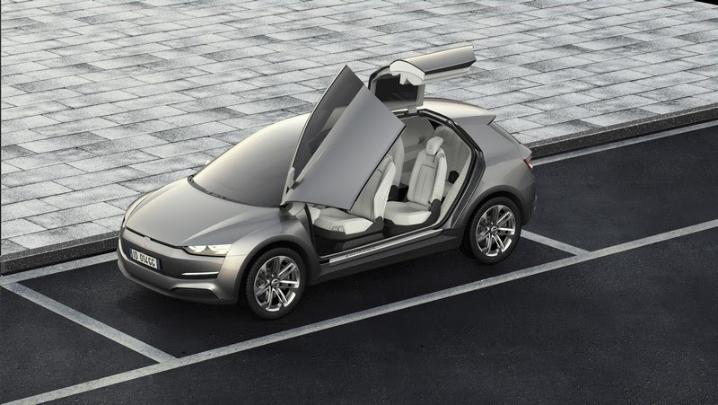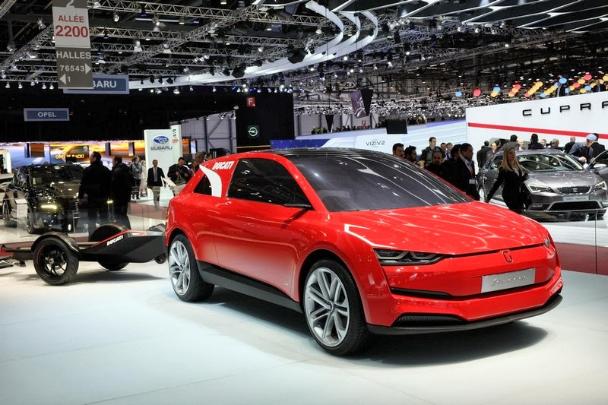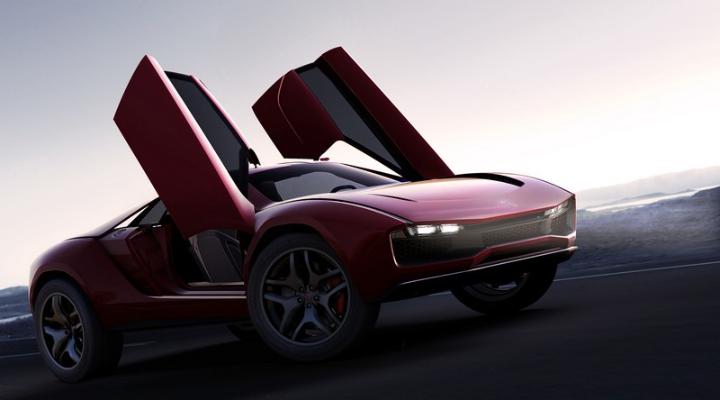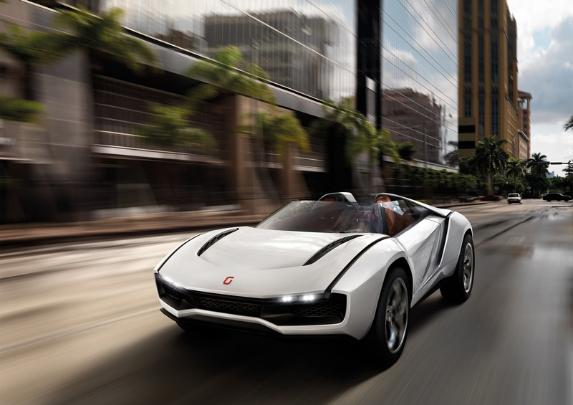

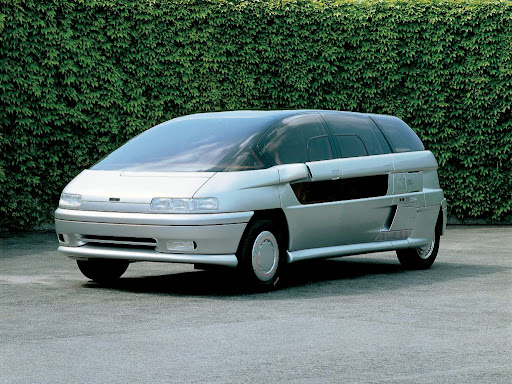
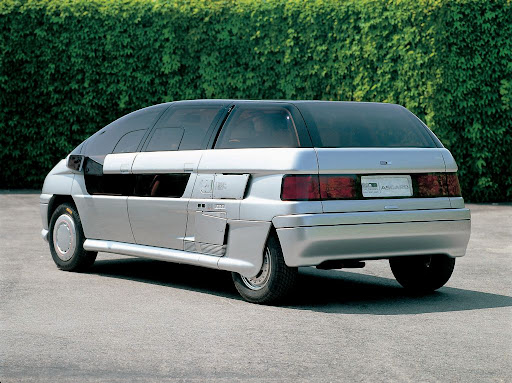
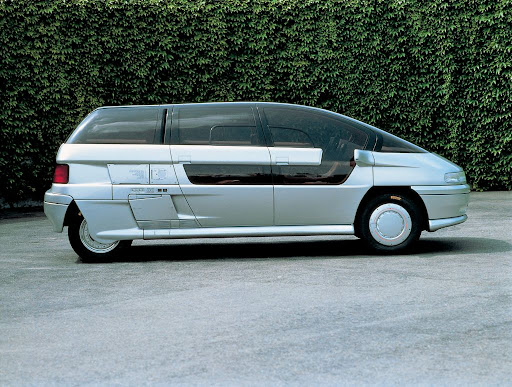
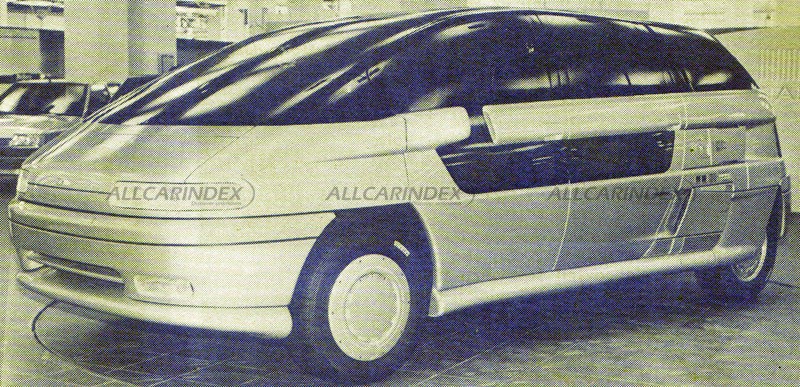
The Asgard is a concept car from the Italian design house Italdesign Giugiaro, conceived as a large-volume estate car, or "Großraumkombi," and shown as a non-driveable design study. Its low, compact roofline gave it a look that bordered on a sporting estate rather than a conventional van. The Asgard was presented at the same time as the Bertone Genesis, another forward-looking one-box estate concept, though the two differed fundamentally in layout: the Genesis used a conventional front-engine, rear-wheel-drive arrangement, while the Asgard was built with a mid-mounted engine and four-wheel drive, an unusual configuration for a vehicle of this type. A comparable layout later appeared in the production Toyota Previa from 1990, although in that car the engine sat beneath the driver's seat rather than ahead of the rear axle.
Giorgetto Giugiaro regarded the Asgard as a continuation of his earlier "space-wagon" design ideas and as an alternative to premium estate cars based on the Lancia Thema, Mercedes-Benz W124 and Volvo 760, intending it to set new standards in performance, handling and design. Its 290 cm wheelbase was created by stretching the underpinnings of the Aztec/Aspid concepts by 30 cm, transforming what had been a two-seat layout into a six-seat cabin with two additional child seats. The bodywork featured a distinctive glass area, with a curved lower front door window merging into a flank window that continued into the rear door, allowing visibility toward curbs and other roadside references. The break in the trim strip between upper and lower side windows was used to mount the door mirror at the front and an air intake further back. A shallow front end housed small rectangular twin headlights, with the bonnet containing the radiator and spare wheel, while a small vent hinted at the engine location ahead of the rear wheels. The roof-hinged tailgate, glazed into the roofline, opened to reveal both the engine and a luggage area containing two folding, rearward-facing child seats trimmed with child-oriented fabric patterns.
Interior space was notable for offering 200 cm between the pedals and the rear bench, said to match the contemporary Volkswagen Passat. Seating comprised a two-place front bench and three individual rear seats, all electrically adjustable with memory settings. A three-speed automatic transmission was specified in place of a five-speed manual, operated via a vertically sliding selector on a dashboard shared with the Aztec and Aspid. The Asgard used a transverse mid-mounted Audi 200 Turbo five-cylinder engine of 2226 cc producing 200 hp at 6200 rpm, driving all four wheels. It measured 4415 mm long, 1970 mm wide and 1575 mm high, on a 2900 mm wheelbase, with a five-door body configured for 6+2 occupants.