
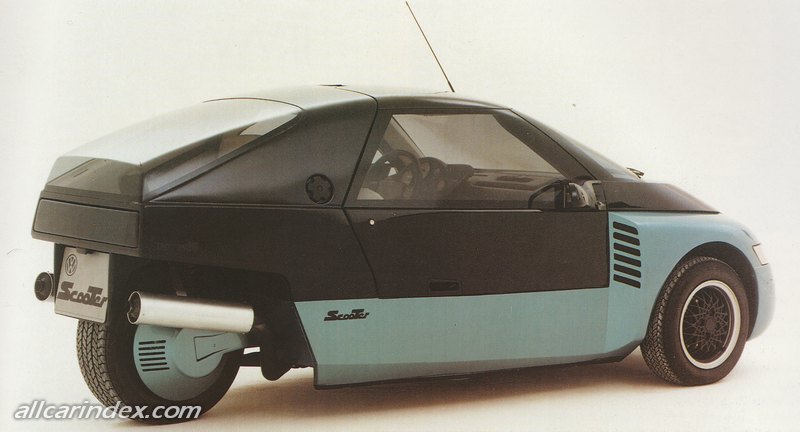
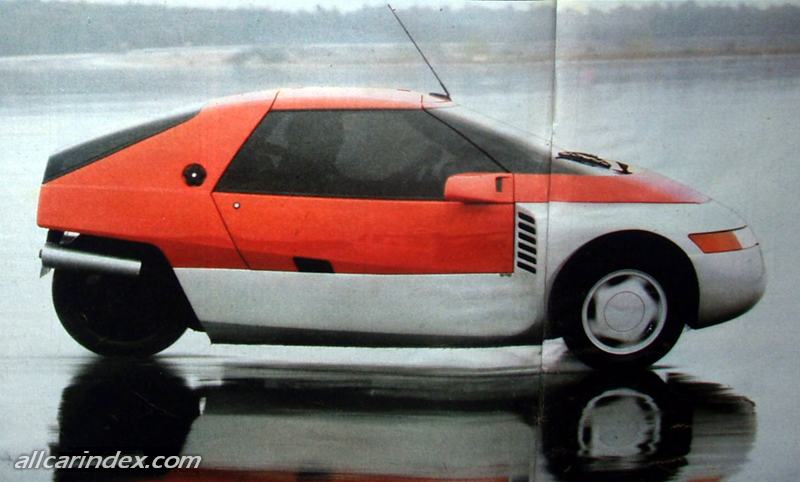
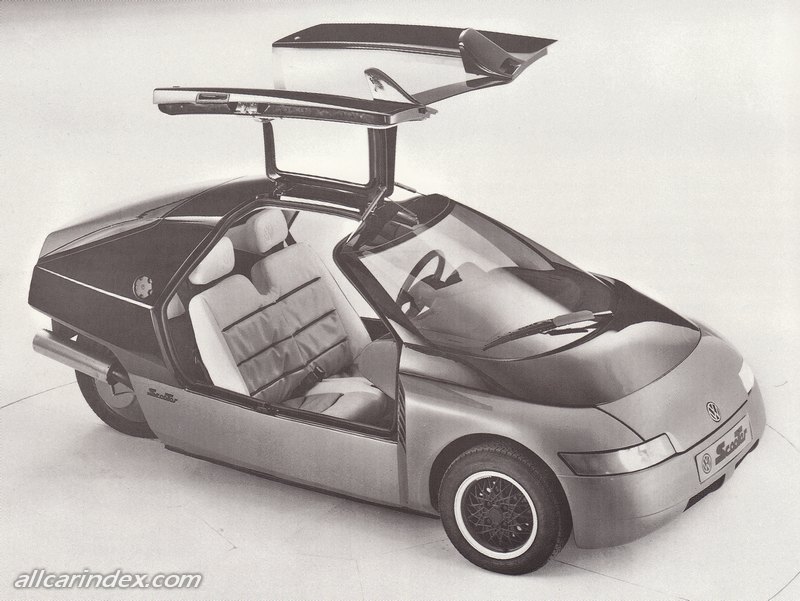
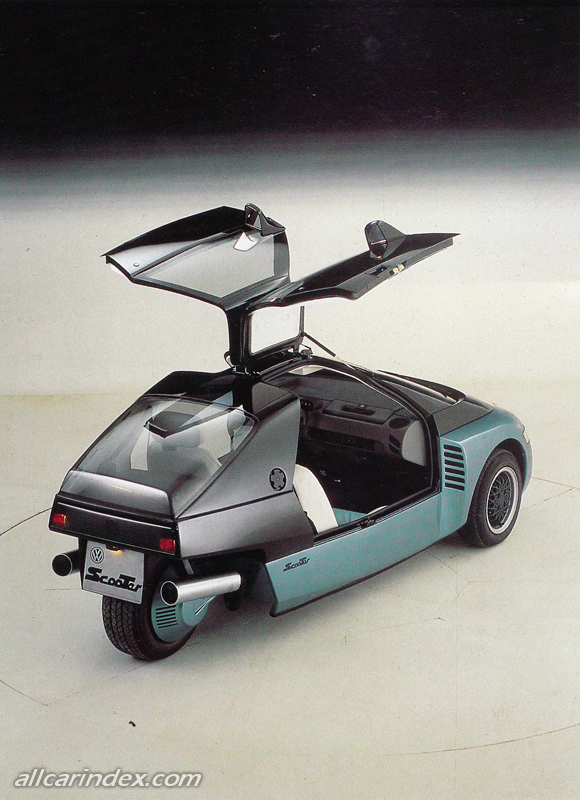
The Volkswagen Scooter was a three-wheeled concept car unveiled by Volkswagen AG at the Geneva Motor Show in 1986. Designed by Volkswagen's Research Department under project leader Ing. Emil Pommer, with a team of young designers, the Scooter was conceived as a way to combine the economical performance of a motorcycle with the sporting comfort of a car, and specifically to explore an alternative to heavy motorcycles, whose dangers were cited by Volkswagen board member Professor Dr. Ernst Fiala, who initiated the project some four years before its unveiling. Other configurations considered during development included a leaning three-wheeler concept developed in England and a tandem seating arrangement.
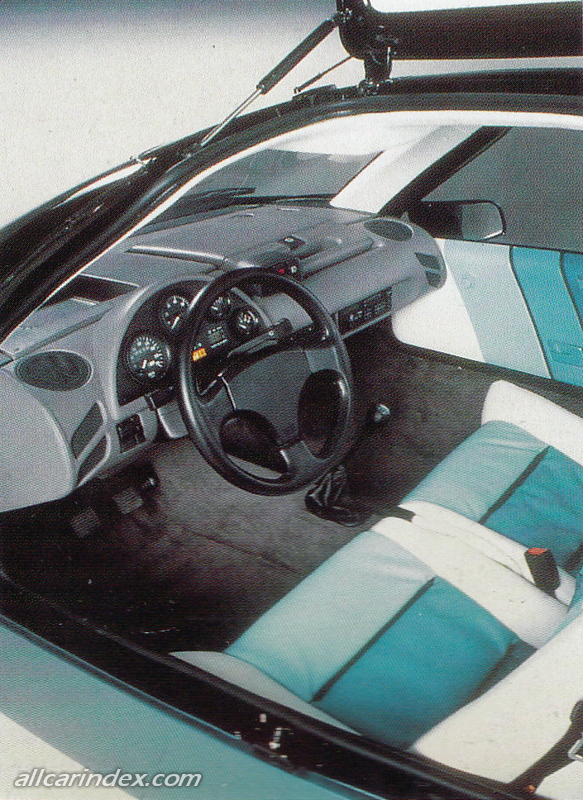
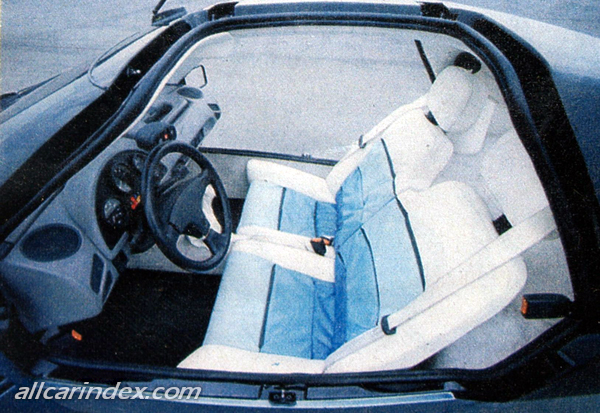
The single-volume, two-seat body used a single wheel at the rear, following the layout popularized decades earlier by the Morgan three-wheelers, rather than the front single-wheel arrangement of Karl Benz's original Patent-Motorwagen. It measured 317.5 cm long (also cited as 3175 mm), 150 cm wide and 124 cm high, with a wheelbase of 215 cm and a track of 130.5 cm, and weighed 550 kg, making it lighter than the contemporary VW Polo (from 700 kg) and Fiat Panda (from 650 kg). Its drag coefficient of 0.25 resulted from a form without a front hood step, flush-fitted glazing, bumpers integrated into the body skin, and flush headlights and door handles. Gullwing doors, which could be removed, gave it a distinctive appearance and produced driving sensations between those of a motorcycle and a convertible; the rear window could also be removed. A dashboard-mounted box in front of the passenger seat could be removed and used as an attache case. Instruments and switches were arranged in a semicircle in the driver's field of view.
Mechanically the Scooter used front-wheel drive with a transversely mounted engine, drawing its drivetrain and front axle from the Polo, front brakes from the Golf GTI, and rear brake components from the Audi 100, paired with a newly developed rear swinging-arm axle. It was tested with two engines: a 1043 cc carbureted unit producing 40 hp at 5300 rpm, and a newly developed 1.4-litre (1378/1400 cc) fuel-injected engine producing 90 hp, both linked to a four-speed manual gearbox. Quoted performance figures were 0-100 km/h in 14.8 seconds and a top speed of 160 km/h for the 40 hp version, against 8.5 seconds and over 200 km/h for the 90 hp version; fuel consumption was quoted at 3.9/5.0/6.7 litres per 100 km on regular petrol, or 4.4/5.6/8.2 litres on premium, depending on speed. Front tires measured 175/60-13 on 6x13-inch alloy wheels, while the single rear wheel used a wider 235/55-15 tire on a 7x15-inch alloy wheel.
The Scooter met European safety standards of the time and was a fully functional prototype rather than a static design study. Volkswagen considered having it built by an outside manufacturer, judging even Karmann, builder of the VW Cabriolet and Scirocco, to be too large a producer for the project. Following the Geneva showing, Volkswagen received around 500 inquiries from the public after allowing press test drives, but the Scooter never reached series production.