
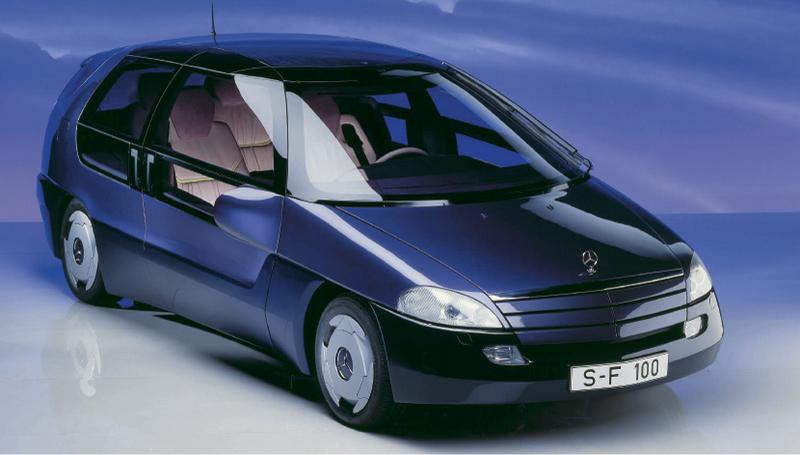
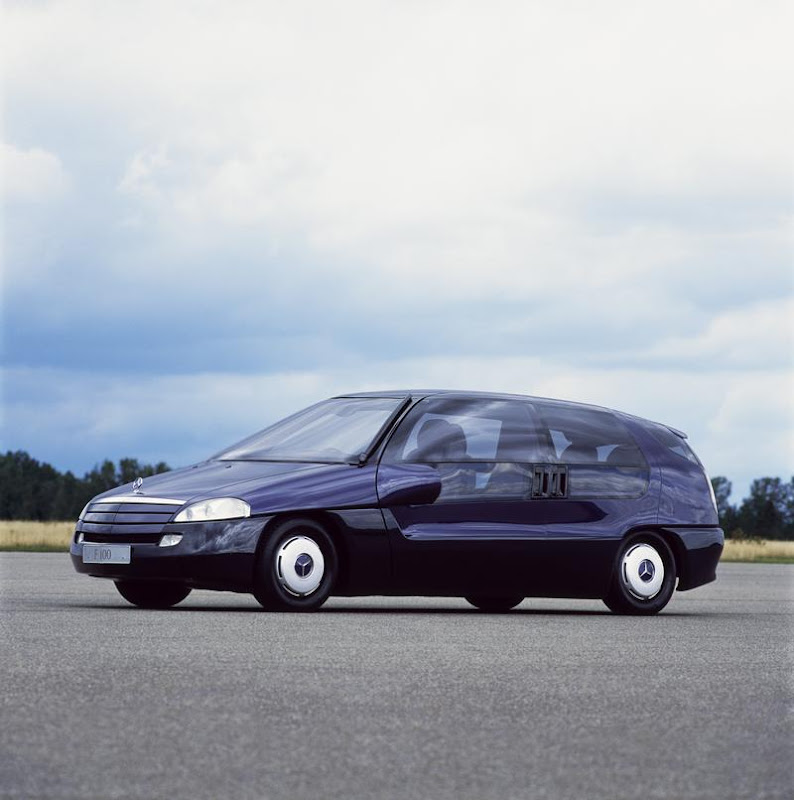
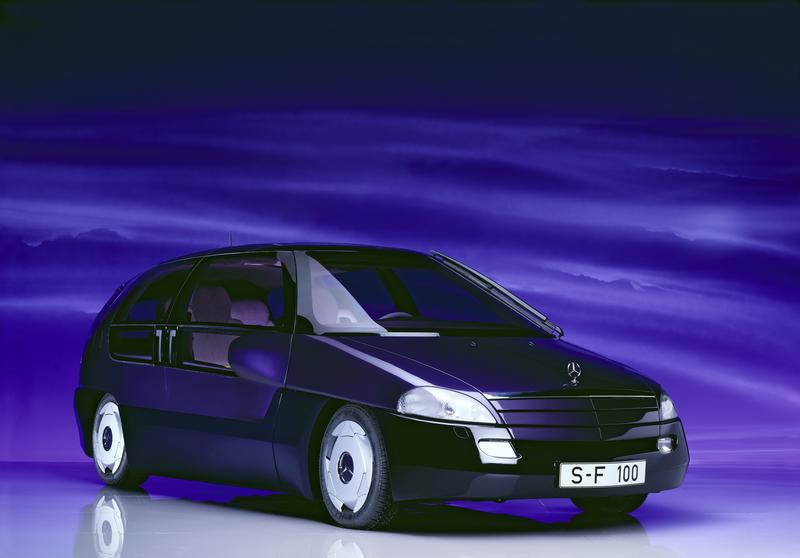
The Mercedes-Benz F 100 is a concept research vehicle unveiled by Mercedes-Benz at the North American International Auto Show in Detroit in 1991. It was one of three new European concept cars shown at that event, alongside the Bertone Emotion and the Pininfarina Chronos, though unlike those two designs the F 100 had not originally been planned for public presentation and had already been discussed as early as late 1990. It took the form of a five-seat estate-type vehicle, described as a large-capacity station wagon body, and was built as a fully functioning research car rather than a styling exercise, intended to explore new ideas around seating, doors, ergonomics, and safety. Mercedes-Benz had been known to be working separately on a large-capacity van-type vehicle at the time, but the F 100 was unrelated to that program despite belonging to the same forward-looking body-style category.
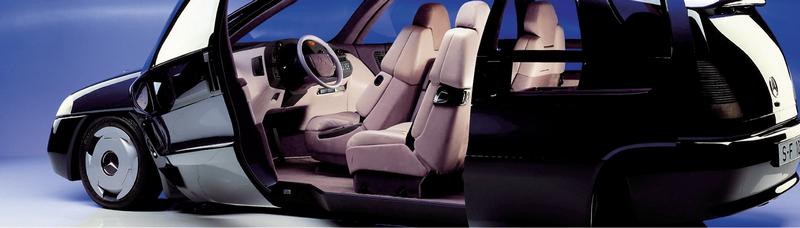
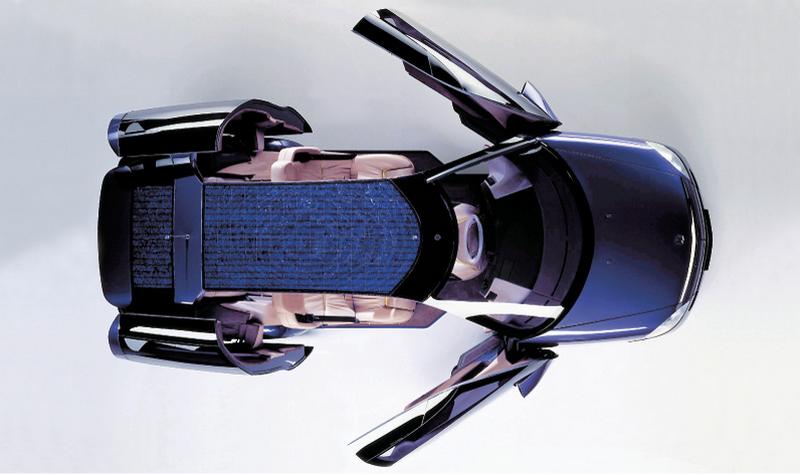
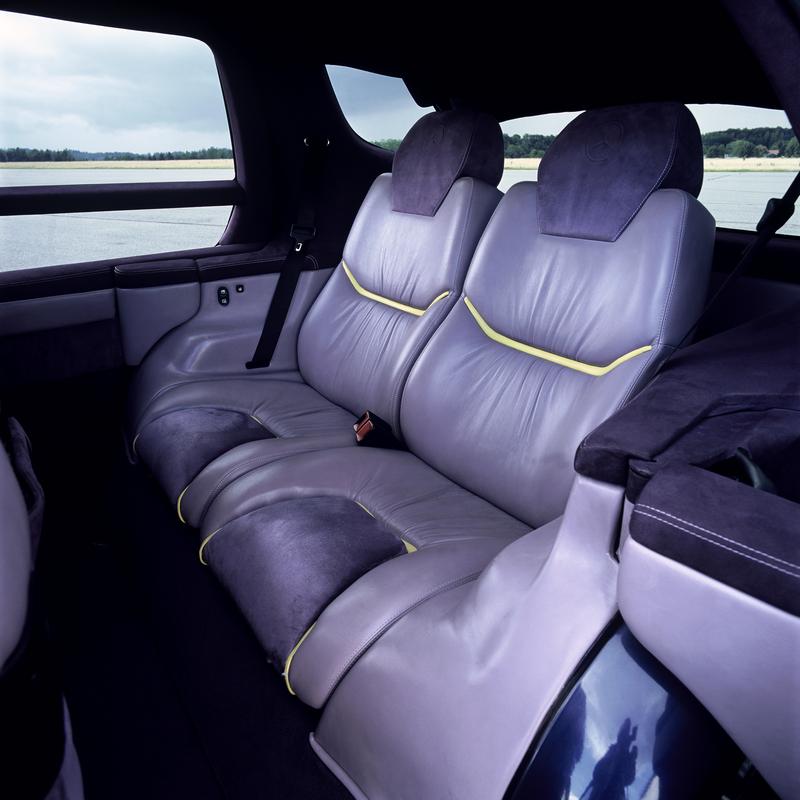
A defining feature of the F 100 was its central driving position, with the driver's seat set noticeably further forward than the outer seats. This layout followed a concept that had appeared periodically in automotive history, including a brief production application by Panhard in its Dynamic luxury saloon in 1937/38, occasional use by Pininfarina in one-off designs after the war, and, immediately prior to the F 100, the Mini MPV concept shown by IAD at the Turin motor show in 1990. The central seat improved sideways visibility and, according to Mercedes-Benz research, offered the driver the statistically safest seating position due to greater distance from surrounding structure, along with the ability to exit the car away from moving traffic. The two rear-seat passengers sat in staggered positions behind the driver at a distance from the dashboard, and two additional seats were positioned toward the vehicle's center between the rear wheel housings.
Access to the driver's seat was achieved through doors cut into both the roof and the floor of the car, referred to internally as Albatros gull-wing doors, which moved on a four-axis guided hinge and retracted a section of the floor as they opened, preserving a normal seating height despite the car's central driving position and raised roofline. To offset the loss of structural rigidity caused by these deep door cutouts, the doors engaged mechanically with the surrounding body structure at three points using latching claws when closed. The rear seats were reached through separate swivel-and-slide doors that required little lateral clearance to open, easing parking in tight spaces; these doors only needed to be pushed shut lightly, after which pneumatic servo units closed them almost silently, with monitoring to prevent operation while the vehicle was moving and a manual override provided in case of power failure. It was suggested at the time that this closing system would soon appear on other Mercedes-Benz models, a reference to the S-Class introduced shortly afterward in Geneva.
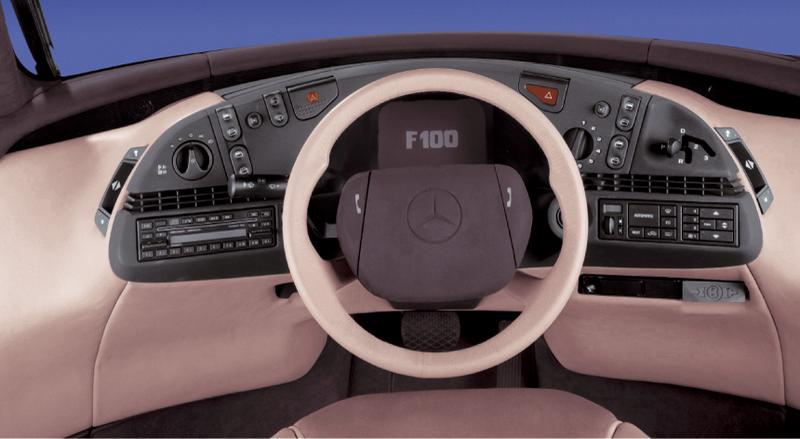
The interior featured a symmetrical, wide instrument panel built around a central screen that displayed information according to three priority levels, illuminating only the reading judged most relevant to safe driving at any moment; speed could be shown in analog or digital form, and warnings such as falling oil pressure or tire pressure could trigger a stop command. The steering wheel carried a fixed, non-rotating hub housing an asymmetric airbag. Rear visibility relied primarily on a rear-mounted camera rather than conventional mirrors, aided by aerodynamically shaped door mirrors, while a retractable optical parking aid extended from the tailgate for maneuvering. A radar system warned of insufficient distance to vehicles ahead and worked with an automatic speed control function, and a separate traffic radar warned of vehicles in blind spots during lane changes and assisted with merging.
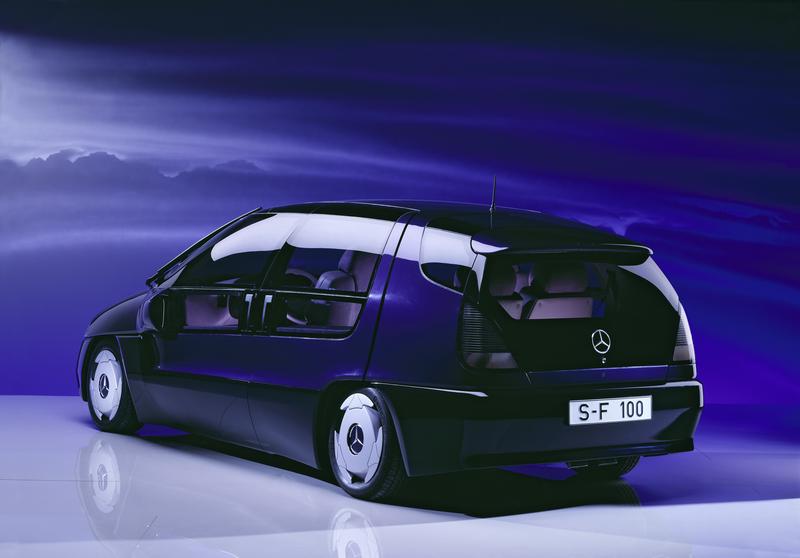
Safety was emphasized throughout the design, with a reinforced passenger cell offering all-round impact protection and a double floor structure. The driver's central position was considered inherently safer due to greater distance from the car's outer structure. A linear windshield wiper swept nearly the full glazed area by moving along the top and bottom edges of the screen, and even the taillights were fitted with a wiping mechanism. The front end combined the Mercedes-Benz grille with gas-discharge headlights, while the taillights used light-guide technology. Solar cells mounted on the roof powered the ventilation system while the car was parked, and two air-guiding fins were fitted to the rear section of the roof.
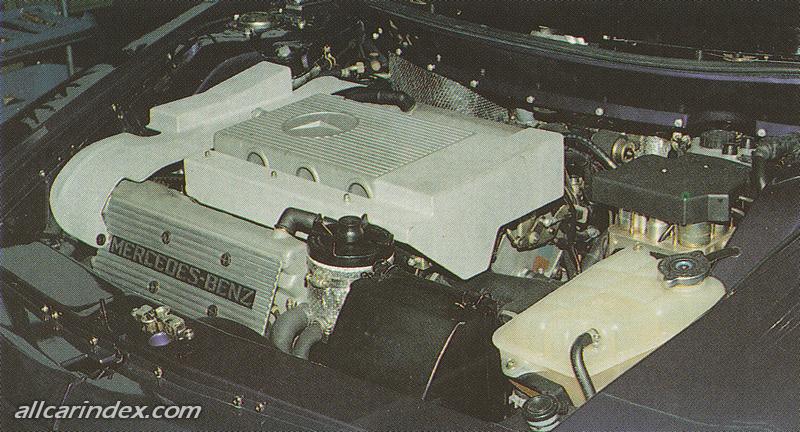
Technically, the F 100 introduced front-wheel drive to Mercedes-Benz for the first time. It was powered by a Mercedes V6 engine, as used in the MB Auto 2000 concept, with a displacement of 2.6 liters and 200 hp, fitted with a pre-heated catalytic converter. Alternative powertrains were discussed as possibilities, including a combination of hydrogen engine and electric drive, with Mercedes-Benz suggesting that a front-mounted gasoline engine paired with a rear electric motor could allow flexible adaptation to different driving situations. The chassis used front strut suspension and a rear multi-link axle with hydropneumatic self-leveling, and Mercedes-Benz stated that all active chassis components, from automatic damper adjustment to rear-wheel steering, were technically feasible. Other notable features included a magnetic chip card replacing a conventional key, which handled seat memory and other functions, integral seats with a fixed belt system, and tires developed for flat-running properties with electronic pressure monitoring. The body, with its deeply drawn, horizontally split side windows, was refined in the wind tunnel to achieve a drag coefficient of 0.24, and its styling drew some comparison to the 1983 Volanis Helios concept.
The F 100 measured 483 cm in length, 178.5 cm in width, and 153 cm in height, with a wheelbase of 295 cm and front/rear track widths of 149 cm and 145 cm, and it weighed 1450 kg. Several of its concepts reached production in later Mercedes-Benz models: the pneumatic door-closing system and chip-card key system were associated with the S-Class, gas-discharge headlights became xenon lighting on the E-Class, the sandwich floor concept appeared in the A-Class, and the solar-cell roof concept was linked to the panoramic roof later used on the Maybach 62. As a research vehicle, the F 100 was not intended for series production but served to demonstrate technologies and concepts under consideration for future Mercedes-Benz models.