

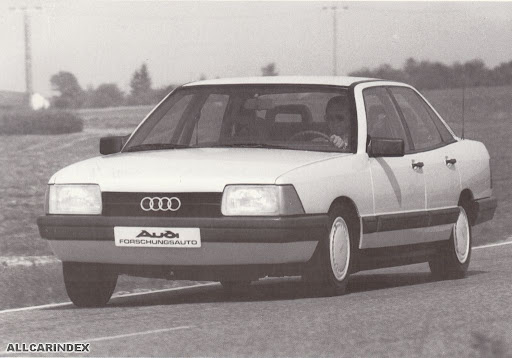
The Auto 2000 Forschungsauto was a research vehicle developed by Audi as part of a project sponsored by the German Federal Ministry of Research and Technology (BMFT), in which Audi, Mercedes-Benz, Volkswagen, and a consortium of three technical universities each built a functional prototype exploring future automotive technology. Audi received the smallest ministry subsidy of the participants, 5 million DM, yet still produced a prototype that was close to production feasibility while anticipating developments still years away. It was a four-door, five-seat mid-size saloon body concept with a drag coefficient of just 0.29, achieved through a smooth-surfaced body with bonded front and rear windows and side glass flush with the roof pillars. This aerodynamic approach foreshadowed the production Audi 100 launched in the second half of 1982, which achieved a cw of 0.30, though that car's front end was more finely detailed and its beltline lower than the research car's.
Underpinning the project, based on the Audi 100 platform, was a special 1.6-liter, four-cylinder engine of 1588 cm³ cast from recycled aluminum with dry grey-iron cylinder liners, hydraulic tappets, a Hitachi HT15 exhaust turbocharger, and an SU flat-slide carburetor mounted on its intake side. Audi developed a dedicated electronic engine management system with mapped ignition control and knock control, along with specially designed swirl ports and combustion chambers with squish areas to reduce hydrocarbon emissions, and the engine ran a very lean mixture under partial load. Output was 108 PS at 5000 rpm and 168 Nm at 3500 rpm, paired with a long-ratio five-speed manual gearbox. Despite the small displacement and economy-oriented tuning, the 1180 kg car accelerated to 100 km/h in 12 seconds and reached a top speed of 180 km/h, with fuel consumption of 5.0/6.9/8.5 l/100 km on the ECE/DIN cycle and a 5 to 10 percent reduction in consumption compared with an equally powerful naturally aspirated engine. The engine and gearbox were encapsulated to reduce noise, requiring a specific cooling layout, and the engine mounts used novel hydraulic dampers with an integrated tuned mass whose resonance frequency could be adjusted electronically according to crankshaft speed.
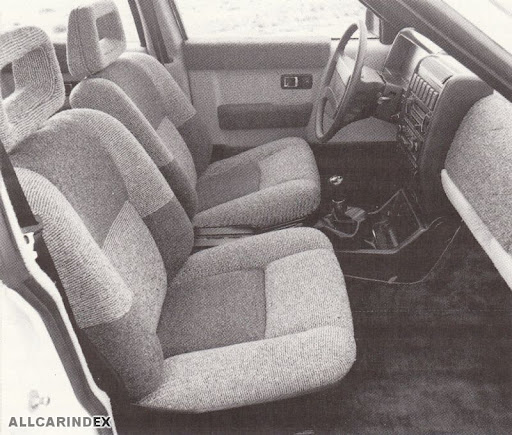
The chassis carried over Audi's negative steering offset principle, and lightweight materials featured throughout, including a fiber-reinforced plastic rear Panhard rod and alloy wheels fitted with 165 HR 14 tires. The body structure was built around a rigid steel sheet-profile cage without a floor or roof, using a sandwich-construction roof of two GRP layers around a lightweight metal honeycomb core that cut roof weight by 60 percent compared to steel, plus a GRP floor pan with integrated stiffening, cable ducts, and steel suspension mounting points bonded into the structure from below. The aluminum hood, also 60 percent lighter, incorporated polyurethane foam at its leading edge for pedestrian-impact deformability, while the trunk lid was made of plastic. The interior featured front airbags, knee bolsters, a fold-out child seat in the rear center armrest, and an instrument panel with two round gauges for speed and fuel consumption plus a small monitor for vehicle function monitoring. The Audi Forschungsauto served to explore both economy-focused operation and cost-efficient production methods.