
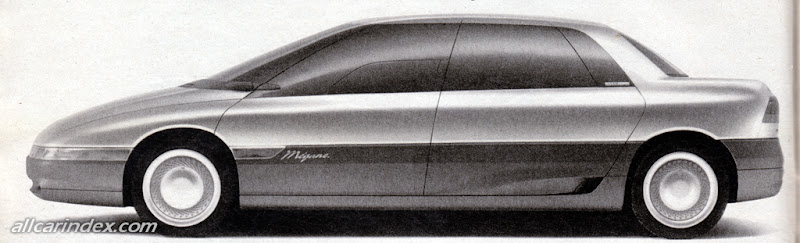
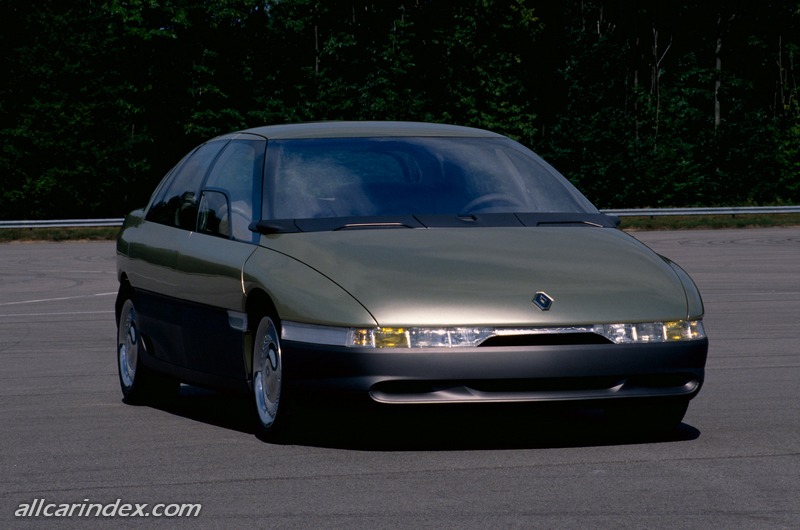
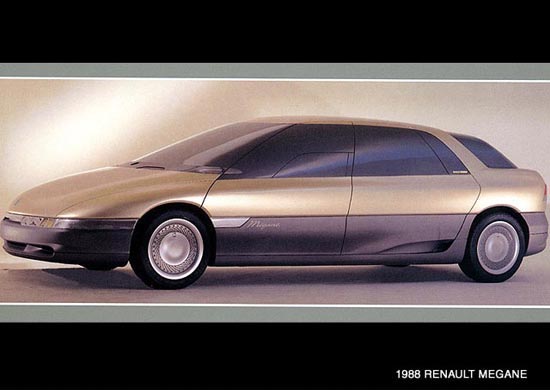
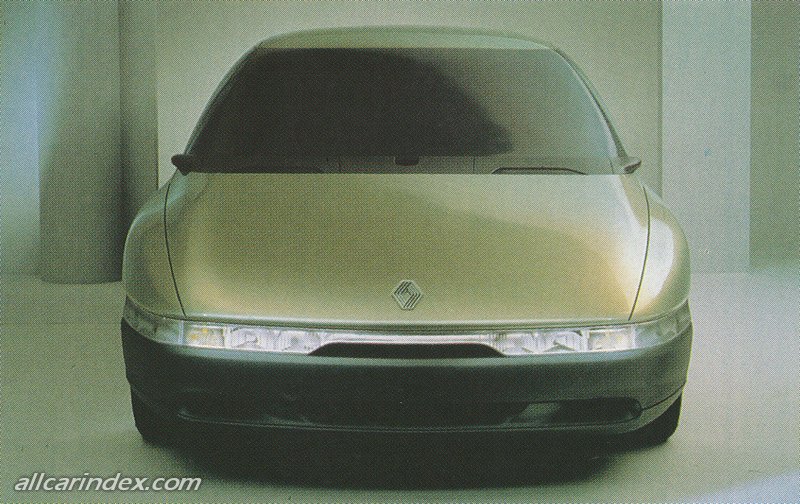
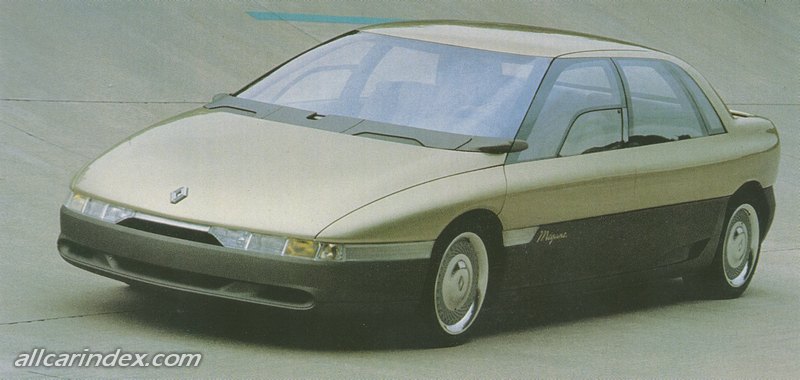
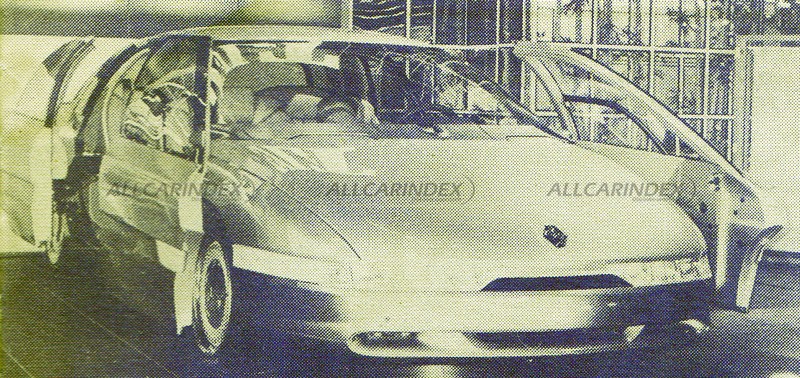
The Megane Concept was a concept car built by Renault as a technology and ideas showcase, presented at the Paris Mondial motor show. It took the form of a luxury four-door, four-seat saloon, larger than the Renault 25, the brand's top model at the time: the Megane measured 495 cm in overall length with a 311 cm wheelbase, compared with the 25's 472.5 cm length and 272.5 cm wheelbase. Its name was a fanciful derivation of the word mega, referring to size. Renault's marketing team described it as a "super voiture a vivre," while the firm's product development chief, Jacques Cheinisse, said the car was meant to demonstrate that Renault could engineer upper-class vehicles, to test and compare complex technologies working together, and to gauge customer reaction to possible directions for future luxury models.
Development was led by design chief Patrick Le Quement, and the project moved from initial planning in January to a roadworthy vehicle within about eight months, aided by CAD and CAM tools. Project coordinator Yves Dubreil oversaw construction of the body, which was built to Renault's plans by the Turin coachbuilder Coggiola. Numerous Renault departments and outside suppliers, notably Valeo, contributed technology to the project. In wind tunnel testing at the new St-Cyr facility, the car achieved a drag coefficient of 0.22 with the engine running (0.21 with the rear window extended), a strong result for a four-door, four-seat saloon, though Renault regarded aerodynamics as a secondary goal next to its unusual engineering features.
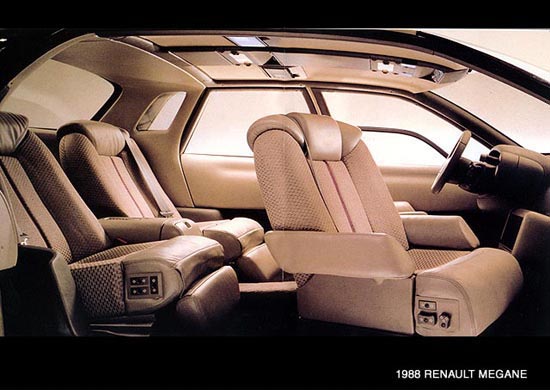
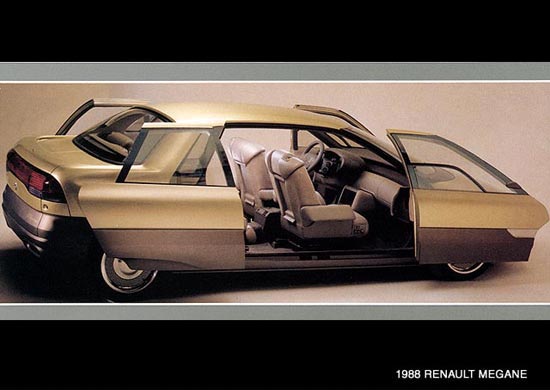
Access to the cabin was through electrically operated sliding doors with no central pillar, opening to create a 165 cm-wide gap, controlled by infrared remote. On opening a door, the driver's seat rotated 60 degrees outward with the steering wheel retracting, while the passenger seat could be turned manually through 180 degrees, a feature also used on the Renault Espace. The driver's seat had seven memory positions, an electrically adjustable lumbar support and integrated armrests. The rear seats could recline electrically to 55 degrees with automatically deploying footrests, and in this position the parcel shelf and rear window slid back 35 cm to give rear passengers more headroom, effectively turning the notchback into a hatchback. The 600-litre boot was split into two sections accessible from inside the cabin, with a sliding floor that pulled out like a drawer for loading from three sides.
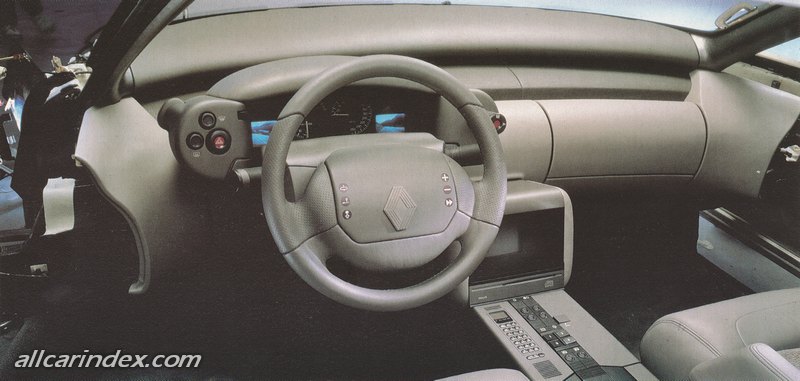
Power came from a development of the PRV V6 also used in the Renault 25, enlarged from 2458 cc (as fitted to the R25 and Alpine Turbo) or 2849 cc (Alpine) to 2965 cc, fitted with a water-cooled Garrett T3 turbocharger for an output of 250 hp at 6000 rpm and 349 Nm of torque between 2000 and 4000 rpm. Drive went through a five-speed transmission offering automatic or manual selection via a small selector beside the steering wheel, with gear changes and clutch actuation both handled electronically through two electric motors and computer-controlled actuators. The car had permanent four-wheel drive using three differentials and a central viscous coupling, with the rear differential disengaging pneumatically above a certain speed, plus four-wheel steering and electronically controlled adaptive damping that adjusted automatically between soft, normal and hard settings.
Other features included four-wheel disc brakes with fourth-generation Bosch ABS, speed-sensitive electronic power steering, an electrically adjustable steering column and wheel, Michelin 235/45 ZR 17 tyres on 8-inch alloy wheels with Michelin's ATS run-flat system and MTM tyre-pressure monitoring, three rear-view cameras in place of door mirrors, and the Atlas navigation system developed with Télédiffusion de France, which displayed digital road maps from CD and offered tourist information alongside vehicle diagnostics. The cabin also featured a Philips-developed audio-video system with ten speakers, fold-down rear screens, a CD player, telephones, and a rear console with a minibar. The self-supporting steel body gave the car a kerb weight of 1800 kg; Dubreil stated that composite materials could have reduced this by more than 100 kg. Top speed was around 260 km/h.