
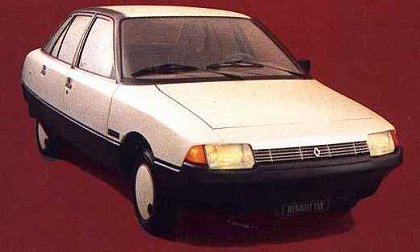
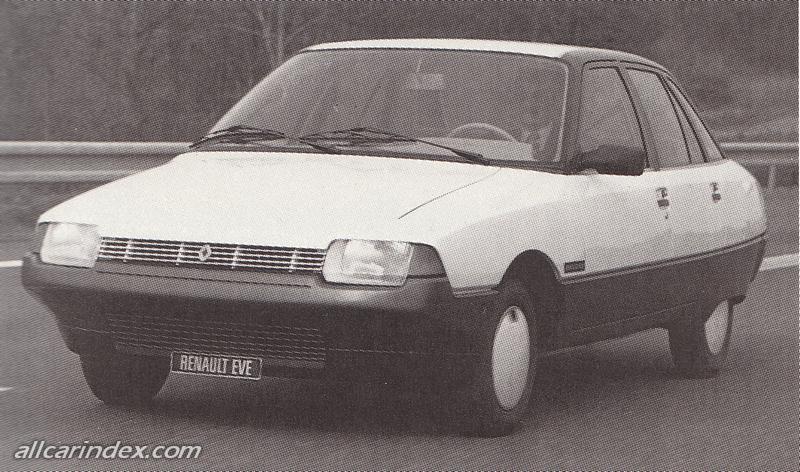
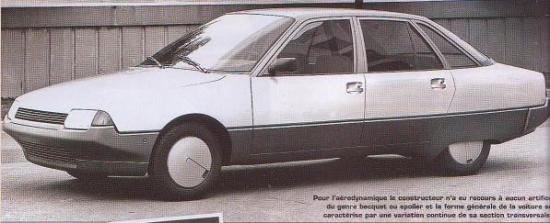
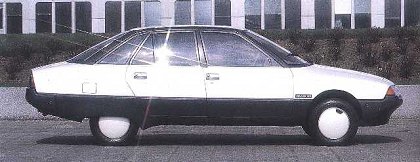
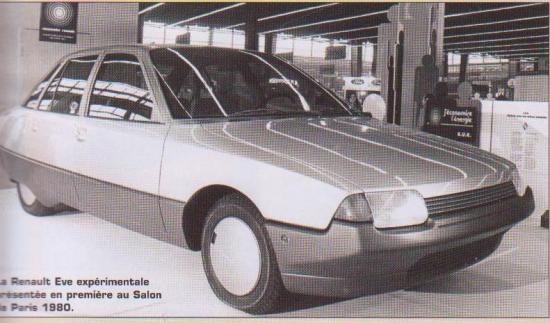
The Renault Eve was a research vehicle developed by Renault at the request of the French energy-saving agency AEE, presented at the Paris Motor Show in October 1980 alongside a comparable Peugeot project. Its name stood for Eléments pour une voiture économe, meaning foundations for an economical car. Renault announced that testing of the prototype would begin at the end of 1980, with results published in the spring of 1981. Built as a four-door, five-seat saloon on the basis of the Renault 18, the Eve received an entirely reshaped, aerodynamically optimized body.
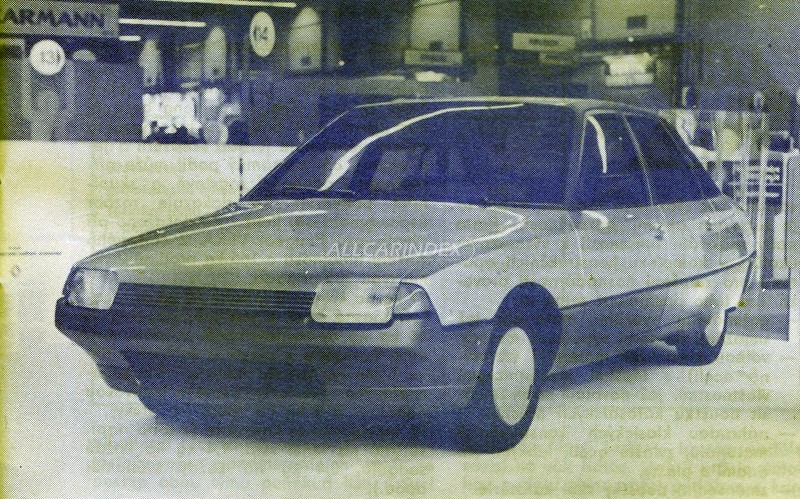
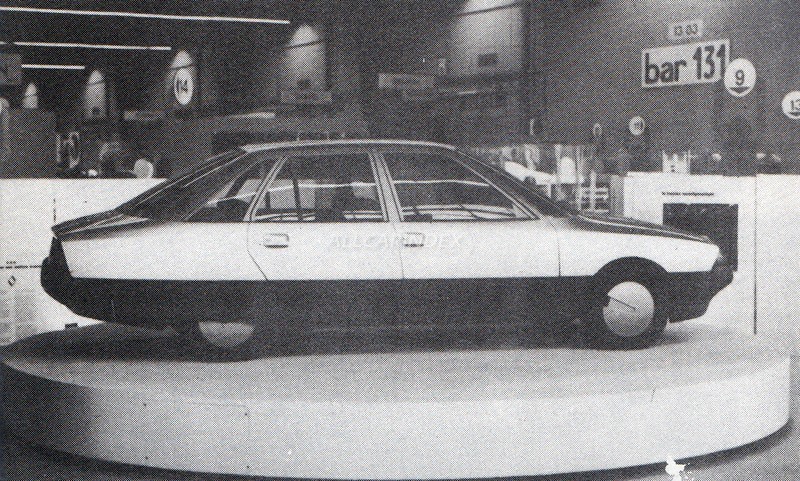
The design featured a wedge-shaped, laterally rounded front end, a narrow bumper leading into a recessed front apron, a strongly curved windshield, bulging side panels that tapered toward the rear, flat wheel covers, enclosed rear wheels, and airflow optimization through the engine bay and wheel housings. This resulted in a drag coefficient of just 0.24, compared with 0.39 for the standard Renault 18 TL, itself considered efficient for its time, representing an improvement of nearly 40 percent. Despite a slightly larger body than the standard 18, the Eve weighed 75 kg less thanks to the use of aluminum, plastics, and thinner glass, resulting in a total weight of 845 kg. It rode on glass-fiber-reinforced wheels fitted with rolling-resistance-optimized Michelin TRX E tires.
The car used the Renault 18 TL's 1397 cc four-cylinder engine, detuned from 63 hp to 53 hp at 5500 rpm, with torque reduced from 101 Nm to 81 Nm at 3000 rpm. In place of the conventional four-speed gearbox, it used a continuously variable transmission (CVT) based on a chain-belt system under development by the Dutch company Van Doorne, later used in the Fiat Uno and Subaru Justy from 1988. The system was linked to a computer control programmed to optimize fuel consumption, operating through a drive-by-wire throttle: pedal position was read by a potentiometer, and the computer selected the transmission ratio and throttle setting via separate actuator motors, with programmable priorities for minimal consumption, lowest emissions in urban driving, or reduced noise at night.
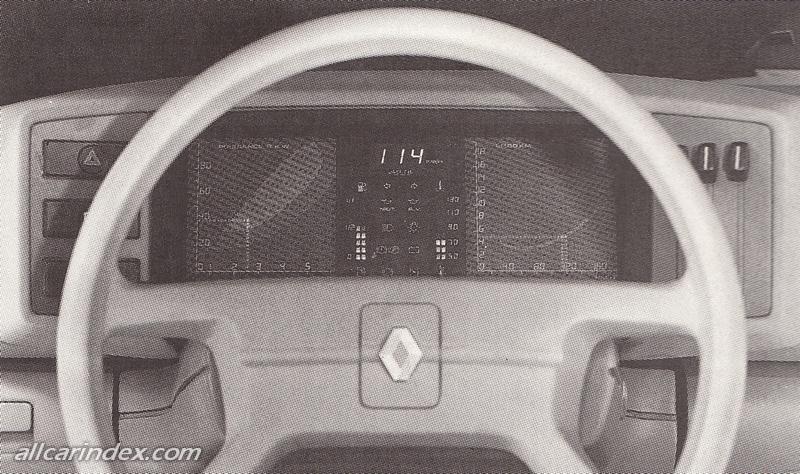
Fuel consumption at constant 90 km/h and 120 km/h and in a city cycle measured 4.1, 5.5, and 6.6 l/100 km, compared with 6.3, 8.4, and 9.4 l/100 km for the standard 18 TL. Top speed rose from 150 to 157 km/h due to the improved aerodynamics, though acceleration suffered, with 400 m and 1000 m from a standing start taking 21 and 38.1 seconds versus 19.3 and 36.5 seconds for the 18 TL. The Eve's electronic instrumentation displayed both specific and effective fuel consumption continuously. Dimensions included a wheelbase of 2510 mm on the left and 2480 mm on the right, a track of 1415 mm, and overall length and width of 4410 mm and 1740 mm.