
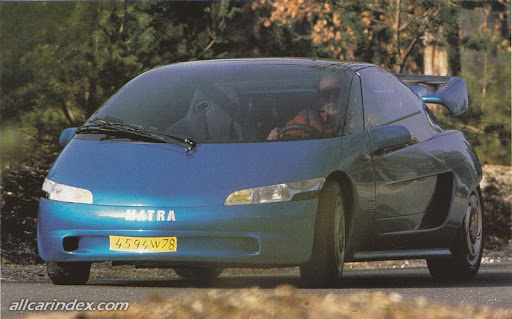
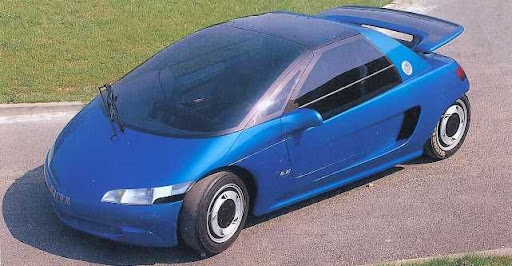
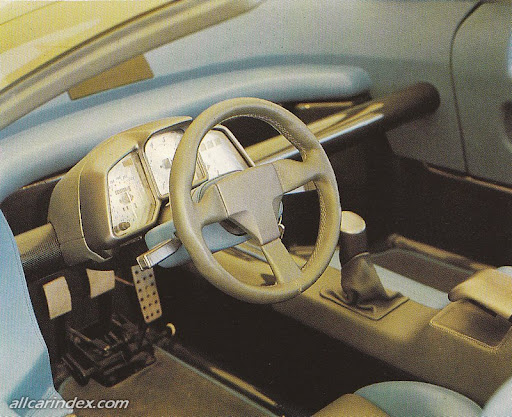
The Matra M25 was a concept study built by the French manufacturer Matra to mark 25 years of Matra Automobile, the "25" in its name referring to that anniversary. Though presented as a concept, it was built in several running examples rather than as a single static show car. It was described by Matra as an "Etude libre" (free study), intended to demonstrate the company's engineering and manufacturing capabilities.
By the time the M25 was created, Matra Automobile had grown from 40 employees at its founding in 1964 to 2460, including 200 engineers and technicians. Alongside producing the Renault Espace, Matra carried out prototype development for outside clients, offering design, engineering and production-methodology services, and had built an internationally leading position in plastics use for car bodywork. Matra-Sports had also recorded a strong competition record, including three outright wins at the Le Mans 24 Hours by 1974, though the M25 itself was not designed for any racing category.
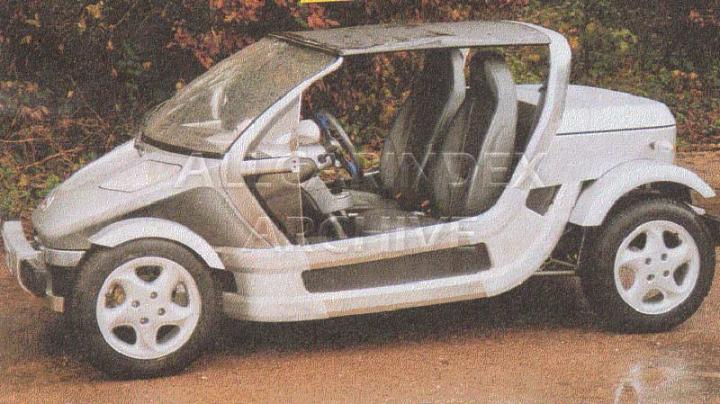
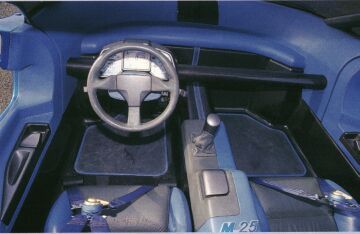
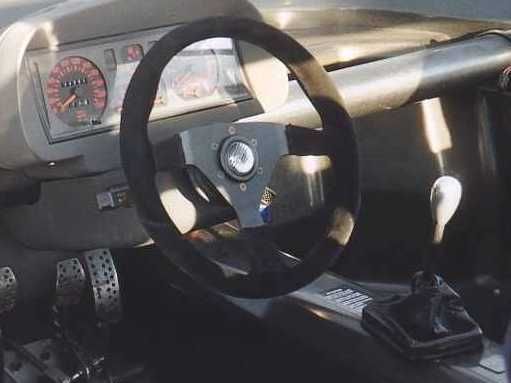
The M25 was conceived as a compact two-seat sports car with performance close to a supercar, built with a modular structure featuring removable doors and roof panels and a retractable rear window. Its designers pursued strong acceleration, sporting handling, and advanced active and passive safety, including a central structure using composite materials, deformable side sections, twin roll-over hoops and four-point harnesses. It used a mid-mounted, transversely installed 1764 cc Renault DOHC 16-valve four-cylinder engine, the same unit later used in the Renault 19, but enhanced with forged aluminium pistons, sodium-cooled exhaust valves and a water-cooled Garrett T25 turbocharger, raising output from 140 to 200 hp at 5500-6800 rpm and torque from 165 to 268 Nm at 4500 rpm. Drive went through a modified Renault five-speed transmission with a differential brake.
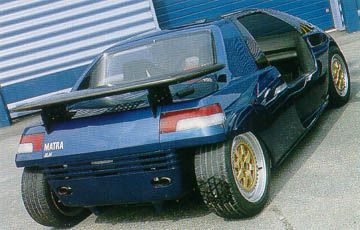
The chassis combined a carbon-fibre sandwich centre section with an aluminium honeycomb core and front and rear tubular subframes carrying the suspension. The front suspension used double wishbones with a patented transverse glass-fibre composite leaf spring of variable flexibility, while the rear used McPherson struts with adjustable dampers. All four wheels had ventilated disc brakes, with Michelin tyres sized 18/56 R14 at the front and 22/64 R16 at the rear, plus a rear wing for added downforce. Wheelbase measured 2430 mm and overall length 3470 mm, with width of 1740 mm and height of 1220 mm; weight ranged from 675 to 720 kg depending on specification, giving a power-to-weight figure around 3.5 kg/hp at 700 kg. Matra also explored four-wheel drive, four-wheel steering and a combined turbocharger/mechanical supercharger setup for the project, and demonstrated the car's performance at a presentation at the Nîmes airfield in southern France.