
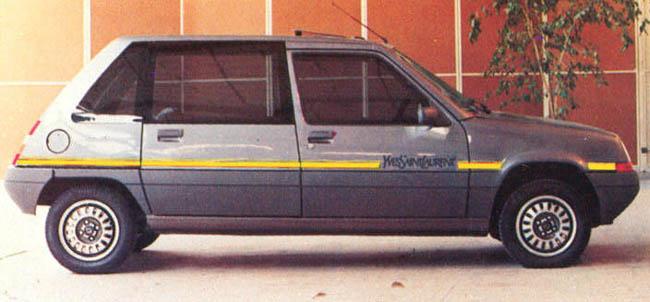
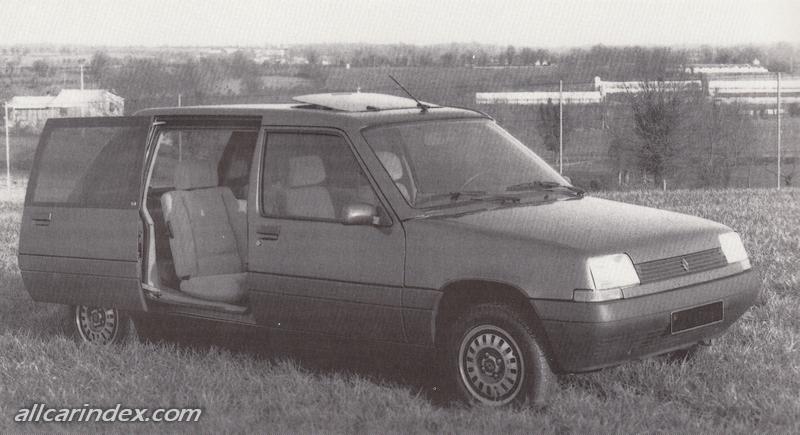
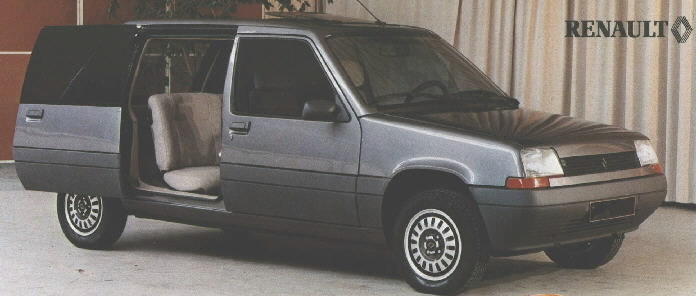
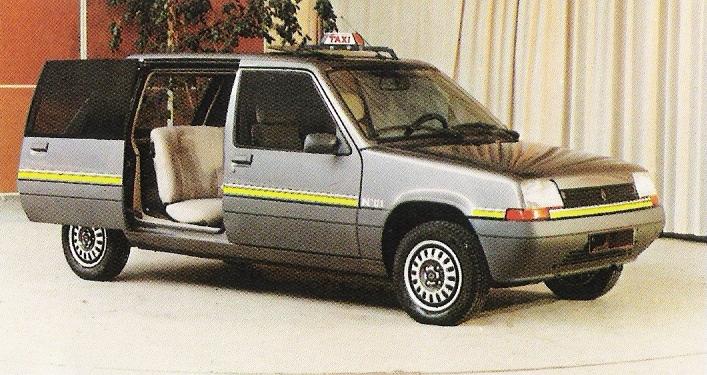
The Super Van Cinq was a concept vehicle built by the French coachbuilder Heuliez, based in western France in the area formed by the cities of Nantes, Tours and Poitiers. Heuliez produced special passenger cars, buses, ambulances, military vehicles and body components for major French manufacturers, with the Citroën BX Break estate becoming its most important product in the 1980s. The company's design arm, France Design Henri Heuliez, based in Le Pin, employed around 150 engineers, technicians, designers and other specialists using CAD/CAM methods to develop prototypes for cars, commercial vehicles, aircraft interiors and industrial components. Heuliez had earlier produced individual creations such as the Murène S with Porsche mechanicals in 1969/70 and a small series of the Citroën M35 with a Wankel engine.
Heuliez presented the Super Van Cinq at its own stand at the 1985 Geneva Motor Show. It revived an idea for efficient passenger transport that Heuliez had first explored with the Peugeot H4 taxi in 1972. Based on the Renault 5, the Super Van Cinq had a wheelbase lengthened by 30 cm, a raised roof and an extra sliding door on the right side, giving it seating for seven. The two rear seat rows could be folded flat, individually or in sections, to create a load floor that could be extended in stages from 29 cm to 140 cm, increasing cargo volume from 120 to 1200 cubic decimeters. The sliding door opened onto a 75 by 90 cm aperture. It used the Renault Super 5's 1397 cc four-cylinder engine, with a wheelbase of 2705 mm, track widths of 1320/1290 mm, and overall dimensions of 3920 mm length, 1580 mm width and 1440 mm height.