
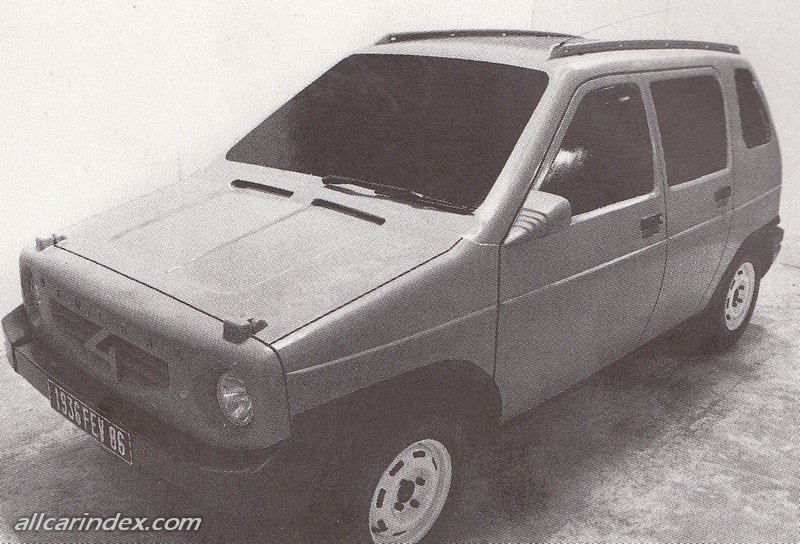
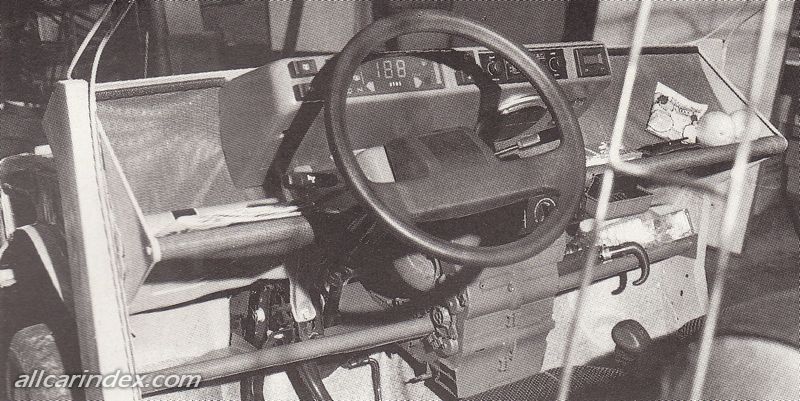
The Neutral 4 was a proposed small French car developed not by a manufacturer but by a trade union initiative, presented to the French press in early 1986 in the form of a maquette. It originated with the CGT, the Confédération Générale de Travail, the largest and communist-oriented French automobile workers' union, which feared that Renault's declining sales of the Renault 4 and the transfer of that model's production to Spain would lead to significant job losses at Renault's home plant in Billancourt, a traditional CGT stronghold. The union had lost its former co-management influence there in early 1985 under Renault's new president, Georges Besse. The Neutral 4 was intended as a successor to the Renault 4, itself launched in 1961 and regarded as one of the most functional car designs of its era, sharing the practicality of the Citroën 2 CV without that car's limited power and noisy air cooling. The project was realized by the APVF, the Association des Anciens et Amis de Renault pour la Promotion d'une Petite Voiture Française, a group of former Renault employees and supporters.
Like the Renault 4, the Neutral 4 had an estate-style body prioritizing versatility over styling, and it used the technical base of the renewed five-door Renault 5, including its 247 cm wheelbase. Despite a larger body, it was meant to sell for 10 to 15 percent less than the R5 through simplified, rationalized manufacturing developed with input from engineers, technicians and workers close to the CGT. It retained flat, uncurved windscreen and rear glass, though the windscreen was larger and more steeply raked than the R4's, and used steel leaf-spring bumpers, with non-functional trim largely eliminated. Compared with the R4, the Neutral 4 was about the same length but slightly wider and lower, giving a marginally larger interior. Its seating was highly convertible: the front passenger seat folded forward to enlarge the load area, the front seatbacks could fold rearward into picnic-style seating, and front and rear seats together could form a bed, with the rear backrest adjustable to progressively enlarge the boot. Various storage compartments were planned, along with passenger car, van and off-road variants.
A simple sales brochure dated February 1986 listed three planned trim levels: the C with minimal equipment and a 950 cc engine at F 37,000; the GT with mid-level equipment and a 1100 cc engine at F 41,000; and the GTL with maximum equipment and a 1400 cc engine at F 48,000, with diesel versions planned later. Engines across the range spanned 956 to 1397 cc. Promoters argued the design could remain unchanged in production for 12 to 15 years without needing a new platform, keeping investment low, and proposed a production rate half that of the R5 and R9/11. Renault's management, then struggling with financial deficits, showed no interest, and the Neutral 4 was never produced. The car was configured as a five-door estate seating four or five occupants.