BMW, formally Bayerische Motoren Werke Aktiengesellschaft, is a German multinational manufacturer of luxury vehicles and motorcycles headquartered in Munich. Trading as BMW Group, the company markets automobiles under the BMW, Mini, and Rolls-Royce brands, and motorcycles under the BMW Motorrad brand.
The company's roots trace back to Otto Flugmaschinenfabrik, founded in 1910 by Gustav Otto, which was reorganized in 1916 as Bayerische Flugzeugwerke (BFW). The name BMW originated separately with Rapp Motorenwerke, a firm founded by Karl Rapp in 1913. In 1922, the name and engine-production assets of Rapp Motorenwerke were transferred to Bayerische Flugzeugwerke, which then adopted the BMW name, giving rise to the company known today.
BMW's earliest products were aircraft engines for the German air force during the First World War, including the BMW IIIa straight-six engine developed by Max Friz. After the war, the company diversified into motorcycle engines, agricultural equipment, household items, and railway brakes, introducing its first motorcycle, the BMW R32, in 1923.
BMW entered automobile manufacturing in 1928 after acquiring Fahrzeugfabrik Eisenach, which had been producing the Austin 7 under license as the Dixi. The first car sold under the BMW name was the BMW 3/15, a rebadged version of the Dixi. During the 1930s, the company broadened its range to include sports cars and larger luxury vehicles.
During the Second World War, BMW's production centered on the BMW 801 aircraft engine, manufactured using forced labor drawn primarily from Nazi concentration camps. Civilian automobile production was sharply curtailed during this period as the company's output was redirected toward the war effort. BMW's factories suffered heavy bombing damage during the war, and its remaining West German facilities were subsequently barred from producing motor vehicles or aircraft. The company survived in the immediate postwar years by manufacturing pots, pans, and bicycles, before resuming motorcycle production in 1948 and car production in 1952 with the BMW 501 luxury saloon.
In 1955, BMW began producing the Isetta microcar under license to broaden its range, but weak sales of luxury cars combined with slim profit margins from the microcar left the company in serious financial difficulty. By 1959, BMW faced a near takeover by rival Daimler-Benz. The company was preserved as an independent entity through a substantial investment by Herbert Quandt, whose family became a long-term shareholder. The relative commercial success of the BMW 700 subsequently aided the company's recovery and supported development of the New Class sedans.
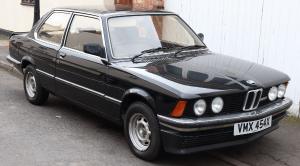
The 1962 introduction of the New Class compact sedans marked the beginning of BMW's reputation as a manufacturer of sport-oriented cars. Through the following decades, the company expanded its lineup with the 5 Series (1972), 3 Series (1975), 6 Series (1976), and 7 Series (1978). The BMW M division introduced its first road car, the M1 supercar, in 1978, followed by the M5 in 1984 and the M3 in 1986. BMW introduced its first V12 engine in the 750i luxury sedan in 1986.
BMW has maintained a significant presence in motorsport, particularly in touring cars, sports cars, and the Isle of Man TT. As of 2023, the company ranked among the world's largest vehicle producers by output and by revenue, with manufacturing operations across Germany, the United Kingdom, the United States, Brazil, Mexico, South Africa, India, and China.