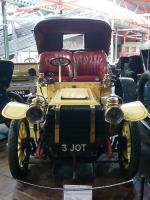
- Company name
- De Dietrich et Compagnie
- Place
- Luneville, Lorraine
- Country
- France
De Dietrich et Compagnie was based in Lunéville, in the Lorraine region of France, and traced its origins to an ironworks founded in 1684, making it one of the oldest industrial concerns in the country. Within a century of its founding, the company operated three large factories across Alsace and Lorraine and had also developed banking interests. The founding family endured significant hardship during the French Revolution but recovered to prosper throughout the nineteenth century, when railway rolling stock was added to its industrial activities. The De Turckheim family joined the business in 1806, following the death of the reigning Baron de Dietrich, and remained influential well into the era of automobile manufacturing.
Following the Franco-Prussian War of 1871, Alsace became German territory, and the company's Niederbronn factory came under German control, later producing vehicles under the De Dietrich (ii) name. In response, the family established a new factory on French soil at Lunéville, in Lorraine, where automobile production began in 1897.
The company entered car manufacturing by producing designs licensed from Amédée Bollée, featuring horizontal two-cylinder engines of 2.3 or 3 litres. These early vehicles were already somewhat dated in their engineering, relying on tube ignition and a complicated transmission system that combined primary belt drive with final drive through two sets of bevel gears. The Lunéville plant built 72 such cars in 1898 and 107 in 1900, but their poor showing in the 1901 Paris-Berlin race made clear that a new design was required.
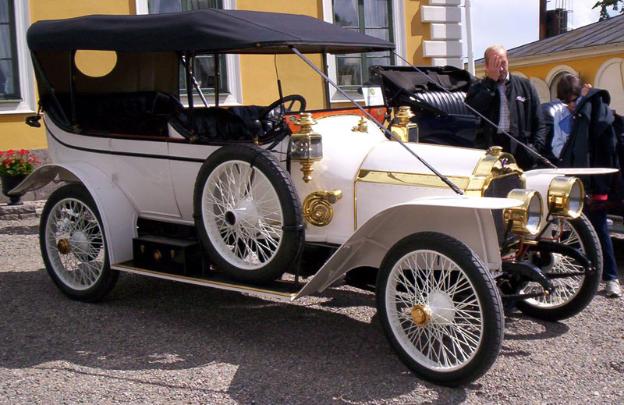
The company subsequently adopted a design from Turcat-Méry, a Marseilles-based manufacturer whose cars followed Panhard principles, with vertical front-mounted two- and four-cylinder engines, automatic inlet valves, tubular radiators, armoured wood frames, and chain drive. By 1903, these cars were offered with four-cylinder engines in three sizes: 3, 4.1, and 5.4 litres. Mechanically operated inlet valves were introduced in 1904, followed briefly by overhead inlet valves in 1905.
During 1905, relations between company figures Adrien de Turckheim and Eugène de Dietrich deteriorated. With financial support from his father, his brother, and Turcat-Méry chairman Henri Estier, de Turckheim established a new company at Lunéville for automobile manufacture, named Société Lorraine des Anciens Établissements de Dietrich et Compagnie. The new company adopted the cross of Lorraine as its emblem, and its cars subsequently became known as Lorraine-Dietrich.