
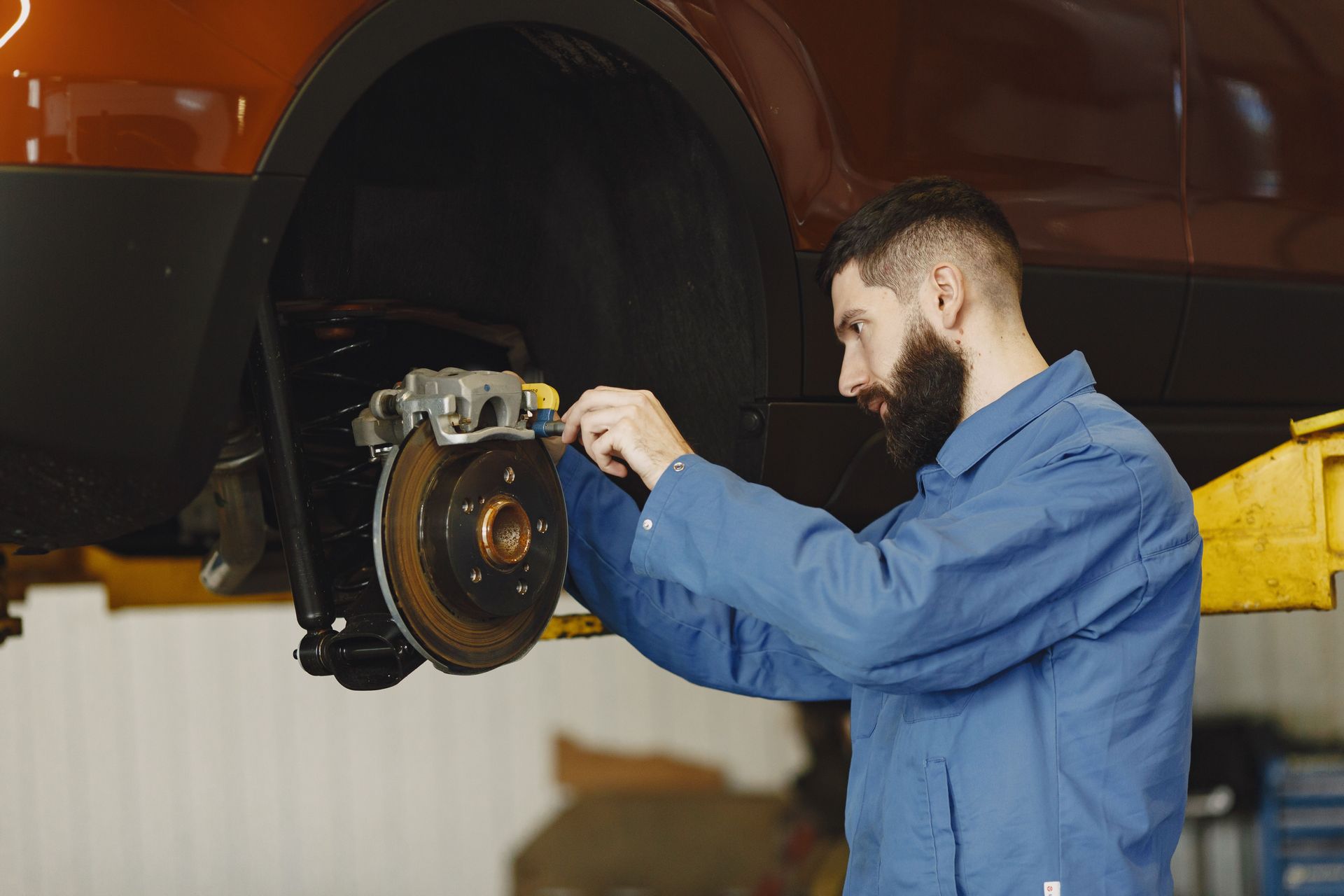

How well do you know your brakes? If you're like most drivers, you never think about your brakes at all. You step on the pedal and the car stops. That's all there is to it, right? Wrong. It took more than 100 years of mistakes, experimentation and innovation to develop your car's brakes.
Even though better brakes have prevented thousands of accidents, they don't ALWAYS avoid a collision. And if that other driver doesn't have insurance, you could be stuck with an uninsured motorist claim through no fault of your own.
Why Brake History Still Matters
The purpose of every advancement in brake technology has been to reduce the stopping distance between "Yikes!" and "STOP". After all, how many inches or feet can spell the difference between a near miss and a trip to the emergency room? Competition among engineers has been fierce.
The problem is... No matter how good your brakes are, you can't stop the other driver. If someone without insurance crashes into you, you'll usually need an uninsured motorist claim to pay for your medical expenses and repairs. And your car's braking data leading up to a car accident can help show you did the right thing.
The Drum Brake Era: Where It All Started
Older cars from the early 1900s had drum brakes. The concept is pretty straightforward. A metal drum rotates with the wheel. Pressing the brake pedal forced curved "shoes" against the inside of the drum to stop the car. Early versions were operated by cables and rods. Meaning a stretched cable could cause your car to pull to one side.
It worked... sort of. The problem was drums trap heat and if brakes get too hot they lose their grip. This is known as brake fade, and on big hills it was frightening.
Hydraulic Brakes: Pushing With Fluid
In 1921 the Duesenberg Model A introduced hydraulic brakes on all 4x wheels to production cars. They replaced cables and rods with fluid in sealed lines. Push on the pedal and fluid flows with equal force on all wheels. The result is smoother, straighter and more reliable stops. Soon nearly every carmaker adopted the idea and hydraulics still power your brakes today!
Disc Brakes Take Over
In 1953, Jaguar did the unthinkable when their C-Type won Le Mans with disc brakes. Disc brakes operate similarly to a bicycle hand brake. A flat metal rotor spins with the wheel and a caliper presses pads against the rotor. Since the rotor is exposed to open air it dissipates heat much quicker than a drum allowing for significantly less brake fade. Discs would trickle down from the racetrack to the family sedan over the years.
ABS: When Brakes Got A Brain
Hitting the brakes doesn't always stop you quickest. Locked wheels skid, and a skidding car won't steer. Enter the anti-lock braking system, ABS. Mercedes- Benz and Bosch introduced one of the first modern electronic ABS systems in 1978. Sensors monitor each wheel and pulse the brakes hundreds of times a second. The result? You can brake hard AND steer at the same time.
Automatic Emergency Braking: The Car Steps In
The next evolution removed the driver from the equation. Called automatic emergency braking, or AEB, the system uses cameras and radar to detect an imminent crash. If you don't respond, the car applies the brakes for you. Guess what? It works. Studies by the IIHS showed that AEB reduced rear-end crashes by 50%.
It’s even headed toward becoming the law of the land. NHTSA’s rulemaking will require automatic emergency braking to be standard equipment on new cars and light trucks by September 2029 at the latest, and the agency estimates it will save at least 360 lives annually. The best brake is the one that stops before you even realize you need to hit it.
Carbon-Ceramics: The Top Of The Food Chain
So what kind of brakes are the best brakes available today? Carbon-ceramic brakes. These rotors are constructed from carbon fibre woven together with silicon carbide -- essentially the same material that goes into aircraft parts. Porsche pioneered their use on the road car with the 2001 Porsche 911 GT2.
Why are they so cool? They can withstand temperatures that would melt regular iron rotors, they are half the weight, and they don't rust nearly as much. The downside? They are EXPENSIVE to replace. Which is why you mainly see them on hyper cars.
When Great Brakes Aren't Enough: Your Uninsured Motorist Claim
The harsh reality: You can have top-of-the-line brakes and still get rear-ended. The other driver may not have insurance. Research from the Insurance Research Council found that 15.4% of drivers were uninsured in the US during 2023. That's 1 in 7 drivers.
What do you do if one of these hits you? Most likely you'll have to file an uninsured motorist claim with your own insurance company. That's where today's brakes do double duty. The majority of new vehicles are equipped with an event data recorder that tracks your speed and brake usage just before a collision occurs. That information can help prove your side of the story and will make your uninsured motorist claim a lot stronger. Ensure your policy covers uninsured motorists -before you need it.
Bringing It All To A Stop
Brakes have evolved over time. Drums led to hydraulics. Discs eliminated the heat issue. ABS prevented lock-up, and AEB brakes apply pressure for you. At the top of the food chain are carbon-ceramics. But no brake system can manage the other driver. That's why it's as important to understand how an uninsured motorist claim works as it is to know your car can stop on a dime. Excellent brakes keep you safe before impact... proper coverage keeps you protected after.