- Company name
- American Motors Corp.
- Place
- Kenosha, Wisconsin
- Country
- United States
American Motors Corporation, commonly known as AMC, was based in Kenosha, Wisconsin, and formed in May 1954 through the merger of Hudson and Nash. For a few years, vehicles continued to be sold under both the Hudson and Nash names, until they were unified under the Rambler brand for the 1958 model year.
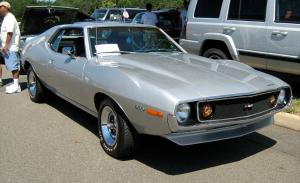
A decade later, AMC introduced its first model not badged as a Rambler: the Javelin, a four-seat sports coupé created to compete in the pony car segment against the Ford Mustang and Chevrolet Camaro. Offered with a range of six-cylinder and V8 engines, the Javelin sold well initially but saw declining demand over time, and was discontinued in 1974 when it could no longer meet federal bumper regulations economically. A shorter two-seat derivative, the AMX, was produced from mid-1968 to 1970. Despite strong performance credentials that allowed it to compete with the Chevrolet Corvette on the track, the AMX sold in far smaller numbers than the Javelin and was eventually dropped.
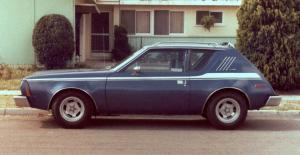
AMC pursued a strategy of differentiating itself from the major American manufacturers, emphasizing distinctive design over imitation. This philosophy led to the 1970 introduction of the Gremlin, a compact hatchback based on the Hornet platform, which predated similar subcompact offerings from Ford and Chevrolet. The Gremlin remained in production until 1978, with total output reaching roughly 700,000 units. Even more unconventional was the Pacer, introduced in 1975 as a "wide small car." Originally designed around a rotary engine that never materialized, it instead used AMC's existing six-cylinder engine, resulting in a heavier, less capable vehicle. Despite an unusual and widely criticized design, the Pacer remained in production until 1980.
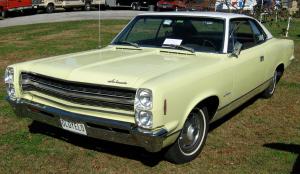
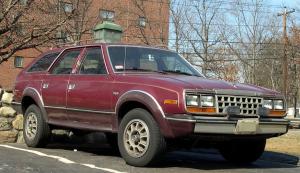
Throughout the 1970s, AMC also produced larger vehicles, including the Ambassador sedan, the compact Hornet, and the mid-size Rebel, later renamed Matador. In 1980, the company introduced the Eagle line, notable as the first mass-produced American passenger cars offered with four-wheel drive, distinguishing them from dedicated off-road vehicles such as Jeeps.
Financial pressures led AMC to form a partnership with Renault, which acquired a significant ownership stake beginning in 1978 and increased its holding to nearly forty-seven percent by 1982. Under this arrangement, AMC dealers began selling Renault-based vehicles, including the Alliance and Encore models, built at the Kenosha plant. These cars achieved strong initial sales but were soon affected by quality issues, contributing to financial difficulties for both companies by the late 1980s.
In 1987, Chrysler, under the leadership of Lee Iacocca, acquired American Motors Corporation for approximately six hundred million dollars, primarily to gain control of the Jeep brand. Following the acquisition, most AMC and Renault-based models were discontinued, with only the four-wheel-drive Eagle name persisting briefly under Chrysler ownership before disappearing entirely from the American market.