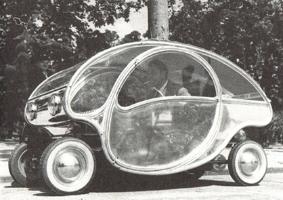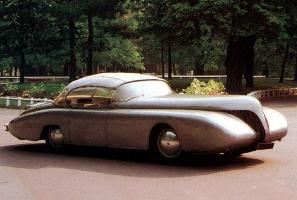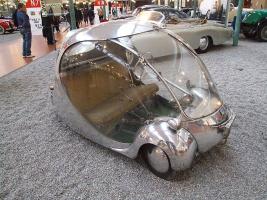
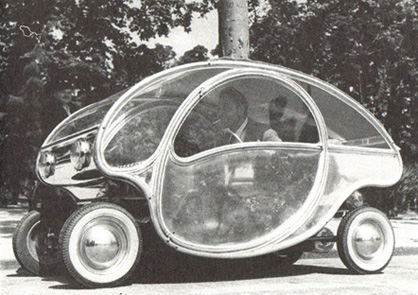
Arzens was the name associated with Paul Arzens, a Paris-based artist, sculptor and designer who became known for creating unconventional small automobiles during the mid-twentieth century.
Arzens first gained attention during the German occupation of Paris for driving a vehicle of his own design known as l'Oeuf, or "the Egg." This near-spherical electric car anticipated the bubble car style that would become popular more than a decade later. Despite the attention it attracted, l'Oeuf remained a single, unique example and was never produced commercially.
In 1951 Arzens developed a second small vehicle, called the Carrosse. It featured an innovative construction method consisting of a tubular exterior chassis with flat metal panels fitted between the tubes, a design intended to allow inexpensive production without the need for heavy industrial machinery. The Carrosse was powered by a rear-mounted 125cc engine and was capable of exceeding 45 mph (72 km/h). Like l'Oeuf, however, the Carrosse never advanced beyond the prototype stage.
Paul Arzens's automotive work stood apart from conventional manufacturing efforts of the era, reflecting his background as an artist and designer rather than that of an industrial engineer. Though neither of his vehicles entered production, both l'Oeuf and the Carrosse were later recognized as early examples of compact, efficient automotive design that foreshadowed later developments in small car engineering.
From €9.90/month — or €50/year (save 58%)
Subscribe Now