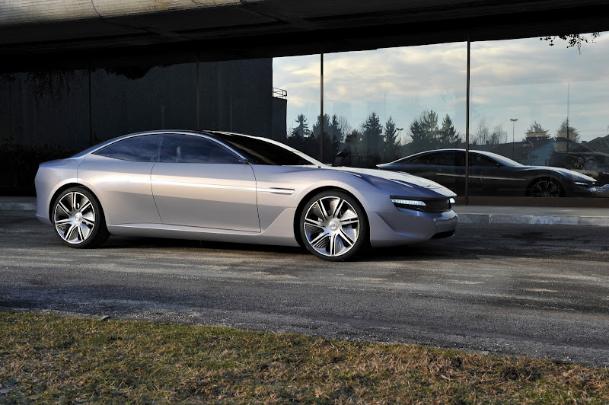



The CNR E2 was a concept car developed by Pininfarina in collaboration with Italy's Consiglio Nazionale delle Ricerche (CNR, the national research council) as part of the CNR Energy Project No. 2, formulated in 1985. It followed an earlier 1978 Pininfarina/CNR aerodynamic study for a four-door "ideal aerodynamic form," which had achieved a drag coefficient of 0.16 on a scale model and 0.20 on the finished full-size body, at a time when the most aerodynamically efficient production saloon, the Audi 100, achieved a cw of 0.30. Building on that earlier work, the CNR E2 was conceived as a fully driveable prototype mid-size saloon with a target drag coefficient of around 0.20, developed with input from Fiat Auto and Alfa Lancia and with attention paid to the requirements of series production.
Achieving the target required a fundamentally new body structure rather than refinement of existing shapes, which could only reach around cw 0.25. The design used a beltline running strictly horizontal from the front door pillar back, a fully rounded nose, a slightly domed roof, a steeply raked rear window, and a pronounced taper at the rear, together with flush-fitting glass, curved plexiglass covers over small twin headlamps, and underbody and rear-wheel paneling. Despite its smooth surfacing, the car retained conventional notchback saloon proportions. Development used computer optimization, including a "square method" that divided a scanned half-body into a thousand sections to calculate airflow parameters, followed by a 1:2.5-scale model built from a fixed center section with four interchangeable front and rear upper and lower elements, allowing 16 configurations to be tested in the wind tunnel. A numerically machined polystyrene 1:1 model reproduced the 0.16 drag coefficient of the original 1978 study.
The prototype was built on the Fiat Tipo platform, shared with the Lancia Dedra and Fiat Tempra (cw 0.28), with the wheelbase stretched by 6 cm to 260 cm and the suspension structure adapted accordingly, including electropneumatically controlled springing and a rear track narrowed by 2 cm. Overall length grew by 20 cm and roof height dropped by 4.5 cm compared with the Tempra. The finished car returned a drag coefficient of 0.185 with closed cooling intakes and 0.193 with them open, meeting the sub-0.20 target, and used less fuel than an equivalent Tempra at constant speeds, though its longer final-drive gearing reduced acceleration in favor of a higher top speed.
The CNR E2 was a four-door, five-seat notchback saloon with a plastic body, powered by a Fiat Tipo-derived 1372 cc four-cylinder engine producing 78 hp at 6000 rpm and 108 Nm at 2900 rpm. It measured 456 cm long, 170 cm wide and 140 cm high, with a wheelbase of 260 cm and a track of 143/140 cm, weighed 980 kg, and reached a top speed of 205 km/h.