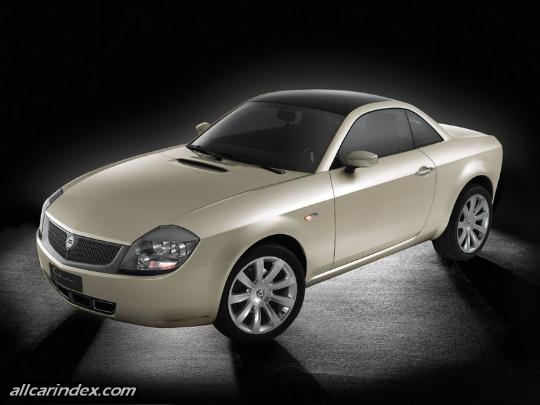



The Lancia Hit was a 2+2-seat coupe concept built by Pininfarina on the mechanical basis of the Lancia Delta HF Integrale. Its name stood for High Italian Technology. Pininfarina presented it as a fully driveable prototype, which was driven to its press unveiling under its own power. The design brief called for practicality, seating for four, and strong driver visibility rather than an extravagant shape, though sports-car enthusiasts hoped it might reach series production. Pininfarina itself described the study only as an exploration of a light, sporty, agile coupe with a high degree of motorization and emotional character. The link between Pininfarina and Lancia dated back more than half a century, and until 1984 the two had collaborated on the mid-engined two-seat Lancia Montecarlo, also bodied by Pininfarina.
The Hit's front end used a low, wedge-shaped nose incorporating a flattened rendition of the traditional Lancia grille, with four small square headlights arranged in pairs under a transparent cover on each side. Except for the steeply raked rear roof support, the entire roof area was glazed, with window surfaces extending over the A- and B-pillars, a transparent carbon-fibre roof panel, and a dome-shaped rear screen. Despite its rounded, aerodynamically shaped exterior, achieving a low drag figure required extensive work in Pininfarina's own wind tunnel and with electronic shape calculations; the finished prototype recorded a drag coefficient of 0.33, along with very low lift and good stability in crosswinds, without any spoilers or wings.
The chassis was a CAD-designed honeycomb sandwich structure using Nomex between carbon-fibre layers, forming a floor pan with central tunnel, bulkhead and rear panel, reinforced by a front steel-tube subframe, giving high torsional rigidity. Bodywork panels were glass-fibre reinforced plastic, bolted to the structure at the lower edge and bonded at the top, with carbon fibre used around the lower body sections and no separate bumpers fitted; the entire bonnet hinged forward, and only the lowest section of each door window could be lowered. The unlined carbon-fibre dashboard carried six round instruments and a central keypad panel between the seats, contrasting with dark grey unlined interior trim, bright red seat covers with green cross-stripes, and a red side stripe on the exterior.
Mechanically the Hit used the production Delta HF Integrale's transverse engine, permanent four-wheel drive, central epicyclic differential with viscous coupling, and rear Torsen differential. The 1995 cc four-cylinder engine had two overhead camshafts, two balancer shafts and eight valves, fed by a water-cooled Garrett T3 turbocharger, producing 185 hp at 5300 rpm and 304 Nm at 3500 rpm. Weighing 980 kg against the standard Integrale's minimum of 1215 kg, the Hit promised a significant performance advantage. It measured 3970 mm long, 1720 mm wide and 1320 mm high, with a 2475 mm wheelbase and front/rear tracks of 1415/1410 mm.